H-Erwin1945
A Brave Man at the
Right Time
AF magazine June 2007

Erwin front row second from right
Henry Eugene Erwin learned
responsibility at an early age. He was born in Docena, Ala., in 1921, the
oldest child in a large family. He was 10 years old when his father, a coal
miner, died. Gene, as the family called him, took a part-time job stocking
shelves in the coal company commissary. "It helped us get along," he
said.
The country was in the grip of the
Depression, and times were hard. Erwin dropped out of high school after two
years and joined the civilian Conservation Corps, where he was put in charge of
220 other young men planting kudzu in north Alabama to stop soil erosion. He
was 17 years old. After the CCC, Erwin went to work .at a steel mill in
Birmingham. For the next several years, he was the chief breadwinner for the
family.
He joined the Army in January
1943. Despite his limited formal
education, he scored very high on the entrance examination and qualified for
the Air Corps and technical training. During an advanced radio course at Truax
Field, Wis., he was approached about going to Yale University for further study
and the possibility of becoming a communications officer.
Erwin "turned down the offer.
"Being a kid then," he explained later, he thought the war might end
before he got into it. He wanted to go on to aircrew duty when he finished
radio training. After a short time on B-17 s,
he
became a B-29 radio operator.
He came home to Alabama on furlough
to get married in December 1944. In January 1945, he was sent to Guam, assigned
to the 52nd Bomb Squadron, 29th Bombardment Group, of Twentieth Air Force's XXI
Bomber Command. His fellow crew members on the B-29 City of Los Angeles called
him "Red" because of his auburn red hair. The new nickname would stay
with him for the rest of his life.
The B-29 Superfortress was the
biggest and newest US bomber. It had been first used in combat from bases in
India and China in late 1944. When operating from bases in the Marianas-Saipan,
Tinian, and Guam-B-29s could reach almost any target in the Japanese home
islands.
Daylight bombing of Japan from high
altitudes was not effective. Cloud cover frequently obscured the targets. More
important, the B-29s flying above 25,000 feet encountered the jet stream. Its
fierce tailwinds added as much as 250mph to the aircraft's speed relative to
the ground, pushing it over the target too fast for the Norden bombsight to
compensate. (Flying against the jet stream, the speed relative to the ground
was so slow that the airplane was a sitting duck for fighters and anti-aircraft
guns.) Crosswinds also carried the bombs off course. XXI Bomber Command
switched to low-level area bombardment with incendiary and high-explosive
munitions from altitudes of 5,000 to 9,000 feet.
The B-29 standard crew had 11
members. Of these, five crewmen-four gunners and a radar observer-were in the
back, aft of the bomb bays. The other six were in the forward section of the
Superfort. The pilot, copilot, and bombardier (who also served as nose gunner)
were up front on the flight deck. The flight engineer's position was just back
of the copilot, beside the nose wheel door.
Mission to Koriyama
At that point, the two forward gun
turrets extended into the aircraft and made it a tight squeeze. The navigator
sat, facing forward, in the space between the upper turret and the left side of
the aircraft, his work table latched to the turret. The radio operator's
position was at the very back of the front section, behind the turret and separated
from the bomb bay by a bulkhead. To get in or out, he had to go through the
navigator's
station.
On April 12, 1945, City of Los Angeles was the lead bomber of a B-29 group sent on a mission against the Japanese chemical plant at Koriyama, 125 miles north of Tokyo. The airplane commander was Capt. George A. "Tony" Simeral. (See "Valor: Missions Accomplished," January 1994, p.73.) B-29s flew in formation against specific targets such as the plant at Koriyama. That concentrated the bombardment and provided better defense against fighter attack. However, formation flying took additional fuel, and so, because there was no fighter threat en route to the target, the bombers flew individually to a predetermined point near Japan, where they then formed up.
The B-29s took off from Guam's North
Field about 2 a.m. and reached the rendezvous point at Aoga Shima, a small
volcanic island 175 miles off the coast of Japan, about 9:30 that morning. The
other aircraft in the squadron would form up on Simeral's aircraft before
proceeding to the target.
Eighteenth Mission
That day, Lt. Col. Eugene Strouse,
the 52nd Bomb Squadron commander, was flying in the copilot's seat of City of
Los Angeles. The radio operator was Erwin, then. a 23-year-old staff sergeant
flying his 18th combat mission. One of Erwin's duties was to launch signal
flares and smoke bombs so the other B-29s could assemble and form on the lead
aircraft.
At Aoga Shima, Simeral told Erwin to
launch white phosphorous smoke bombs. Erwin was bareheaded and had his shirt
sleeves rolled up. He was wearing his Mae West life jacket, as he always did on
a mission over water, because he couldn't swim.
Erwin pulled a pin to arm a smoke
bomb and dropped it through a chute in
the floor of the aircraft near the radio operator's station. He was on
his knees. After the pin was pulled,
there was an eight-second delay before the bomb ignited. Normally, that was
plenty of time for the bomb to fall through the chute and out of the aircraft.
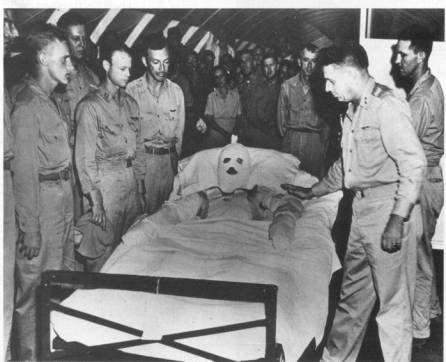
Maj. Gen. Willis Hale (right) presented the Medal of Honor to Erwin. The aircraft commander, Capt. George Simeral (left, with hat) and other crew members look on.
It is uncertain what went wrong. The
flap valve at the bottom of the ejection chute may have jammed. Perhaps, Erwin said
later, the aircraft hit some turbulence or there was a malfunction in the bomb.
In any case, he said, "I knew that sucker was coming back."
The bomb exploded in the chute and
shot back into the interior of the aircraft, hitting Erwin in the face. The
phosphorous was burning at 1,300 degrees. (As a point of comparison, the
heating element of an electric range is at 1,100 degrees when it is glowing
red.) Thick white smoke filled the forward section of the airplane.
Erwin had phosphorous allover him, blinding
him and burning off his hair, most of his right ear, part of his nose, and
large patches of his skin. His clothing was on fire. "I was completely
aflame," he said.
The entire crew was in mortal
danger. The phosphorous was burning with intensity and eating its way through
the metal of the bulkhead. With smoke filling the airplane, the pilots could
not see. Except for the incredible courage of Red Erwin, the only question
would have been whether the B-29 would crash into the ocean before the fire reached
the munitions in the bomb bay.
Erwin was alone. The navigator whose
station was closest to his, had gone aft to the celestial navigation dome to
take a star shot. Even worse he had left his folding table down and latched.
The smoking bomb lay at Erwin's feet.
"I reached down, I grabbed it
with my right hand, I began to crawl,” Erwin said. "I remember opening the
navigator's table, crawled by the engineer—the
flight engineer was on the right—went up between the pilot and the
copilot."
His path forward was blocked by the
navigator's table. "Erwin couldn’t release the table 's latch with one
hand so he grabbed the white-hot bomb between his bare right arm and his rib
cage," an Air Force report said. "In the few seconds it took to raise
the table the phosphorous burned through his flesh to the bone."
Erwin "stumbled into the
cockpit, threw the bomb out the window, and collapsed
between the pilots' seats," the report said. He had to move 13 feet
through the aircraft to toss the bomb out the window, but "it seemed like
miles when you are burning," he said. "When you are on fire, you
cannot see, and you are crawling by instinct."
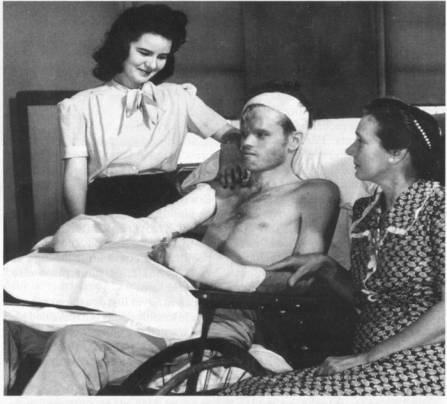
Erwin-here with his wife, Betty (standing), and mother, Pearl Erwin-had grabbed the burning smoke bomb 3nd held it between his bare right arm and rib cage.
"My flight suit was gone,"
Erwin said, but he had the Mae West. "That's the only thing that saved my
chest. Otherwise, I was burned allover." (See "Valor: Red Erwin's
Personal Purgatory," October 1989, p. 91.)
"I'm Fine"
"You could see nothing,
absolutely nothing," Simeral said. "Not even your hand before your
face. So it obscured all the instruments. Fortunately, we were on autopilot
except for the elevators and that saved us. But what I was fearful of was stalling
out if I put any back pressure on the elevators."
To be sure of staying above stall
speed, Simeral said he "probably put more pressure on the downside,"
easing the flight controls forward. That lowered the nose of the airplane but
it also reduced the altitude. "But after Red threw that bomb out the
copilot's window, ...the smoke cleared out, and I could see the instruments and
at that point we were at 300 feet," Simeral recalled. "If he hadn't
gotten it out of there, well then, why, we probably would have gone on
in."
Until the smoke thinned out, the
rest of the crew did not know what Erwin had done. When they saw him, they were
aghast. Erwin recalled it later as a strange moment when somebody asked,
"Red, are you all right?" and he replied, "I'm fine."
Sgt. Vern Schiller, the flight
engineer, had turned a fire extinguisher on Erwin. That put out the fire in his
clothing, but the phosphorous embedded in his body continued to burn. Simeral
aborted the mission and headed for Iwo Jima, halfway between Japan and Guam,
and the closest US medical facility. He climbed to cruising altitude,
jettisoned his bombs, and broke radio silence to tell the alternate leader to
take over the formation.
Erwin's colleagues did what they
could for him, but that was complicated by the fact that Erwin himself was the
crew's first aid man. The bombardier, 1st Lt. William Loesch, injected morphine
and tried to inject plasma, but Erwin's arms were so badly burned he couldn't
find a blood vessel. "We didn't discover until after, much later, that,
after we landed and talked to people, you could do it through any vein,
...ankle, or some place else," Simeral said.
Erwin never lost consciousness. He
was in terrible agony but remained alert and warned the others not to give him
too much morphine. As they gathered around him, he asked, "Is everybody
else all right?"
"Fortunately, Iwo Jima was wide
open, and we made a straight in approach and parked on the runway until the
medics got Red out of the aircraft," Simeral said. The hospital at Iwo
Jima was underground. Erwin said, "I remember going to this cave, and this
doctor was working on my eyes [and saying], 'We've got to get this phosphorous
out of his eyes. Otherwise, he's going to be blind.' "
The crew visited him briefly in the
hospital and then flew City of Los Angeles back to their base on Guam. Lt. Col.
Corey Ford and Maj. Alastair MacBain were there when Simeral landed. They
talked to the crew that night and went aboard the airplane the next day. They
helped write the recommendation for the Medal of Honor. They also described the
damaged forward compartment in an article for the Aug. 4, 1945 issue of
Collier's.
Blocked by the navigator's table,
Ford and MacBain said, Erwin had "fumbled with the spring latch until it
opened. The loose skin came off his hand onto the table as he lifted it. We
looked over the plane [the] next day.
You
could see the imprint of his whole hand seared on the table."
The assumption was that Erwin would
die. When he was still alive three days later, he was airlifted to the Navy
hospital on Guam.
Maj. Gen. Curtis E. Le May,
commander of XXI Bomber Command, used the full force of his personality to get
the Medal of Honor recommendation rushed through channels. Approval was obtained from Washington in
record time so the medal could be presented while Erwin was still alive.
A Medal of Honor was taken from a
display case at Army headquarters in Hawaii and flown to Guam, where it was
awarded to Erwin on April 19, 1945 – a week after the mission – by Maj. Gen.
Willis H. Hale, commander of Army Air Forces Pacific Area. Simeral 's crew and
Strouse were there to see it.
On May 7, LeMay asked Erwin if there
was anything more he could do for him. Erwin asked for his brother, Howard, who
was on Saipan with the 7th Marine division. He had not seen him for three
years. Howard Erwin was flown to Guam by movie star Tyrone Power, who was a
Marine Corps pilot. Power's usual duty was flying supplies into Iwo Jima and
wounded troops out.
"And so my brother was there
the next morning," Erwin said. "He stayed with me for 24 hours. I
couldn't see him but I knew he was there and that was a great comfort."
His condition was grave. "I was
losing weight all the time," he said. "In fact, I got down to 87
pounds, skin and bones, because I couldn't open my mouth to eat. I didn't give
up. ... They kept me soaked in saline solution so what little flesh I had
wouldn't come off."
Erwin was airlifted back to the
United States. "They were scraping phosphorous out of my eyes," he
said. "I was still smoldering 30 days later when I got to Sacramento.
...When the oxygen hits it [the phosphorous], it begins to smolder again. They
would scrape and scrape."
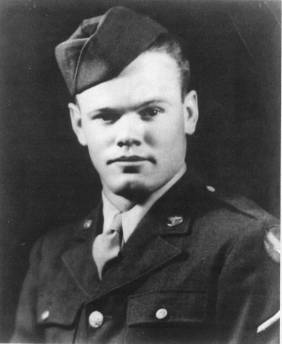

Erwin “embodied all the ideals of the Medal of Honor”
After 30 months and 41 surgeries,
most of his eye-sight was restored and he regained the use of one arm. "Both eyes were sewn up over a
year," Erwin said. "Then
postage skin grafts were put under them to keep down the tension. ...When I got
out in October 1947, they still wanted to do more surgery, but at that time I
had had it. I was married. I wanted to go home and go to work."
Erwin in October 1947 was separated
from the Army as a master sergeant, receiving a disability discharge. "I
love the military," he said. "Even though I was severely burned, if
they had retained me, I would have stayed in."
In an Air Force oral history
interview in 1986, Erwin reflected on World War II. "We had the leaders,
we had the logistics, and we had the brave men at the right place at the right
time," he said. "Outstanding" Rating "I went to work for
the Veterans
Administration
in J anuary 1948 when I got out," Erwin said in the 1986 interview.
"Harry Truman had issued an executive order that any Medal of Honor
recipient, otherwise qualified, was eligible for a veterans' benefits job. I
knew that the TCI Company would never give me my job back at the plant due to
the loss of my arm. I went to work for the Veterans Administration as a
veterans' benefits counselor. I did that for 37 years, so I retired two years
ago with 43-and-a- half years of federal service." He got an
"outstanding" performance rating from VA every year.
Hollywood took notice, but just
barely, of the events of the Medal of Honor mission. David Sharpe played Red
Erwin in "Wild Blue Yonder" (Republic Pictures, 1951), but the scene
lasted only a few moments. The rest of the movie was a fictionalized account of
B-29s against Japan and the pursuit by Forrest Tucker and Wendell Corey of Army
nurse Vera Ralston.
Erwin stayed in touch with the
members of the City of Los Angeles crew, all of whom survived the war. In 1989,
he and Simeral-who retired as a colonel-were interviewed together for a
videotape, "Prepared to Die," produced by the Air Force Sergeants
Association's Airmen Memorial Museum.
He is well remembered at the Air Force
Enlisted Heritage Research Institute at Maxwell AFB , Ala. In 1997, the Air
Force introduced the Henry E. Erwin Outstanding Enlisted Aircrew Member of the
Year award.
Back in Alabama, Red and Betty Erwin
raised one son and three daughters, and in time, there were seven
grandchildren. "Dad had limitations after the war," said Henry E.
Erwin Jr., who is in his second term as an Alabama state senator. He could not
use his right arm. It was locked in a 90-degree angle. He could move his
fingers but could not touch his head. "Dad's hair came back a darker red
than before. It was also much straighter than the wavy appearance of World War
II."
The younger Erwin went on, "He loved
sports, especially baseball. He directed a local Little League for several
years. [He] used his good arm to hit flies and skinners to the outfield and
would even umpire a game when necessary. He loved Alabama Crimson Tide football
and listened to the games on radio for years." Despite his limited
eyesight, Erwin was a "news junkie" who devoured the daily newspaper
from the first page to the last.
"Dad was a man of manners,"
Senator Erwin said. "He was always polite and courteous. He rarely got
angry, but when he did, he meant business. He never yelled and screamed, but he
had a firmness to his voice when he was angry. ...He embodied all the ideals of
the Medal of Honor. He wore them like a well pressed suit. He was honest,
thrifty, and patriotic. ...He never owed a debt, never got a ticket, never was
sued. He obeyed the law, attended church, and treated everyone with courtesy
and respect."
Henry E. "Red" Erwin died Jan.
16, 2002, at age 80, more than half a century after the expectation in the
underground hospital on Iwo lima that he would not live out the week.