HD1963MM2pam

A Look at Minuteman Program
As associate prime contractor for
guidance and control equipment for the MINUTEMAN ICBM, North American
Aviation's Autonetics Division designed, developed, and is producing virtually
all missile avionics. Autonetics
systems integrated into MINUTEMAN for guidance and control comprise 99% of all
electronics in the missile (except for the reentry vehicle). In addition to airborne systems, the
division provides supporting aerospace automatic ground checkout and alinement
equipment.
In
fulfilling requirements of the MINUTEMAN I Program, Autonetics has met or
surpassed goals of reliability, accuracy, and weight. Of the more than 25,000 components in its systems within each
missile, over 98% achieved reliability improvement by a factor of 100 to 1. The
program has established a record for the shortest development time from design
to operation of any ballistic missile.
Technological requirements of the
Ballistic Systems Division of the U.S. Air Force for the MINUTEMAN I missile
were unprecedented at the outset of the program. The missile required a degree of reliability previously
considered impossible. Design
parameters called for extreme accuracy, storability, productivity, and low
cost. The guidance and control systems
were to be self-contained, jam-proof, and non-radiating. The requirement to fire from an underground
silo in less than 60 seconds demanded subsystems and components of such
long-term reliability that they could be left running for years without failure
ready at any moment for launch to a target more than 6000 miles away.
To meet the challenge, Autonetics
applied a concept of system simplification for the avionics design, and
initiated a rigorous program of reliability improvement for components and
systems. New engineering techniques and
production methods were introduced, together with innovations in cost reduction
and control. A separate MINUTEMAN
Division was established to coordinate the activities of Autonetics, and of 35
major subcontractors and 3200 suppliers covering 40 states.
The overall technical key was
integration-integration of Autonetics technical resources into the MINUTEMAN
Division; and integration of multiple subsystems into a simplified, automatic,
digital computer-controlled system which operates unattended.
Delivery was made of two complete
wings the first year. The 300th
unit-targeted for November 15, 1963 was delivered October 23, 1963. In August of 1964, the 1000th MINUTEMAN guidance
system was delivered.
During the past 3 years of the
MINUTEMAN I Program, Autonetics has held costs below the Ballistic Systems Division ceiling and/or target.
A look at Minuteman Scoreboard:
RELIABILITY
Guidance and
Control (G&C)
Wing I: 70% higher than contract
objective
Wing
II-V: 60% higher than contract objective
(Wing II-V objective was 110% higher
than Wing I objective)
Flight
Control
Wing
I: 900% higher than contract objective
Wing
II-V: 360% higher than contract
objective
(Wing II-V objective was 200% higher
than Wing I objective)
Operational
Ground Equipment
Wing I: 66% higher than contract
objective
Wing
II-V: 89% higher than contract objective
(Wing II-V objective was 135% higher
than Wing I objective)
WEIGHT
Airborne
Systems
15%
below contract objective
ACCURACY
30%
better than contract objective
FLIGHT TEST
PROGRAM
Eastern Test
Range (Cape Kennedy)
In 40 months: 53 Flights; 49 G&C
Successes
Last
20 months: 35 Flights; No primary G&C failure
Western Test
Range (Vandenberg AFB)
In
22 Months: 60 Flights; 57 G&C Successes
First
15 Months: 25 Flights; No primary
G&C failure
EQUIPMENT
DELIVERED
R&D 1,103 Pieces of End Item
Equipment
Production 5,254 Pieces of End Item Equipment
16,357 Total
in 34 Months
At
Present 3 5 Major End Items shipped
per working day
MINUTEMAN I
DELIVERY
PERFORMANCE
Ahead
of accelerated contract schedule
SITE
OPERATION
In
less than 22 months:
4
Complete Wings 600 Operational Sites
Over
6.4 million Gyro Operational Hours
Over
9.6 million Velocity Meter Operational Hours
PARTS
OPERATION
Silo
25,505 Electronic Parts per silo
Over 60 billion Operational Parts
Hours
Airborne
20,440 G&C Electronic Pprts per
missile
Over 46 billion Operational Parts
Hours
SPARES
DELIVERED
Over 24,000 Line Items
Over
800,000 Parts
TRAINING
Over
500,000 Conducted Student Hours
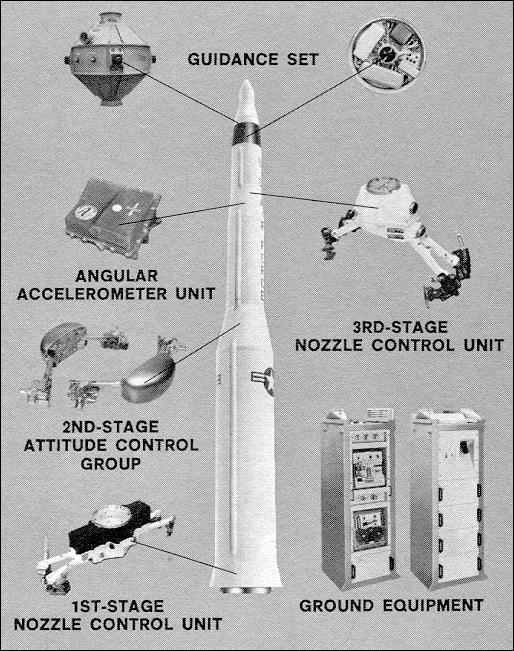
A Look at MINUTEMAN II
AUTONETICS SYSTEMS FUNCTIONS IN
MINUTEMAN II
Autonetics' new guidance and control
system plays an expanded role in the MINUTEMAN II Weapon System, contributing
substantially to the missile's increased range, accuracy, reliability, and
strategic flexibility.
The heart of the system is an
extremely fast, lightweight, microminiaturized D37 digital computer with a
memory capable of storing a complete ground and airborne operational program,
including all target data required for guidance to one of a number of stored
targets. The desired target is selected
remotely from a launch control center prior to missile launch.
PRELAUNCH: The computer, with the aid of Autonetics aerospace ground
equipment, sequences the guidance and control system through alinement, test,
calibration, and targeting modes into a strategic operating mode. During the strategic mode, the computer
automatically decodes, processes, and executes commands from the launch control
center for test, calibration, and targeting, and in addition continually
monitors and reports missile and support equipment go/nogo status to the
control center.
LAUNCH: When commanded to launch, the computer controls complete
countdown in less than a minute in conjunction with the support equipment. Countdown includes complete testing of the
missile system, activation of the missile battery power supplies, arming of the
missile ordnance devices, initiation of flight program, and igniting of
first-stage motor.
FLIGHT
After ignition of the first stage, the computer processes missile attitude,
attitude rate, and velocity information from stable platform position pickoffs,
downstage angular accelerometers, and platform accelerometers, to solve
guidance, steering, and control equations.
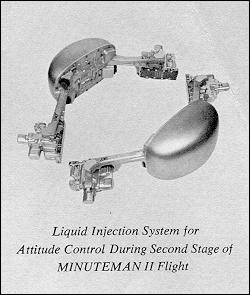
Moveable nozzles on first and third stages, and liquid injection on
second stage, control the direction of thrust for missile steering. Nozzle movements and liquid injection are
commanded by the computer and mechanized by the flight control system. The computer also generates signals for
staging, third stage thrust termination, and warhead pre-arming, as well as
re-entry vehicle separation, retro-rocket firing, and penetration aids
dispersal. Pre-arming of the warhead
follows flight safety checks made during final moments of powered flight.
A Look at...
ADVANCES
IN MINUTEMAN II ELECTRONIC SYSTEMS THROUGH USE OF MICROELECTRONICS
Technical advances by Autoneties in
microelectronics are being incorporated into the MINUTEMAN 11, to achieve even
greater dependability of the missile, increased system flexibility, lighter
weight for extended range, and ultimately lower cost. For this improved version of the missile, Autoneties developed
the first microelectronic equipment ever pro. vided for a major defense
program.
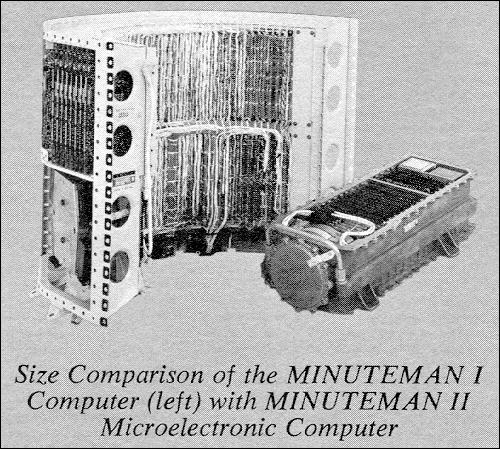
COMPUTER
ADVANCES: Autonetics' D 37 computer in
MINUTEMAN II is the first military production-designed microelectronic
computer. Size of the D37 is one-fourth
that of its D17 predecessor in MINUTEMAN I. Weight has been reduced by
one-half, and power requirements are one-half.
Memory capacity has increased by 2 1/2 times. The power supply has been incorporated into the computer. In addition, many of the previous ground
checkout equipment functions are performed by the new microelectronic computer.
The D37 is mechanized by integrated
circuits. Multilayer circuit boards, on
which the microelectronic circuits are mounted, provide for high packing
densities, improve the interconnection techniques, and permit easy maintenance.
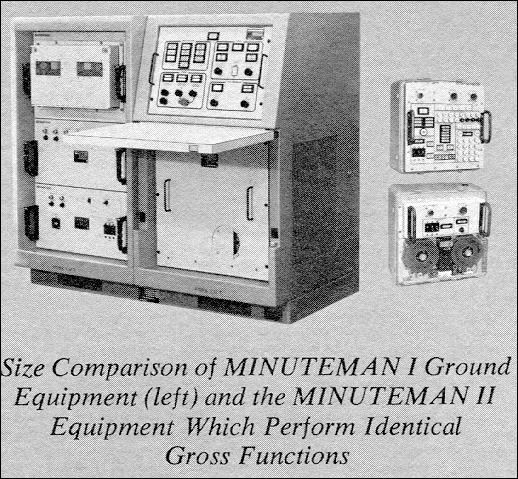
GROUND
EQUIPMENT ADVANCES: Use of
microelectronic circuits has reduced both size and weight of MINUTEMAN ground
equipment and increased its operational flexibility. Equipment for MINUTEMAN I, which consisted of a two-bay console
housed in a targeting van, has been miniaturized to the size of two small
suitcases for MINUTEMAN II. Weight has
dropped from 950 lb to 90 lb – or to just 45-lb one-man carry" weight for
each of the two suitcases.
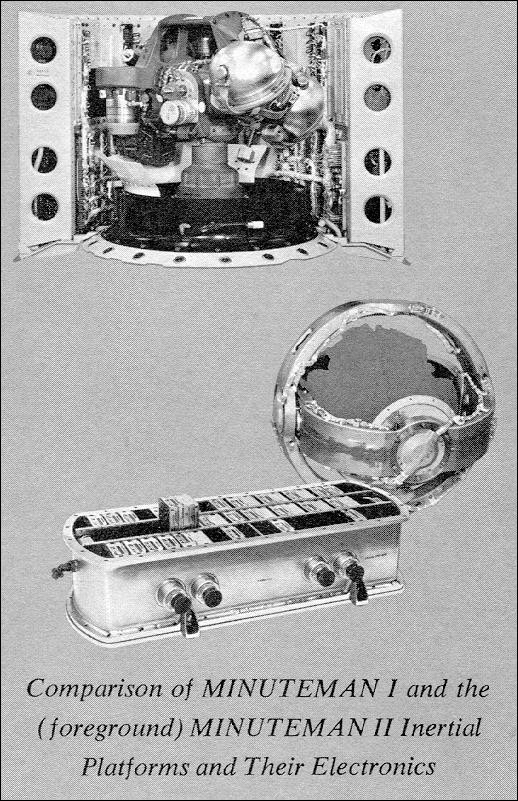
INERTIAL PLATFORM ADVANCES: The MINUTEMAN II uses a three-axis,
gyro-stabilized platform which mounts three pendulous integrating gyro
accelerometers and a gyrocompass azimuth assembly. The platform includes extensive microelectronics and is of
conventional external-gimbal design with beryllium gimbals and a beryllium
stable element. Ruggedness and extreme
rigidity are primary characteristics.
The stable platform is mounted
within a pressurized housing which contains a water-to-gas heat exchanger for
precise temperature control.
FLIGHT
CONTROL ADVANCES: Microelectronics
incorporated into Autonetics' flight control subsystem in the MINUTEMAN II
contributes to the missile's lighter weight, increased reliability, and reduced
field maintenance costs.
The use of integrated circuits and
microminiaturized components allows the major portion of flight control
electronics to be packaged into a single unit and moved upstage into the
guidance and control package of MINUTEMAN II.
Because this guidance and control section can be replaced in the silo
without removing the missile, field maintenance has been considerably
simplified.
A new attitude control group
(secondary injection system) with microelectronic components governs injection
of liquid Freon to the second stage nozzle control unit.