HD55-NAVAHO
The Navaho Cruise Missile--A Burst of Technology
Dale D. Myers, North American
Aviation, Later Deputy Administrator, NASA, Ret.
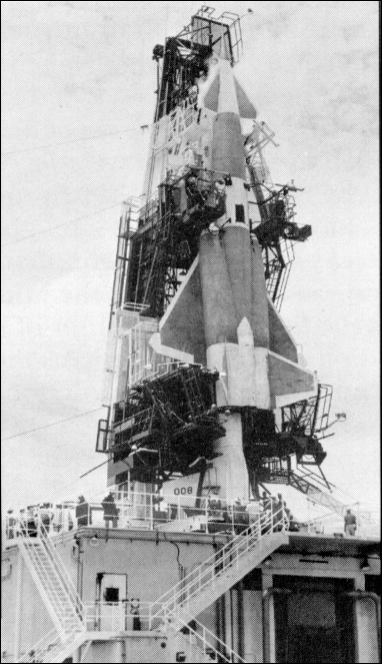
Fig
1 XSM-64 (G-26)
The Navaho Program
The Navaho missile
Program, because of its very difficult requirements, spawned a new generation
of aerospace applications that revolutionized the aerospace industry in the US.
Starting with WW II new aerospace technologies from Germany, the program set
new baselines for aerodynamically efficient supersonic configurations, advanced
rocket engines, practical, accurate inertial navigation, and new materials and
processes. Although the program was canceled in 1957 because breakthroughs in
warhead size reduction and reentry technologies made intercontinental ballistic
missiles feasible, the navigation system, the rockets, and the improved
materials and processes from Navaho contributed heavily to that feasibility,
and set the stage for our spectacular space program.
The
first half or the 20th century had been a bonanza of progress in aviation.
Speeds had increased from 40 to 400 mph in about four decades. Slight nudging
of supersonic speed had occurred experimentally. Payloads were up, altitudes
were up, and for the U.S., production had peaked in 1945 and then crashed.
In
1945, the U.S. began to get microfilm covering the aeronautics and space
activities of Germany for the period through World War II. We were all amazed.
The U.S. had concentrated on production of aircraft to give us the advantage in
air power. The Germans, recognizing resource limitations, tried to beat us with
technology.
Their
technology was outstanding, covering swept wings, axial flow turbojets,
alcohol/oxygen 56,000 lb rocket engines, the V-2, the V-1 buzz bomb, vertical
takeoff rocket powered interceptors, flying wings, rocket antiaircraft
missiles, and the beginning of inertial navigation.
In
1945, after V-J Day, the aerospace industry was decimated. North American
Aviation, for example, dropped from about 100,000 to 6500 employees in about
two months. North American built the Navion private airplane, and a small group
started looking at the German technology for applications. At the same time,
the Army Air Corps, seeing the jump in technology that Germany had, and being
impressed with the guided missile technology particularly, started a series of
guided missile programs with the industry, partially to retain some capability.
Programs
were initiated such as Rascal, a rocket powered, air launched missile, and
Bomark, a ground to air ramjet powered interceptor. A series of subsonic,
turbojet powered missiles included Matador, a ground-to-ground missile;
Regulas, a Navy sea-to-shore missile; and Snark, a long range missile. Navaho,
with a long range supersonic goal, started with a boost-glide missile, based on
the German A4b. The MX-770 program started in December, 1945. Note that all the
ground to ground missiles were cruise or glide missiles. That was because it
was generally agreed at that time that warheads were so large that
intercontinental ballistic missiles would be huge, that reentry was not
feasible, and that navigation to 1 mi accuracy was not possible. (I'll speak
later to this point.)
In
May 1946, North American Aviation formed the Aerophysics Laboratory. Dr.
William Bollay was it's Director.
The
specified performance at that time was 500 mi, supersonic boost-glide, 1 mi
accuracy, and a 3000 lb warhead. By 1946, we had a 3 1/2-in supersonic wind
tunnel, were blowing up small liquid rockets in our empty east parking lot,
were trying out solid fueled ramjets, and were dreaming about inertial
navigation accuracy, new high performance rockets, and the other new
technologies that would be required.
In
1948, the range requirement was increased to 1,000 mi. We abandoned the
boost-glide (A4b) approach, and added ramjets for cruise. We looked at ramjets
mounted on the wing tips but expected flutter. We looked at mounting them on
the vertical upper and lower tail. We looked at ramjets ducted through the
body. (For the ducted body configuration, we considered a Mach 3.5 rocket
powered aircraft as the first stage to take the missile, riding piggyback, to
its cruise speed.) The evolution of the program is shown on Fig. 2.
By
mid-1947, North American Aviation had started the development of a major new
rocket engine test facility, and a Supersonic wind tunnel. By 1950 they had
brought in Curtis Wright for ramjet development, and Thompson Products for the
auxiliary power unit. We even studied nuclear rockets, since, at that time,
media opinion had not turned against this form of energy. For guidance, we had
developed an outstanding capability to invent new navigational sensors and
instruments.
After
the Armed Services Unification Act in 1947, the Army and the Air Force reached
painful agreement on what performance domain each was to pursue, and that
created a need to extend the range. By 1950, the requirements were extended
again, this time to 5,500 n.m., one quarter mile accuracy, Mach 2.75, and up to
15,000 lb payload.
Today,
that major change in specification probably would call for a new competition.
Then, it caused us to go back to ground zero, review all the potential
technologies that we could reach, and totally reconfigure the program. In a
period of 3 months, we developed a canard configuration using side inlets
leading to buried ramjets. The missile would be boosted beyond cruise speed
with a parallel expendable booster. It would be guided by pure inertial
navigation. (We had considered radio guidance for the boost phase, and had
developed the first daylight star tracker, but, because of the progress of
double integrating accelerometers and reversing (NAVAN) gyroscopes, neither was
needed.) The Mach number would be 3.25, and the altitude 80,000 ft., zooming to
90,000 ft just prior to dive-in.
In
order to fly at that Mach number, we would need stainless steel and titanium
sheet, and we would need many other weight-saving ideas. By 1950 we were doing
the first flight testing of inertial navigators, but they used vacuum tubes for
computers. No large ramjets had been built, and no air supply existed to test
them. With some difficulty, 75,000 lb alcohol/oxygen rocket engines were just
getting into test.
It
became clear that we had so many technical breakthroughs to make that we could
not totally define the system, so we proposed, and the Air Force accepted, a
three-phase program with a schedule as shown on Fig. 2 & 3.
I. Build a full scale model of an
intermediate range ramjet, and power it with turbojets (X-10), as shown on Fig.
4.
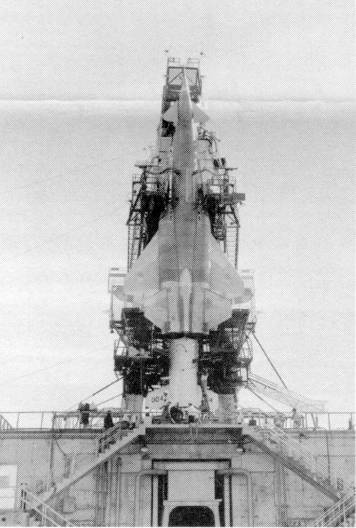
II. Build a ramjet with 2,500 mi range. Fly
it at Mach 2.75, so it could use essentially the same airframe (aluminum wings,
stainless fuselage) as the turbojet version (XSM-64), as shown on Fig. 1 &
8.
III. Advance the state of the art, and then build
the ultimate 5,500 n.m., Mach 3.25, 15000 lb. payload version, with 1/4 mile
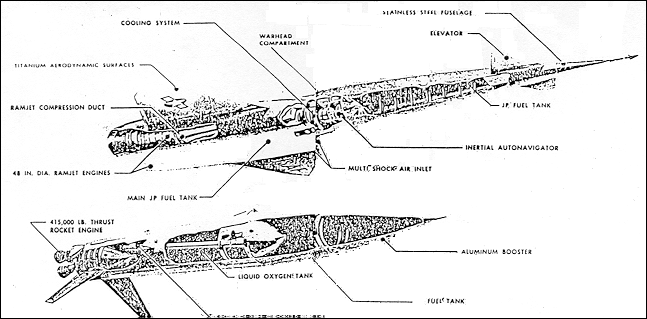
CEP accuracy (XSH-64A), as shown in Fig. 5.
The
X-10 and the XSM-64 were designed to be recoverable by conventional landing
gear, using a fully automatic landing system, with a radar altimeter
controlling flare. The XSM-64A was optimized for range on the premise that most
flight test considerations would be developed on the two previous models before
the final one flew. Therefore, the XSM-64A had no landing gear, and had a small,
all movable vertical surface.
The
X-10 first flight was in October 1953; 15 flights were flown at Edwards AFB,
and 12 more from the skid strip at Cape Canaveral, which was shared with Snark.
Eight flights were flown with one missile. In 1956, the X-10 flew Mach 2.05,
using the Westinghouse J-40-8 with afterburner. The flight was totally under
the control of the N-6 inertial navigator, including a supersonic reentry (Mach
1.3 at sea level).
The
X-10 had these characteristics that were ahead of their time;
1. Delta wing with fully powered delta
canard.
2. Twin verticals for directional
stability at high angles of attack; Landing speed was still 150 mph, which
drove tire technology.
3. Fully inertial guidance control, using
the first transistorized navigation computer.
4. Fully automatic landing system, except
for lateral control on the runway, where ground clutter destroyed the accuracy
of the SCR-584 radar.
5. "Hero Pilot" for lateral
control on the runway. (He tracked the bird through a transmitting transit from
the end of the runway that the vehicle was approaching in its rollout).
That
the vehicle was never converted to be manned was a great regret of mine.
General Boyd, then at Wright Field, wanted to add a cockpit, but could not get
enough support. The X-10 flew beautifully on radio command and on inertial
navigation, and I believe it could have made a very interesting X airplane.
The
XSM-64, with the same appearance and general configuration as the X-10, flew
first on November 6, 1956. It was
vertically launched, using two 120,000 lb kerosene/oxygen rocket engines from
the (now named) Rocketdyne Division of North American Aviation, Inc. A parallel
booster was used. In place of the turbojets, Curtis Wright 48-inch diameter
ramjets were mounted. The inlets were half-round spike inlets with boundary
layer bleed. Cooling was with ammonia, and electrical power was supplied by a
separate Thompson Products gas generator powered APU. Wings and surfaces were
aluminum, and flight speed was Mach 2.75. By this time in the program,
automatic circuit continuity and automatic checkout were being used
extensively.
Navaho
had a formal reliability program, with FMEA's and a rigorous test and
qualification program to deal with the new 600 degree Fahrenheit temperatures
and the high vibration levels. Testing was carried to the extent that every
booster was live fired as a total system prior to flight. In spite of this
care, the XSM-64 flight test. program could not be labeled a resounding success.
In looking back, I believe we (and the whole missile industry) were putting too
many new technologies together without the incisive systems analysis that is
more prevalent today.
By
1955, the design of the final vehicle had begun. Stretching to meet (the now)
6,500 n.m. at Mach 3.25 with a (now) 1 mi accuracy, here are some (but not all)
of the "firsts" applied to the program.
The Airframe
Canard Configuration
Early supersonic
wind tunnel tests of the A4b supersonic glider showed a very strong center of
pressure movement as the Mach number increased. Tests in the Aberdeen 13-in.
wind tunnel and in a 3 1/2-in. tunnel at North American showed that a fully
controlled delta canard, with a delta main wing gave almost constant center of
pressure, and yielded positive lift with trim. This advantage has been applied
to many aircraft since, such as the Swedish Gripen, the French Raphael, and the
US B-70.
Parallel Booster
When
the 5,500-n.m. requirement was imposed, ramjets were selected and optimized at
Mach 3.25. A booster was necessary. Studies of the loads imposed on the
missile-booster interface with a series booster, led to a choice of parallel
booster. Booster separation was aerodynamic, after explosive bolts broke the
physical connections. The concept was later used by the Shuttle, the Buran, and
seems to be favored for the now National Launch System.
Structure
Navaho
developed the first use of titanium skin for aircraft application, and it
developed forming and welding processes. The material was later used by several
aircraft, notably the SR-71.
Pressure stabilized
stainless steel tanks were originally designed for the Navaho missile, but the
rough environment that the missile took in equipment installation and ground
handling caused us to stiffen it with longerons. The concept was used very
successfully on the Atlas missile.
Chem-milling
(etching out unwanted material) was developed for aluminum, titanium, and
steel. Aluminum chem-milling is now used on almost every aircraft and liquid
powered space booster in the world.
Automatic
inert gas shielded fusion welding was developed for high strength aluminum
alloys and for stainless steel.
Fuel
cooling, cooled low pressure hydraulic fluid to cool the high pressure
actuators, metallic seals, and ammonia-water cooling of electronics all led to
applications in advanced missiles and aircraft.
Guidance and Control
The
first all inertial navigation system was conceived by Peenamunde scientists
working on the boost-glide A4b. When the U.S understood its implications, MIT
(as overall monitor), North American Aviation (Navaho) and Northrop (Snark)
were designated as development centers. German scientists at Huntsville and
Wright Field worked closely with these centers.
North
American invented double integrating accelerometers, and the NAVAN reversing
gyro concept. At the same time, radio guidance during boost was considered and
a single "Cycloptic" daylight star tracker for platform correction
was developed and flight tested. Navaho, with its relatively short flight time
(3 hr), was able to meet its requirements without radio guidance or a star
tracker.
The N-6 navigator
flow in 1956 at Mach 2.05 in the X-10 and at Mach 3.0 in the XSM-64 in 1957.
For these flights, a completely transistorized computer with etched circuit
boards was used; this was another first.
Although
different means of improving accuracy developed later, the mechanization,
computational techniques, and detailed management of these systems comes from
the Navaho inventions and extrapolation of the early German work.
Inertial navigation
systems for commercial transports, ballistic missiles, submarines, and fighter
aircraft all have a heritage to Navaho. An N-6 Navaho navigator, with only
minor modifications, guided the Nautilus submarine under the ice to the North
Pole, another first.
Rocket Propulsion
As
in the case of the airframe, the technology was not in hand for the Navaho
motors, and a phased program was undertaken, including the assembly of the
German V-2 engine (which was not fired), and the development of a new 75,000-lb
engine for an early version of Navaho. By 1950, the requirement change on
NAVAHO caused the 75,000-lb engine to be dropped (but picked up by the Army
where a modified version was used in Redstone).
A
new revolutionary 120,000-lb engine was then developed. This engine became the
basis of a whole new generation of rocket engines because of its new features:
1. Kerosene as fuel, rather than alcohol
2. Flat injector faces
3. Tubular fuel cooled nozzle
4. High speed turbopump with a single gas
generator running multiple chambers
5. Boot strap starts, using the prime
fuels for the gas generator
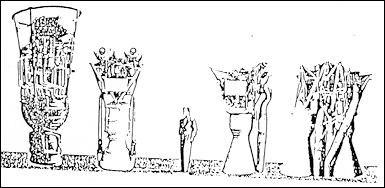
The
thrust-to-weight ratio of this engine was almost five times the German V-2
engine. The comparison of the engines is shown on Fig. 6.
By
the late fifties, versions of this engine were being developed for Navaho,
Atlas, Redstone, Jupiter, Thor, and the Apollo S1b. Many of its features are
still used in modern engines such as the shuttle SSME and the now NLS.
Ramjet Propulsion
Using
the work of Tony Ferri of NACA and Oswatisch of Germany, North American started
high Mach number inlet studies in 1947 and was able, with the help of NACA, to
develop a high efficiency spike inlet for the Curtis Wright 48-in. Ramjet. Segmented
ramjets were seriously considered as per Hermes II, but we concluded that as
large air supplies became available, better overall efficiency, range and
reliability could come from two large circular engines.
The
missile was over-boosted, in order to start the inlet and to retain 100 percent
capture of the air. Fuel control kept the internal inlet normal shock near the
throat to maximize engine efficiency. Vortex generators were used internally in
the subsonic inlet flow. Although internal instrumentation was primitive, the
overall performance of the missile was as predicted, indicating that the engine
performance was good.
Facilities
Major
rocket engine test facilities were built at Rockotdyne, Edwards AFB and
Tullahoma.
Major
Air Supplies for Ramjets (and later-turbojets) were built at NASA Lewis
Laboratories and Tullahoma.
New
supersonic wind tunnels were built at Wright Patterson AFB, NACA, and North
American Aviation.
New
integrated circuit development facilities were installed at North American
Aviation's Autonetics Division.
Operations
The operations
concept called for:
1. Air Transport fully assembled in
environmentally controlled boxes
2. Minimum field assembly
3. Mobile launcher
4. Automatic sequencing checkout
Cancellation
In
July, 1957, the program was canceled. The only reference that I can find says
"the program cost too much." But remember, Navaho had proven the
feasibility of:
1. High impulse light weight rocket
engines
2. Highly accurate fully inertial guidance
3. Light weight stainless pressurized
tanks
At
the same time, re-entry technology was being solved and warheads were getting
smaller. The combination showed that intercontinental ballistic missiles were
feasible, and the National will shifted away from cruise missiles.
Summary
The
legacy of Navaho was encapsulated beautifully by Robert Hotz, long time editor
of Aviation Week, who, in an Editorial entitled “How Research Investments Pay
Tremendous Dividends" wrote this: "The case history of the Navaho
research and development program should be carefully studied by every
congressman concerned with military appropriations, by the comptrollers at all
levels of the executive branch of the government, and by the taxpayers whose
$700 million were invested and who stand to collect the real benefit from these
dividends in a stronger defense capability and new additions to the dynamic
technology that is required to keep the civilian economy rolling. It is a prime
example of how a wise investment in military research and development can pay
handsome dividends for the future."
Bob
Hotz's 1957 words are just as applicable today. Programs like SDI, the NASP,
and the NLS are hard programs to do, and, because they are hard, engineers are
stretching hard to meet their requirements. That's good for those programs, but
it's also good for the overall status of technology to be applied to other
military and commercial applications in the future.
As
we often said in those days after the Navaho cancellation, "The operation
was a success, but the patient died.” Navaho technology fed commercial and
military aircraft, but its major contribution was to our space program, where
light weight, high performance rocket engines, advanced electronics, and light
weight structures allowed us to quickly regain the lead. Redstone missiles sent
our first satellite into orbit, and launched our first astronauts, both with
the Redstone rocket, slightly modified from the interim Navaho rockets. Our
first orbiting Astronaut, John Glenn, rode an Atlas missile with a first cousin
of Navaho for rockets.
That
head start on the technologies needed for space opened the heavens to mankind.
Bibliography
1.
Development of a Strategic Missile and Associated Projects. Aerophysics Lab.
Report 1347, October, 1951
2. Navaho Mission. North American
Aviation, Unpublished report, 1956
3. Development of the Jupiter Propulsion
System. Julian Braun. Sixth Army R and D Unit Scientific Symposium. Corvallis,
Oregon, August 12, 1958
4. Papers and Charts from the work of
Ralph Oakley. Rockwell International, December, 1961
Recollections and
notes of:
Martin Boe --
structure
Tom P. Dixon --
rockets
Alan J. Grant --
guidance
Dale D. Myers --
overall
Oran W. Nicks --
ramjet
Norman F. Parker --
guidance
William C. Perkins
-- Titanium
I particularly want
to thank the six Navaho program ex-co-workers listed above for their extra
effort in supplying data for this report, and to Dr. Shirley Thomas for her
continuing support in obtaining data. Ms. Elyse Nicholson of Rockwell
International supplied photographic help.
Table 1. Requirement Revisions, 1950
Overall Objective
-- 5,500 n.m., up to 15,000 lb payload
Later changed to
6,500 n.m.
Accuracy-1,500 ft
CEP (later changed to 1 n.m.)
Speed -- Greater
than Mach 2.75
Altitude -- Greater
than 70,000 ft
Intermediate
Objective -- 2.500 n.m. (later changed to 3,600 n.m.)
Table 2 Resulting
Performance, 1957
|
Name |
Mach No |
Range nm |
Max. Alt ft |
Warhead lb |
CEP nm |
Length ft |
Gross Wt lb |
Flt. Date |
|
X-10 Demonstrated |
2.05 |
625 |
45000 |
Instruments |
N/A |
68 |
35000 |
Oct 1953 |
|
XSM-64 Demonstrated |
2.99 |
1075 |
65000 |
Instruments |
< One |
68 |
65000 |
Nov 1956 |
|
XSM-64A Estimated |
3.25 |
4400 |
75000 |
15000 |
One |
89 |
120000 |
N/A |
|
|
|
5500 |
80000 |
5000 |
|
|
|
|
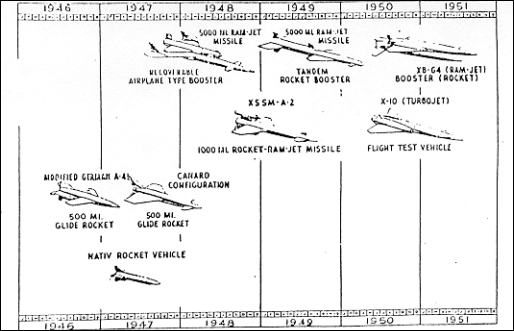
Fig
2 Navaho Configuration Development
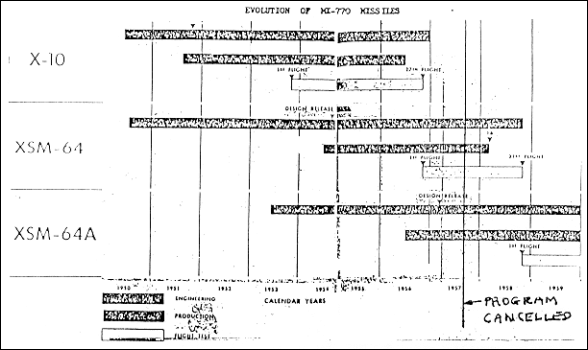
XSM-64 was known as G-26 during components
development, a planed design G-38 is not shown.
Fig
3 Navaho Schedule
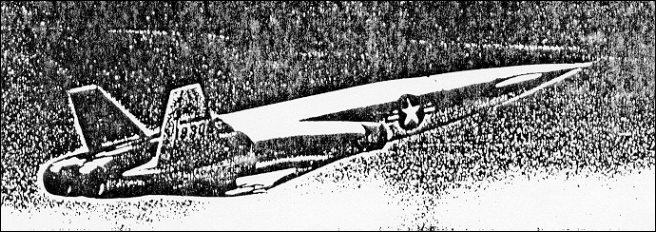
Fig
4 X-10
Fig
5 XSM-64A , Mach 3.25
Lower
part was better known as the G-26 Booster
Fig
6 V-2 Rocket at left, man middle, Navaho Rocket right
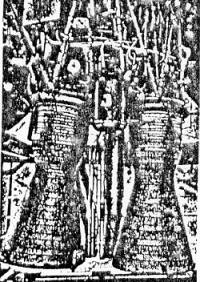
Fig 7 Navaho
Type:
liquid propellant, pump fed
Thrust:
120,000 lb (cluster of two)
Propellants:
Kerosene/Liquid Oxygen
Specific
Impulse: 245 sec
Mixture
Ratio: (O/F) 2.17
Chamber
Pressure: 538 psia
Area
Ratio: 4.6:1
Weight:
4800 lb
Dimensions:
(system) 126 in long, 84 in wide
Fig
8 XSM-64