B-29 Mechanics 102 Following my first days lesson I
continued, going from plane to plane working as a crew member, becoming
acquainted with them and learning more.
During my flight line time on Guam I learned something new almost every
day. Those of later generation are
unaware of how rapidly technology was changing, every aspect of weaponry and
infrastructure. The farming region
where I grew up was being powered by horses, mules and manual labor when I
began learning about things. Our first
family car was a 1928 Model-A Ford, my fathers “company car” was a 1923 Model-T
Ford. My first car in high school was a
1927 Model-T that cost $5.00 plus $4.00 for a car tag. That car was my B-29 maintenance trainer,
later upgraded to a $40 1932 Model-A
maintenance trainer. I did well in my
first class in airplane mechanic because I’d learned how to use hand tools from
a Black Smith, threading U bolts when I was in grade school.
There was a huge demand for skilled
mechanics and all of the better ones had learned much, as I did, before going
into service. Military aptitude tests
had assured a supply of capable people into the ground crew ranks, I found that
crew chiefs and specialist ground crew were well above average intelligence –
you can’t judge a man’s capability by their appearance, one of the brightest
guys on the flight line looked dumb as a clod.
I was proud to be learning from some of the best.
The B-17 was flying with a 1932
designed engine, the B-29 was flying with a 1942 designed system rushed into
service before the bugs had been worked out.
The first day I realized B-29 engines were the primary maintenance
problem. Many of the flight crew were
unaware of the maintenance required because they always took off with good
engines, unaware an engine had been replace while they slept. A “power plant” is a system and not just and
engine. From day one I focused on how this power plant was packaged.
Packaging Horsepower
18
pistons with 3350 cu in displacement must breath hard to produce 2200 hp.
Granddad never dream that many horses could be harnessed to one pull point –
let alone hitch four wide to fly higher than Santa’s Reindeer. Real horses use sweat for liquid
cooling. “No Sweat” did not apply to
cooling B-29 horse power. They were air
cooled and un-intended turbulence caused some to became burnt toast, oil cooked
to carbon, but you can’t see turbulence or cooked oil, cockpit temperature
readings were not reading the hottest.
Breathing
air entered at chin level before being turbo-compressed and piston-sucked
(push-pulled) through a filter to carburetor mixing air with metered gasoline –
then ignited. Carburetors are
mechanical computers for metering fuel to match air flow. Exhaust was collected front and back to
power left and right superchargers.
Cooling
air flowed past the propeller hub and inside minimum drag cowling – through an
annulus gap in a torturous path to an exit metered by cowl flaps set by the
flight engineer. Engines were suspended
on shock mounts and moved inside the fixed outer cowling, forward exhaust
stacks had flex joints at the engine to allow for engine movement. Cowling skin
was removable for access to align these droopy tubes and replace spark
plugs. The system was a masterpiece of
air flow management – a special blend of geometry and thermodynamics. The
engine kinematics were the result of an evolutionary process. There was one crankshaft with a master front
and aft connecting rod, to which 8 articulating rods attached.

Intake and exhaust valves are opened by
rocker arms (a pivoted titer-totter) at the top. Valve springs close the valves and push rods, lifted by a cam
plate in sync with the crank shaft, pushed the rocker arm, overcome the spring
force and hold valves open for a proper time. Valve timing is fixed and not
adjustable. There is valve opening overlap
where inlet helps clean out exhaust.
Each engine was fitted with a 60 gallon
supply of oil, pumped to and from the engine.
Valve lubricating oil went up inside push rods to lubricate brass valve
guides and returned inside push rod covers.
Changing individual cylinders was possible, but difficult. Since the failure of one cylinder was a
precursor to pending other failures it was pragmatic to change the entire
engine.
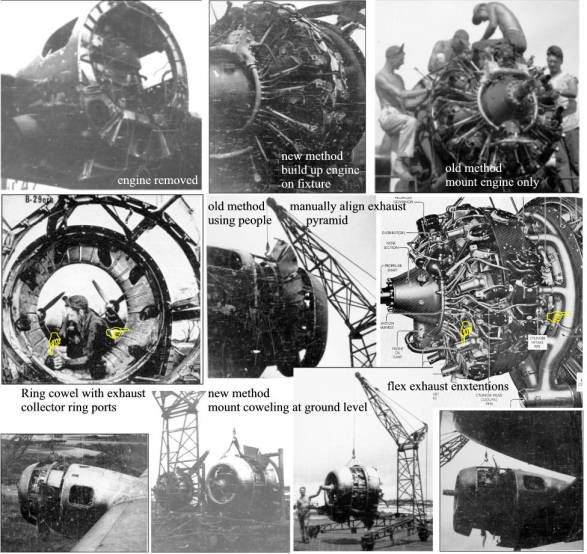
An engine change could be achieved
by one person, however it required many hands to hold the nine flex joint
exhaust extensions when slipping the cowling on.
A
time consuming tedious job was clamping the air inlet to the engine carburetor
after engine installation. This was
done with a quite long bolt with fine threads – fitting the bolt in place was
the easy job – but tightening the nut could only be done with and open end
wrench that had to be flipped after each movement to fit on the nut – while
your body was inside the engine access port above the back of the engine,
facing up. Having done this many times
I would sometimes relieve a mechanic so he could rest his contorted body and
reset his disposition.
There
were more change modifications to the engines than to the airplane. The aircraft and engine was designed after
the war began and went into combat while still fixing flaws. That’s me above, with left hand on the
engine, which shows relative size.
Combat life of R3350 engines = 97 hours
In the urgency to deploy, a fixable flaw
fell through the crack
I
went to 314 wing hdq to obtain maintenance data on the R3350 engines, tech
orders rated it’s life as 450 hours, I was shocked to find the average combat
life was 97 hours. Since an average
mission lasted 12 hours, the average engine was good for 8 missions. The ground crew had to replace one of the
four B-29 engines every other mission.
While training in the states, B-29 engines did well to last 12
hours. To win the war in the Pacific it
was essential to make B-29’s available as fast as launch sites became
available. Gen Hap Arnold pressed to
obtain new aircraft, new bases and train crews as fast as possible, none
existed when the war began.. The
program pressed on using flawed engines while incorporating improvement
modifications. It was known that
exhaust valves failed due to over heating.
Modifications helped but were
not fixes – the program pressed on.
“Blow By” Crew
There
was no simple way to know when an engine needed changing. As a preventive maintenance effort Capt
Keough established a “blow by” crew, R. Bixby and W. Driscoll. Two mechanics, one on each side, on ladders
place their ear to each exhaust and listened for faulty exhaust valve
seating. If an exhaust valve did not
seat properly on the compression stroke, “blow by” could be heard. Engines that failed this test were replaced
before they failed in flight. Due to
this preventive maintenance 28th Sqd had the best maintenance record
in the 314th wing, possibly the 20th AF.
Write Unsatisfactory Reports to Wright Field on Failed Engines
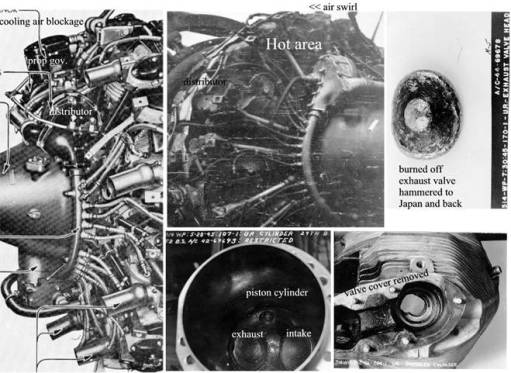

Burned off Exhaust Valve
After about a week and a half Keough said enough of your working as a mechanic, you know enough already. I can’t keep up with things that need to be done, come with me. He took me to a collection of some 20 removed engines, saying I want you to write UR (Unsatisfactory Reports that are sent to Wright Field) on these engines. He didn’t elaborate on what or how. I knew from things he’d told me that he’d given these failures much thought. I was sure Wright Field already had stacks of UR’s stating that burned off valves were the cause of engine failure. I wanted to know why the valves failed, and knew Keough expected more than a simple answer. I also had motive, I’d been up all night with mechanics trying to get engines changed in time for the pending mission.
Flight crews filled out a Form
41A stating known problems when they
landed. Ground crews maintained a Form
41B stating the status of a repaired airplane.
Most of the time engines with burn off valves would continue running and
were reported as “engine running rough” or “oil leak on #3” – valve failures
could also result in severe problems.
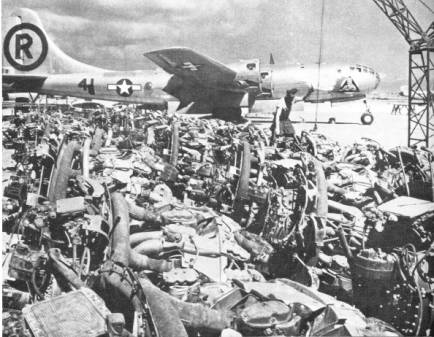
Removed B-29 engines on Iwo Jima
I
decided to use a “speed wrench’ and remove all exhaust valve rocker covers and
look at the status of all the valve stems – my gosh – in short order the cause
became evident. On certain cylinders
lubricating oil to the exhaust valve stems had been cooked to carbon! Why valves failed was obvious. This had to be known to every engine rebuild
center – exhaust valves got too hot. I
learned that Wright Field had come up with a fix, they were changing all new
engines to use “fuel injection”, a carburetor is not used, gasoline’s is
squirted into the cylinder so that “heat of vaporization” can cool the
combustion chamber. Wright Field
assumed that all the cylinders were over heating. However from the sample I had,
many of the cylinders were just fine?
Those in the upper right, as viewed from in back, were the only ones
cooking oil to carbon. All others were
just fine? The Wright Field solution
did nothing for the huge numbers of engines already in service – this looked
like a fixable problem..
Exhaust valves were larger than
intake valves and filled with sodium, which became liquid when hot and
“splashed heat” from the valve head to the valve stem. The valve stem cycled up and down in a brass
sleeve bushing, pressed into a cast aluminum cylinder head with cooling
fins. If cooling could not keep up, the
brass bearing would wear and the valve head not seat properly. With improper seating thermal runaway began
– cooking the lubricating oil and sometimes burning through the valve stem,
leaving the valve head inside the cylinder.
The above photo shows such a hammered valve head.
So why did some valves remain
adequately cool and some not? The
engines were symmetrical with regard to cooling fins and air flow, except for a
Propeller governor at the top and two ignition distributors on each side. Those disrupted air flow, and is why the one
and only temperature reading was on the top front master cylinder. The flight engineer could read the status of
the believed to be “hottest cylinder” with this thermocouple reading – and cut
back power before the engine overheated.
However my sampling showed the top front cylinder was not the hottest –
but why? The prop governor in front of
it should have caused it to be the hottest.
Boeing
designed the engine cowling (aerodynamic engine cover) for minimum drag –
however the B-29 was different than any other radial engine equipped airplane,
it collected exhaust to power a turbo super charger. Covering the forward exhaust collector ring, pinched off cooling
air flow. All believed there was
adequate cooling so long as the flight engineer kept the temperature reading
within limits. In fact during high
altitude cruise it was necessary to close the cowl flaps a bit to keep the
engine warm. Take off temperatures at
low speeds were “hot”, be it KS or Guam, while high altitude air is very cold.
Why were Failures Skewed to Right?
I
was stumped – why did most cylinders immediately behind the air flow
obstructions stay sufficiently cool while others did not? I completed my assigned task and made my
findings known via my UR reports.
Keough found my findings and conclusions quite interesting. Those prior to me were too hard pressed with
immediate tasks, they didn’t have the time or the sample to study the problem –
the condition was there for anyone to read. I stopped work on this and put the puzzle on my back burner.
Cylinder Change, a
Bloody Job
Most of the Crew Chiefs had at some
time changed individual cylinders in lieu of doing a complete engine change.
What seemed a simple solution turned out to be a bear and the practice was
avoided. I learned of the difficulties
first hand when one of the mechanics came to me with bloody hands and asked if
I'd help him finish. The problem was access to the safety wire through the
cylinder hold down bolts.
The cylinder heads were of cast
aluminum but the cylinder walls were steel with fused on sheet metal fins.
These fins were stamped out of sheet stock and their edges were razor sharp.
Without special tools one had to shove hands into the confined areas between
the cylinders and work the stiff wire through the bolts with fingertips. There
was no way to get this done on an installed engine without scraping or slicing
knuckles or palms of ones hands. They'd bleed and be sore when you most needed
them to work tools. We settled for some real crappy looking safety wire jobs
but they were all safety wired. At the
time we didn't tumble to the fact that it was always cylinders in the HOT
quadrant region that needed changing.
Changing the #1 master cylinder was
rare and required special care. As the cylinder was lifted off the piston, it
was necessary to rig a holder to keep the master rod centered in the open port.
All articulating rods, those to the other cylinders, connected to it. If it
tilted beyond certain bounds, attached articulating rods would pull pistons too
far into the crank case and the piston rings pop to full expansion making it impossible
to put them back. The entire engine would need to be removed to correct the
problem. Remove and Replace was not as simple as it might sound.
Bernard B Bug, Adjutant and
Confidant
Bernie, a most unusual character,
lived in the opposite end of our barracks. He'd been trained as a navigator but
became air sick, was grounded and assigned as Sqd Adjutant. He was quick,
bright and liked by everyone and became the confidant to most crew members. His
serious poker face veiled his active but dry sense of humor. The crews trusted
him implicitly and he carried all sorts of instructions in his head or in
special notes to be sure letters from girl friends were not sent to families,
etc.
My first contact was when Bernie
asked me to loan him some money - he told me he needed $300 for a stake in a
poker game. He didn't want to borrow from flight crews or those who gambled. I
loaned him the money and he gave me $350 the next day. His poker face put him
in good stead, no one knew of him being a loser after a nights play. He was
often broke and borrowed money. Bernie sent his winnings home making sure he
couldn't loose what he'd won! His habit
was to borrow to get into a game, some might have thought he’d been loosing. Poker was played at the officers club with
the standard ante being $25. This was usually in the form of bill's tied
together. It was not a game for amateurs.
Jets Stream blows B-29's out to
sea, Smitty modifies Bomb sight
Near by bunk mates Smitty a ground
maintenance Radar Officer, Brownell a ground maintenance Radio Officer and
Pultz a de-briefing Intelligence Officer told me about early missions which
were flown at high altitudes to evade flak and fighters. They encountered high
velocity winds of over 200 mph. These were later called Jet Streams and used to
advantage in commercial flying. It was found that when trying to fly into them
to reach a target they were sometimes actually being blown away from Japan with
a negative ground speed. Brownell told how Smitty had devised a new scale so
they could correct for these strong winds which were beyond the Bombardiers
Nordon bomb sight scale. They used Smitty's modified scale as an alternative
until LeMay ordered a shift to low level bombing.
Electrical Problem Fix
Electrical Specialists told me of
unique solutions for early special problems.
The B-29 used many electrical systems and was a maze of wires. Electricians found wires chewed on by rats,
when baited traps didn't work they called Operations. Operations send a crew equipped with old style oxygen masks to
take the plane to high altitude and suffocate the rodents – it worked.
Clipping Off the Tree Tops
Before I arrived M-6 was flown by
Hans Gammel through Pati Point trees on take off, Johnson was the crew chief.
About 1995 I met with Gammel and Vern Chandler and listened to Hans tell
Vern of keep it in the air, passed the cliff and salvo their bomb load. Engine
#4 was delivering power but vibrating due to it's damaged prop. They feathered
the prop and began dumping gas as they swung about and landed mid island at
Harmon Field. Harmon Field was used for
planes that had to return so as not to interrupt takeoffs from North Field. The
Service Center and Johnsons crew soon had the plane repaired and on flying status
again. (Vern Chandler and Hans Gammel
were 28th Sqd Airplane Commanders flying the same missions. Vern found Hans was in a near by Texas
hospital. Before going to see Hans, Vern made a model B-29, with limb poking
from it’s right wing, and took it to Hans with best wishes.)
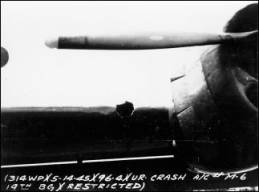

Gammel flies M6 through Pati Point tree tops
during takeoff
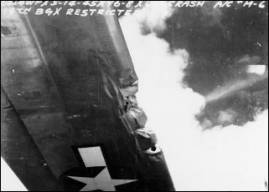
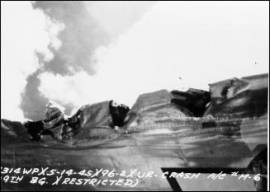
Trimming trees with fully loaded B-29 is not
recommended.

Hans Gammel M-6 crew
Hardstands
the B-29's Home Everyone worked from early morning at the
steady efficient pace of men who knew their jobs and recognized they were
working against the clock. In addition to basic repairs to the aircraft, the
planes had to be turned around. The repair areas were black topped branches off
the taxi strips called "hard stands". Some were short with room for
one plane and some longer with room for two planes. Returning from the previous
mission, the planes were taxied into the hard stands. They had to be towed out
onto the taxi strips and backed into the hard stands so they could taxi out at
take-off-time.
The planes were normally turned
around using a Cletrack before they were loaded with fuel and bombs. It was a
real struggle to back a 70 ton loaded plane up even a slight incline.
A hard stand could become very
crowded. The maintenance crews required hoists and platforms in order to reach
and work on the engines. It was essential for Ordnance people to have room for
their bomb dolly's. Tank wagons and oil trucks needed access in order to load
the 6700 gallons of gas in the wings and add 60 gallons of oil to each of the
four engines oil tanks. The Armament people had to load the (10) 50 caliber
machine guns.
Pre Take Off

M-10 ready to taxi out
Few of the planes were ready when
the flight crews arrived. Ground crews
were tired but working at a feverish pace to meet the deadline. The flight
crews were sometimes tense before take-off-time and naturally finicky about the
condition of the plane. A squadron of
15 planes was bound to produce some sharp impatient exchanges. In most cases there was much understanding
an patience. The status of each plane had to be checked and ground crews
shifted to help those having trouble meeting the deadline.
Prop tip splits bill on Parks cap Crew Chief Parks had an agreement with the
Bombardier that Parks would hunching his back into the new air operated bomb
bay door to latch it shut. Crews would
get in and out in and out and the air compressor could not keep pressure
up. This worked fine till a new
Bombardier, seeing the door did not latched flipped it to open and try
again. Parks found he was being pushed down as the air compressor built
pressure. Engines were running and he
could not be heard. Aware his head was
inline with the prop blade he decided he’d better drop to the ground fast
before pushed into the prop blade. When
he dropped the blade flung his cap off.
When he recovered it he found the prop tip had split the tip of his ball
cap. With the compressor recharged the
door latched and the plane taxied out.
You can be assured Parks didn’t let that happen again.
Engine Noise The whole area became an inferno of engines
being given final checkout. Each of the 60 engines had to be run to full power.
Torrents of air whipped the landscape. Conversation in the vicinity of a plane
was impossible except by shouting in the person's ear, hand signals were used
when practicable. As the planes were
turned over to the flight crews the inferno would diminish and permit
identification of those having trouble. Troubles came in all kinds of packages.
The obvious ones were of crews trying to clear fouled spark plugs by running up
engines to 2/3 power for longer than normal periods or those bellowing black
smoke and backfiring due to flooded engines. The carburetors rarely
malfunctioned but an engine could be over primed at start up and bellow smoke
till the carburetor took over.
Radio and Radar people had to
service their sets. Armament had to
check guns and service the automatic fire control systems. Electrical and instrument specialist had to
check automatic flight control systems, instrument panels, control mechanisms
auxiliary power supplies, cabin pressurization systems, photo, navigational
systems, etc., including the thunder mug. All these people competed for access
in and around the plane.
Liquid locks: Invariably there was a liquid lock where
oil had settled into the piston heads of the bottom cylinders. With the valves
closed the engine would not rotate in the forward direction. The orthodox
remedy was to remove a spark plug and drain the oil, but which one or ones? This
method took time and delayed take off for that plane. An unorthodox remedy,
described later, was technically all right and quite pragmatic, but got us in
trouble.
Standby Crew at Take Off
There were many types of problems
that required hurried trouble shooting to find the fault and led to tedious
frustration in accomplishing a repair in time. As take-off-time arrived the
planes would move out into single file along the taxi strips. When the flight crew took over the ground
crew would gather at the engineering tent – they would not leave until they saw
their plane lift off, then they would go to the 6x6 and fall asleep pending a
full load for the trip to mess hall.
A
“Stand By Crew” took their place in the Weapons Carrier (a pickup type truck)
and the Line Chiefs would join the Engineering Officer in the jeep. As ground crew would gather around the
Engineering tent the Crew Chief would report as his plane taxied out and join
his crew to watch for their plane to come down the runway.

Standby crew in Weapons Carrier or Jeep
would weave their way to plane in trouble.
180 B-29's lined up for take off is
a noisy, windy, dynamic sight but attention was focused on the runways. Engines
had to be driven to maximum power to lift the 10 ton bomb load and a 16 hour
fuel supply, they lifted a load equivalent to that of (5) B-17's, for a
distance equivalent from Los Angeles to Chicago and back with a crew of 11. The
armament and armor plating was a considerable load in itself without the bombs.
The same engines were used by airlines after the war. However, they were asked
to deliver 1/2 the horsepower.
As each plane came down the runway
it's ground crew listened to the pitch of its engines, watch the color of the
exhaust and look for hot spots. Turbo
superchargers driven by exhaust gases from the engines pumped extra air into
the engines for take off. Each ground crew member watched for any kind of fault
symptom as their plane roared down the runway.
When their plane lifted off and dropped out of sight when past Pati
Point cliff, they walked past Keough’s Jeep saying M-2 is off OK and climbed in
the 6x6 truck for the ride back. They
were too tired to be interested in the dynamic spectacle - they'd seen it many
times before.
Two Lift off per minute:
Planes took off at one minute intervals on each of the two runways, a
plane became airborne every 30 seconds. Even so a take off could span a two
hour period in case of problems.
Weaving through traffic A plane in take off cued with a problem
would call the tower, the tower called the engineering tent and word yelled to
the Standby Crew of the planes number
and location. Keough’s Jeep would take the lead in a “mad dash” past, through
and around planes advancing toward take off position. The canvas Jeep top would
be caught in the slip stream of an engine revved up to move a plane ahead to
take up slack in the queue line. If caught from the side, the blast would
almost blow the Jeep over. Typical of such problems was that the copilot would
open his window while waiting in the taxi line up and then not be able to close
it. One of the "Specialists"
would run to the plane climb in and in a few moments return with the window
shut. The plane would retain its taxi position. We were always thankful a fixable thing was the extent of the
problem. It was a good take off if
there were no aborts; ie, planes that started but didn't deliver.


A shackles was a manual or electrical
commanded device for connecting bombs to Bombay support structure.
Bomb Shackle Problem
The morning after completing the UR report on engines Keough said, come with me. I followed Keough to look at bomb shackles scattered about a hard stand. Keough said Ordnance should pick these up and not leave them where equipment can run over them and people slip on them. Bomb shackles mount on bomb racks and clip on bombs to hold them in place. They are equipped with a manual and electric release, so the bombardier can release one or many.
Ordnance personnel, tired after
hours of sweaty work loading bombs, would leave extra shackles not needed for a
particular mission on the hardstand. Though rugged these mechanisms were
vulnerable to being run over by Cletracks, fuel trucks, etc. They were disliked by the maintenance crews
who'd sometime slip on them and fall, another frustration they didn't need.
Keough felt these were sufficiently complex mechanisms that they should be
stored so as not to be smashed and unreliable. Ordnance claimed they didn't use
them if damaged, besides they didn't work for Keough.
Varied Bomb Loads
|
Number |
Bomb Weight |
Total Weight |
|
80 |
100 |
8000 |
|
56 |
300 |
16800 |
|
40 |
500 |
20000 |
|
12 |
1000 |
12000 |
|
12 |
1600 |
19200 |
|
8 |
2000 |
16000 |
|
4 |
4000 |
16000 |
The
tables combinations of bombs are for bombs only with out bomb bay tanks.

Bombay Fuel Tank
Take
off weight was mission dependant. One
bomb bay fuel tank weight would be 4232 lb allowing 500 lb for the tank, 640
gal per tank and .70 specific gravity for gasoline. Consuming 1/4 bomb bay
capacity it could be 85% of a max load.
500 lb incendiary clusters were bulky and full count would not fit,
18650 being a max load.


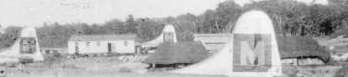
2/Lt D. Landau, 1/Lt
R Heinze & Capt _____
Ordinance Ordnance building
and tents.
I
piled some shackles in the jeep and took them to the Ordinance tent and
encountered three officers; two 1/Lts and a Capt, I’d never seen before sitting
in the tent door way. I unloaded the
shackles at their feet saying, “ Keough said he wanted these picked up.” They said, “we don’t take orders from
Keough.” Pause – I said, “well I do
take orders from Keough, and by the way I agree with him, they are in the way
and subject to damage.” As I started
the Jeep to leave they called out,
“your as much of an SOB as Keough.”
I understood why Keough sent me -- he’d been doing battle with
ordinance for some time.
Ordinance
needs an incentive I recalled when M-6 was given a full power
check it would almost blow the Ordinance tent away. I went to crew chief Johnson and told him “our problem” and asked
him to aim M-6 a bit more toward the Ordinance tent and give it a full power
test – to almost but not quite blow their tent away. Johnson smiled and did that.
When I arrived with the next batch of shackles I dumped them at their
feet again, smiled and said, “gentlemen this has a simple solution: you pick up
your shackles and we will take care to not blow your tent away.” I sustained a grin while looking them in the
eye. I watched their scowls give way to
grins as the better option. In fact we
became good friends, probably because of that.
I never spoke to Keough about this, but know Johnson told him why the
shackles were being picked up.
Fuel Tank -- Flak Damage
I helped replace a wing fuel tank
damaged by flak, such maintenance was time consuming and difficult, we were not
equipped to handle such things. Wing jacks had to be placed to lift-twist the
wing so the phillips head screws could be removed to get the tank out. The tanks were large, heavy and awkward to
handle. The reverse process of
installing the tank was more difficult. It was difficult to align hole through
skin and doublers to match screw hole in the structure. Wing jacks were used to distort the wings in
order to align plates and doublers with the screw holes. There were many, many
closely spaced screws, designed for a very tight fit as they were under high
stress as wings flexed in flight. I was
called upon to help by those whose arms and wrists had just given out. I soon
understood their difficulty. We used drift pins to align and jacks under the
screw driver to keep it engaged. The torque required was considerable placing
excessive strain on the wrist. My wrist was sore for some two months after
three hours helping fellows finish. B-29 operations would have been greatly
impaired if enemy flak had repeatedly punctured fuel tanks. Fortunately it
was seldom.
Momentary Duty Fuel Valve in Leading edge
Some Boeing engineer chose to use a
momentary duty coil to latch a fuel transfer valve under the leading edge. Some flight crew members didn't know it was
designed for momentary use. For
inexplicable reasons they would hold the switch on and burn out the solenoid
coil making it necessary to remove and replace the leading edge of the wing to
get at it. We cussed the Boeing design and the crew member for sleeping on the
switch. The only access was to remove
the leading edge between engine nacelles.
Electrical to Pneumatic Bomb bay Doors
Early model B-29's had electrically operated doors and newer planes had pneumatically operated doors. M-3 and M-11 used the old kind. At start up a planes created a calliope of sounds, the air compressor for operating the bomb bay doors was a new one. The electric doors were slow. An electric motor turned a long threaded shaft that had a high gear ratio to overcome the aerodynamic loads on the large doors. Some planes had experienced sever structural loads, pulling G's to evade search lights or when caught in thermals from massive incendiary bomb raids. One of the planes had been so badly bent that when loaded with bombs a motor was burned out just closing the doors. This was replaced before take off and another given to the Bombardier as a spare. I was present just before take off when Keough and the crew chief were showing the Bombardier how to change the motor in flight if necessary. It was to be used for closing the doors if the new motor just installed failed after opening the door. This was a new crew and not happy about the procedure. The Bombardier complained to Keough, "this damn thing is warped!" Keough responded, "You’d be warped too if you had as many missions." Sometimes Keough had a short fuse. I’m sure Operations had told Keough to keep that plane flying rather than pull it for modification.
If
a crew aborted a mission Operations would call Keough to find out if there had
indeed been a problem, they knew they'd get a straight and honest answer. One returned claiming an engine was
emitting smoke, the ground crew could find nothing wrong. A check revealed the "smoke" had
been a vapor trail and the crew sent back in the air again – Operations was
demanding.
Keough becomes 19th
Bomb Group Engineering Officer
Landau becomes 28th
Sqd Engineering Officer
I had been there about three weeks
when Keough was abruptly moved up to Group Engineering Officer, the Capt became
Major. Major Keough turned “his” 28th
squadron over to 2/Lt Landau. I was
taken by surprise because in doing this several more experienced 1st Lt's were
by bypassed, the table of organization called for a Captain and they would have
advanced a grade. I didn’t have enough
time in grade so remained a 2nd Lt. I
pondered this. I recalled him having
private conversations with the crew chiefs before I was told, but I had a
feeling solving his running battle with Ordnance had something to do with
it. Thankfully I received wonderful
support from everyone. Now many tasks
handled by Keough became my responsibility, again I had to adapt and learn
fast, which was only possible with the help of top notch Flight Line personnel. They solved most of the problems; each day I
learned more.
Keough
was advanced because the prior 19th BG EO was sent to Okinawa to
help set up operations there. A later
Keough told me I was to be the Engineering Officer of a new 4th Squadron to be
added to the Group. I doubt if those doing the planning had any idea there was
an Atomic Bomb.
Answer to the valve heating puzzle
The
answer came when standing in front of a B-29 being run up for engine change
ground test, prior to flight test. I
noticed how the propeller lifted water up, swirling it like mist through the
front cooling air annulus – my gosh, that was it! Cooling air did not flow back over the engine, it swirled at an
angle, behind the propeller governor.
This was why the cylinders down stream at an angle from the Prop
governor were the ones deprived of adequate cooling air. Why hadn’t I taken
note of that before -- why hadn’t others?
A solution use Oil as Coolant
Each
engine had a 60 gal oil tank with cooled engine oil, one pump fed oil to the
engine and two “sump” pumps carried it back to the tank. There was plenty of liquid coolant on
hand. We could use the front sump pump
to pump cooling oil to the over heated valve region, the oil could flow back,
as always, through the push rod housing.
We could carry cooling oil up from the front of the engine, behind push
rods, and not cause extra drag, and feed it through holes in mounting studs to
inside the rocker arm covers.
Modification kits could be made and installed at engine build up. Thus cooled, these engines should last as
long as R-2800 used on P-47’s and B-26’s ,with 2000 hours rated service. I sketched a design on how to do this and
gathered parts to modify an engine – then the war ended – after which nobody
gave a damn about improving engine life.
Had the engines been so modified we could have flown missions every
other day rather than every third day interval -- if bombs and fuel were
supplied fast enough.
How did problem fall through crack?
Engines
were designed, manufactured and qualification tested in the time honored way,
and passed qualification tests with flying colors. Boeing fine tuned the engine installation after Eddie Allen, the
Chief engineer and test pilot, was killed due to an engine failure and fire – a
failed engine was not a Boeing problem.
Flight testing, normally done by Boeing, was taken over by the military
and a senior pilot with combat experience put in charge. Though the engine failures screamed for
attention, the Col in charge officially wrote them off as “due to hot Kansas
summers”
If
qualified engineers had been assigned to fix the problem it could
have been done in the early test phase.
The right people were not in the right place at the right time. The US was in very short supply of trained
engineers. The one in charge would need
to insist that the problem be fixed and not patched. Without a failed sampling to draw from, as I had, a qualified
engineer would needed to instrument tests to map temperatures – when running
the engine inside an engine nacelle.
That would be easy ten years later using transistor technology. At the
time it was very difficult. It would be
necessary to run thermocouple wire from each test point to special ammeter –
which could be done on the ground. This
would have shown that the top cylinder was not the hottest. A quick fix would be to put the thermocouple
on the hottest cylinder, so the flight engineer got a true reading of engine
status. Once a thermal map was known
there would be multiple options on how to how to cool the cylinders.
The
damage took place during take off, continued use did not clear damage done,
damage accumulated. Maj Chandler,
typical of flight crews, was unaware of the magnitude of the engine change
problem. His rough running engines were
always replaced before his next mission.
All knew engine problem were common, but often accepted such problems a
part of flying combat. Operations could
always continue by replacing engines.
Blissfully flight crews didn’t know – particularly those taking off from
Tinian and Saipan, who didn’t have a 600 foot cliff to drop from and let
engines cool. 122 hp of heat was
applied to each exhaust valve from the moment of applied full power at a
standing start with nil cooling air flow, till lift off and cruising speed air
flow two minute later. There was no
cooling problem cruising at altitude.
Hot KS summers had little to do with it.
The engines had lasted long enough to win the war and all thoughts shifted to going home. These engines become scrap replace by new engines using secondary injection.