H-KOREA\CD-KP28.DOC
28th Bomb Squadron
3 June 1951
CERTIFICATE
I, Donald M. Covic, Captain, USAF,
A)-715947, Aircraft assigned to the 28th Bomb Squadron, 19th Bomb Group Medium
APO 239-1, hereby certify the following information to be true and correct to the
best of my knowledge:
On
31 May 1951, flying with my complete
crew for the first time, I took off on a daylight mission to northwest Korea in
B-29 #1562. We arrived at the assembly point and got into formation as #2 wing
man in a two ship formation. From the
assembly point we proceeded to the fighter rendezvous and pick up a four ship
F-86 fighter escort.
Just
as we left the initial point on the bomb run to the target, we were attacked by
approximately twenty MIG-15 type jet fighters.
In the ensuing battle the tail gunner, Sgt. Allen Goff, and the CFC
gunner, S/Sgt. Michael Martocchia, shot
down one of the enemy MIG-15 fighters and damaged another. The kill was confirmed by Lt. David Self.
co-pilot, and Lt. William Hammond, bombardier, Lt. Self was able to get a
picture of the pilot as he bailed out of the MIG-15 and floated down and to the
rear of our right wing. The forward
bomb door failed to open so I pulled the emergency release handle to my left
while on the bomb run and it then opened.
Our aircraft, B-29 #1562, was hit by
a canon shell from the MIG-15 fighters just aft of #2 engine. A hole about two feet square was later found
as a result of the cannon exploding in the wing section. Lt Hammond, bombardier,
was able to drop his bombs exactly with the lead air-craft while the attack was
in progress and the target was hit. The
enemy fighters continued their attack until the turnoff the target was
accomplished despite the fact that our F-86 escort had engaged them.
Due to the fact that gas was flowing
from # 2 engine nacelles as a result of the hit, #2 engine was feathered
immediately after the turn off the target was completed. The fuel from # 2 engine nacelle was
transferred to the other tanks. It was
then discovered that the flux gate compass had been shot out and after a
further survey of the battle damage, numerous holes were seen to be present all
along the upper and lower portions of the left wing from a position just
inboard of #1 engine all the way to the fuselage. The landing gear was lowered at this time to ascertain if it was
operating properly.
T/Sgt Ayers, flight engineer, after assaying the damage to our
aircraft, quickly computed the gas consumption for the three remaining engines
and advised me that we had enough fuel to proceed to our home base in Okinawa
with approximately 2 ½ hours reserve.
At this time the radio operator, Sgt Stanley Smigel, secured the latest
weather forecast for our home base which was a 2000 foot ceiling and 5 miles
visibility with intermittent rain. The
decision was then made to return to home base.
Due to the expert navigation by the
navigator Lt Daniel Price and radar observer, Lt Bernard Stein, we maintained a
perfect course and arrived over our home base.
The base at this time was under the effects of frontal weather with a
200 ft ceiling and at best ¾ mile visibility with intermittent heavy rain.
While
holding over NF radio range waiting our turn for Ground Control Approach, the
VHF went out on all GCA channels. After approximately 30 minutes of extreme
anxiousness we were able to read GCA very weakly and indistinctly on Fox
channel but were unable to transmit to them. Transmissions were acknowledged by
utilizing the tone control with a “ “ or “K”. Lt Self remained on Command
position as long as possible and received all GCA transmissions and repeated
them to me to ensure that I got them.
The
landing gear was lowered on the base leg and after the turn on final the flaps
were “milked” down to 25 degrees in order to be ready for any emergency malfunctions
due to battle damage. We broke out at approximately 200 feet and in heavy rain.
The runway lights were sighted a short distance in front and below us.
Upon initial contact with the
runway, it was observed that both left main gear tires and the hydraulic system
had been shot up. We began to skid from side to side down the runway; and as I
handled the controls and #1 throttle, Lt Self, my co-pilot, utilized the
emergency brakes. T/Sgt Ayers, flight engineer, turned the emergency filler
valve open and held the emergency brake system until all of the hydraulic fluid
was exhausted. Through our ability to coordinate our efforts, we were able to
keep the aircraft on the runway until our emergency brakes also became
inoperative. At this time the aircraft started a slight turn to the left and
the nose wheel cocked full left, causing us to make a complete 270 degree turn
to the left, missing a deep ditch paralleling the runway by only a few feet.
The success of this mission was only
possible through complete teamwork and ability of my entire crew.
Donald M. Covic
Captain USAF
Aircraft Commander
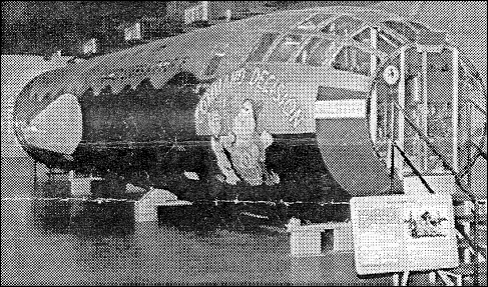
This
fuselage is painted in the markings of "Command Decision," the famous
B-29 Superfortress. During the Korean
War, gunners on the "Command Decision" shot down five Soviet-built
MG-15 jet fighters. This qualified the
aircraft for unofficial recognition as a bomber "ace."
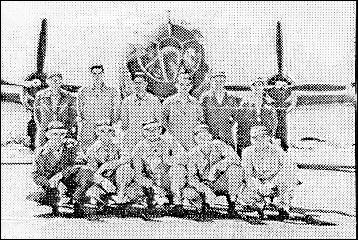
The “Command Decision” crew is shown
in this photograph.
Standing
left to right:
Technical
Sergeant Carl W. Ayers, flight engineer
Sergeant
Stanley Smigel, radio operator
*
*Staff Sergeant Michael R. Martocchia, central fire control
Sergeant
John J. Nally, left gunner
*Private
First Class Henry E. Ruch, right gunner
*Sergeant
Merle A. Goff, tail gunner
Kneeling,
left to right
Captain
Donald M. Covic, aircraft commander
Captain
David P. Self, pilot
Lieutenant
Daniel M. Price, navigator
Lieutenant
William M. Hammond, bombardier
Lieutenant
Bernard G. Stein, radar observer