HH-03-NearEastCiv
The
.Nile, the Tigris, and the Euphrates
All peoples, whether they are savage
Masai in east Africa: or sophisticated city dwellers in metropolitan New York,
have a more or less complex culture. We have already seen in Chapter 1 that the
term culture used in this sense describes the sum total, or pattern, of any
people's governmental, economic, social, religious, and intellectual
institutions, no matter whether its people are primi-
tive or
advanced. But though culture is a characteristic of all peoples, the same
cannot be said of civilization. People are civilized only when they have
succeeded in evolving an advanced and complex culture pattern which rests upon
a complicated social organization and extensive control over nature. Civilization
has been defined as "that stage of life in which there takes place the
organization of sedentary folk into towns and cities, in order that life may
become safer, more cultured, happier, and more productive of those elements
which induce what is optimistically called progress." The growth of civilization has been mainly
associated with the rise of town and city life, as the above definition
indicates. In fact the term civilization is derived from the Latin word
civilis which refers to civis, meaning
citizen. Complex social organization has developed not among nomadic peoples
but rather among dwellers in cities, where the circumstances of people living
close together and depending on one another for fulfillment of needs require
cooperation and a high degree of organization.
More specifically, civilization
necessitates the existence of a device whereby the experience and the
accomplishments of one generation can be passed on to the next. This becomes
possible to a significant degree only with the development of writing, which
enables the cultural heritage to become cumulative. There must also exist an
advanced material culture guaranteeing people some degree of physical
comfort and security from famine and want. Freed in this way from anxiety over
uncertainty of food supply, man is given the necessary leisure and tranquility
of mind to turn to artistic and intellectual achievement. Thus art,
architecture, literature, philosophy, and science are developed. While
Paleolithic and Neolithic man had been making striking advances in the
direction of civilization in western Europe, parallel progress was being made
in the Near East, near the Nile and in Mesopotamia. Our discussion, however,
has been concentrated upon the advances made in Europe, for there we have more
evidence of early man's progress than in any other area in the world. The rate
of advance of Neolithic and Paleolithic man apparently was about the same in
Europe and in the Near East until about 5000 B.C., when progress was
accelerated in the latter area and Europe was left far behind.
In Egypt, the land of the pharaohs and the
pyramids, we will see how man succeeded in creating a flourishing civilization
along the banks of the Nile: Then we will turn east, leave north Africa, cross
the great desert of Arabia to another ancient river valley, the Tigris and
Euphrates, extending north from the Persian Gulf. Here a succession of important peoples rose and fell, and each
made important contributions to civilization.
This was the home of the Sumerians, Assyrians, Babylonians, and
Persians.
A narrow band of fertile land connects this second great river
home of ancient civilizations with the coast of the western Mediterranean. The
connecting corridor, called the Fertile Crescent, played an important part in
ancient history. It was the highway for trade and for the mass migrations of
peoples. In this area such peoples as the Phoenicians, Hebrews, and Arameans
played their parts in history.
Cradles of Civilization
Advent of
civilization. It can be said that culture becomes civilization and recorded
history dawns between 1000 and 3000 BC in what is known as the Ancient Near
East. In the latter part 0£ the nineteenth century, Egypt was regarded as the
most ancient center of civilization in the Near East. But discoveries recently
made at Ur in Mesopotamia have led some scholars to regard the Tigris Euphrates river valley as the cradle of
civilization.
Other Archeologists have recently entered
a new champion for the honor of originating civilization-India. In 1924 in the
province of Punjab, a very ancient
civilization was discovered at Mohenjo-Daro in the valley of the Indus River.
This civilization was at its height when Cheops in Egypt was building his first
pyramid. Presenting evidence of highly developed city li£e and bronze culture,
perhaps Mohenjo-Daro is the oldest civilization yet discovered. When the spade
of the archaeologist has turned up India's soil as thoroughly as it has the
soil of Egypt, it may uncover civilizations much older than those which once flourished
along the Nile. It is also a common belie£ that the oldest civilization
originate in China. No one however,
knows how old Chinese civilization is, and as yet archaeological investigation
in that country is only in its infancy. According to our present knowledge, it
would seem that Chinese civilization originated nearly two thousand years later
than civilization in the Near East.
While at present
the weight of evidence gives the palm to Egypt and Mesopotamia as the cradles
of civilization, it must be admitted there is no certainty in the award.

Early
civilization a river product. In the origin of civilization geography
played an important part. All early known civilizations – Egypt, Mesopotamia,
India, and China – began in river valleys This was no historical accident,
especially in Egypt and Mesopotamia. The great rivers annually overflowed their
banks, depositing a film of rich alluvial soil on the floors of their valleys.
In regions where rainfall was sparse, great pools were created in order to
provide irrigation facilities. The well-watered soil produced abundant
harvests. These in turn made possible a large increase in the population, and
small cities and villages arose. Artificial irrigation of crops with the
accompanying construction of dams and canals necessitated group effort and
cooperation among the people. Everybody was required to help build the dikes
and keep open the canals. Furthermore, dependence upon a wide network of
interrelated canals demanded that all people within the area they served accept
certain rules concerning the repair and defense of the works and the use of the
water. Of necessity there developed a government whose word was law for the
entire area served by the canals.
The rich surplus
of crops encouraged trade and commerce. The profession of merchant was born,
and caravans and merchant vessels began to carry wares from one area to
another. Contact between peoples led to
the exchange of ideas and inventions from one to another. Culture diffusion,
already discussed in our first chapter, became more and more an instrument of
progress. We can understand, then, the importance of rivers in the growth of
civilization.
Water has always
exerted an important influence upon human affairs. Scholars sometimes refer to
it in dividing civilization into three great epochs: (1) the fluvial centered
along the banks of rivers and in fertile river valleys, (2) the thalassic
focused in great inland seas such as the Mediterranean and (3) the oceanic, in
which man utilizes the great oceanic stretches of water as bonds of contact
making the world one unit. Until the time of Greece, civilization can be
regarded as essentially fluvial. European civilization then became thalassic,
centering in the Mediterranean, and remained so until the fifteenth century.
Finally, with the age of exploration and the voyages of Columbus and his
successors, civilization became oceanic.
Civilization Dawns along the Nile
Egyptian culture and
history. The life span of ancient Egypt extended from about 5000 B.C. to
525 B.C. During that period the Egyptian pattern of life evolved from a rather
primitive Neolithic culture to a flourishing civilization in which pharaohs
ruled with absolute sway, agriculture and commerce throve, a noble art
flourished, and mighty temples and monuments were constructed. Then decay set
in, and the once proud land of the pharaohs passed under the rule of the
Persians in 525 B.C. For more than two thousand years a succession of alien
peoples-Romans, Greeks, Arabs, and Turks-ruled over Egypt. The most recent
foreign rule was that of the British, whose direct control ended only in 1937.
The dates of
Egyptian history have not been definitely established, but the following
chronology is roughly accurate. Egyptian history before 3400 B.C. is called the
Pre-Dynastic period. The era after 3400, when the land was ruled by one
pharaoh, is known as the Dynastic period, The latter includes three periods of
greatness and two interludes of retrogression: the Old Kingdom (3400-2475
B.C.), followed by the transitional Feudal Age (2475-2160 B.C.); the Middle
Kingdom (2160-1780 B.C.), ended by the HyksoS domination (1780-1580 B.C); and
the Empire (1580-525 B.C.).
Pre-Dynastic
Egypt. Egypt passed from stone to copper culture in the Pre-Dynastic
period. Artifacts have been discovered in tombs which go back as far as 15,000
B.C. These remains show that the early Egyptians passed through the main
divisions of the Old and New Stone ages. Progress was apparently rapid, and
soon the people lived in crude houses, had weapons of flint and copper, and
engaged in agriculture. Examination of grain and husks found in the stomachs of
corpses in ancient tombs has shown that as early as 10,000 B.C. the Egyptians
had developed superior strains of barley seed which could be easily cultivated
and which produced heavy yields. The early Egyptians, whose race has not yet
been conclusively ascertained, wore linen garments and were especially
remarkable for their artistic skill, particularly in pottery. Their polished
red and black ware was never surpassed by their descendants, even in the
periods of highest Egyptian accomplishment.
During the long
Pre-Dynastic period, largely because of the necessity £or cooperation in
building canals and irrigation works, the small political units gradually
merged into larger ones, until finally two kingdoms, Upper Egypt in the south
and Lower Egypt in the north, were created, These date back perhaps to about
5000 B.C. and were probably the earliest nations. The process of national
unification was further advanced in the forty-third century B.C. by the union
of these two kingdoms under the leadership of the king of Lower Egypt. With its
center at Heliopolis, Egypt's first capital, the union endured £or about eight
hundred years. Several noteworthy accomplishments were made during the period
of union. The introduction of the plow increased the acreage it was possible
for a man to cultivate, and the first national irrigation system was evolved.
Progress was made in writing and in the invention of papyrus and ink. Another
important achievement was the creation of the first calendar, which, it has
been claimed, goes back as far as 4241 B,C. If true, the date £or the beginning
of the Egyptian calendar is the oldest in history.
The Dynastic
period. The first union of Egypt was not permanent, and for a time each kingdom
led a separate existence. About 3400 a strong leader arose in Upper Egypt. According to tradition King Menes effected
the second unification of the two kingdoms and established a new capital at
Memphis at the head of the Nile delta. After Menes a long succession of ruling
houses, or dynasties, controlled the affairs of Egypt. The second union of
Egypt marks, therefore, the beginning of the Dynastic period and the advent of
the Old Kingdom, which can be regarded as the first great epoch in Egyptian
civilization.
The Old Kingdom. During the period of the Old Kingdom the Age of
Metals was definitely inaugurated in Egypt. Mining expeditions were sent to the
nearby peninsula of Sinai to obtain copper. Trade was also developed. Boats
were sent to the coast of Syria to obtain timber which was needed in Egypt for
the construction of boats, houses, and furniture. Important advances were also
made in industry, £or papyrus-making was begun, the potter's wheel perfected,
glass manufactured, and beautiful Jewelry made by expert craftsmen.
One indication of
the advance in civilization during the period of the Old Kingdom is its
pyramids. The first of these gigantic monuments was constructed by the
architect Imhotep for a pharaoh of the
Third Dynasty. The tomb, which is the
oldest existing building of stone masonry in the world, was a terraced,
structure, with each successive layer smaller than the previous one. Today it
is known as the Step Pyramid.
Of the six
dynasties of the Old Kingdom, the fourth was the most powerful and prosperous,
and consequently its pyramids were the most impressive. The largest of them,
the tomb of Pharaoh Khufu, also known as Cheops, required the labor of 100,000
men for twenty years. The building of these great tomb fortresses, designed to
protect the dead pharaoh's body so that, as the representative of his race, he
might become immortal, required a knowledge of geometry, knowledge of the principle of the inclined plane, and the
use of bronze saws to cut the great stone blocks.
Egypt’s Middle Kingdom and Empire
The Feudal Age.
During the rule of the Sixth Dynasty of pharaohs of the Old Kingdom, strong
centralized government was undermined by the rise of independent and ambitious provincial
governors. Upon the death of Pepi II, who had reportedly ruled for ninety-four
years, civil war broke out and the power of the pharaohs collapsed. For three
hundred years petty governors struggled among themselves for power, while the
lot of the common people became almost unbearable because of famine, oppression
by petty tyrants, and destruction caused by fighting. The period which saw the
destruction of the Old Kingdom is known as the Feudal Age (2475-2160 B.C.) and
marks the transition from the Old Kingdom to Egypt's second great epoch of
civilization, the Middle Kingdom.
Progress in civilization practically ceased.
It may be helpful
to remember that the period of confusion is called feudal largely because there
was an absence of centralized authority. In world history there are many
instances of feudal ages, all characterized, more or less, by the existence of
powerful local lords, usually possessing extensive tracts of land on which
lived large numbers of fighting men ready to do the lord's bidding. In such a
system it was every man for himself; might made right. Traces of feudalism
still linger today. In England there is still an important landed aristocracy
whose lands .and titles go back to the English feudal age of more than five
hundred years ago. Japan emerged from a feudal age only about eighty years ago.
We shall see later in this book that the most famous feudal age of all time
existed in Europe during the Middle Ages and reached its height in the twelfth
century.
The Middle
Kingdom. After three hundred years of disunity, the princes of Thebes, a
city on the upper Nile, succeeded in reestablishing national unity under one
pharaoh. They were the rulers of the famous Twelfth Dynasty, the most important
of whom were Sesostris III and Amenemhet III. Under the capable guidance of the
new line of pharaohs, strong monarchy, law and order, and economic prosperity
were restored, and progress in civilization was resumed. The Twelfth Dynasty
ruled for about two centuries. The period of its rule with that of its
predecessor, the Eleventh Dynasty, constitutes what is known as the Middle
Kingdom in Egyptian history (2160-1780 B.C.). If the Old Kingdom is famous for
its pyramids, the Middle Kingdom is especially noted for its literature. In
fact it excelled in all the arts, and with the probable exception of
architecture, its artistic accomplishments were never surpassed in any other
period of Egyptian history.
The Hyksos invasion. The
history of the Old Kingdom, however, was recapitulated in that of its
successor, the Middle Kingdom, for a period of progress and prosperity was
succeeded by political decentralization and civil war. Following the demise of
the Twelfth Dynasty, the Nile valley was fragmented into petty states, all
warring on each other. Internal disunity was the occasion for foreign invasion.
About 1780 B.C. an Asiatic people whom the Egyptians called Hyksos, possessing
a superior army equipped with horses and chariots, swept down on Egypt,
thoroughly conquered the region of the delta, and gradually extended their
power over most of Upper Egypt. For two
centuries, until 1580 B.C., these aliens lorded it over the Egyptians, treating
them with terrible cruelty and taking much wealth from the Nile valley. Under
such circumstances the Egyptians, who heretofore had been a peace-loving
people, became imbued with strong nationalistic feeling and hatred of their
oppressors. On all sides nationalistic rebellion broke out against the hated
Hyksos, who had settled down and adopted Egyptian customs, even to the title of
pharaoh.
The Empire
period. The struggle against the foreign Hyksos was bitter, but finally a
complete victory was achieved at Thebes by the princes of the south, who drove
out the alien dynasty. Aahmes 0£ Thebes was the liberator and great national
hero who gained independence £or his people. His reign (1580-1557 B.C.) marks
the beginning of the third and last magnificent period in ancient Egyptian
history, that of the Empire. The rulers of Egypt believed that to make their
country secure from Joreign invasion it was essential for them to control
Palestine, Syria, and Phoenicia. In addition it was imperative for the pharaohs
to maintain a fleet which could control the waters of the eastern
Mediterranean. In order to protect themselves, the Egyptians therefore embarked
on a policy of imperialism, its object being to control the routes utilized by
the invaders.

The new
dynasty,.the Eighteenth, founded by Aahmes, successfully carried out the policy
of conquering strategic areas adjacent to Egypt. The greatest pharaoh of the
period was Thutmosis III (1479-1447 B.C.) who is often called the Napoleon of
Egypt. As a result of numerous campaigns, Thutmosis conquered Syria, Phoenicia,
and Palestine, and even far off
Babylonia sent him gifts out of respect for his power. The relationships
between Egypt and these areas become clear later in the chapter. There is good
reason to believe that Thutmosis also brought Nubia under his sway and
compelled Cyprus and the cities of Crete to become his allies.
During Egypt's
greatest glory under the pharaohs of the Eighteenth Dynasty, her civilization
and political power reached their zenith. Law and order again prevailed along
the valley of the Nile, trade flourished, and vast wealth in the form of
tribute or booty flowed into Egypt as a result of military conquest. Thebes,
the imperial capital of the pharaohs, became the most magnificent and richest
city in the world. Great temples, beautiful gardens, and imposing mansions for
the nobility made Thebes the most beautiful capital of its day.
Under Amenhotep
III (1411-1375 B.C.) the empire reached its height. However, in his reign signs
of decline were apparent. Religious controversy and pressure from without on
the part of aggressive enemies resulted in the loss of most of the territories
outside of Egypt. To the period of decline, in the last days of the Eighteenth
Dynasty, belongs the weak emperor Tutankhamen, who has received an undeserved immortality and fame
resulting from the discovery in 1922 of his remarkable tomb.
Ramses II
(1198-1167 B.C.) of the Nineteenth Dynasty, pharaoh of Hebrew oppression, tried
to restore the glory of the empire and had partial success. Egyptian power was
reestablished in southern Syria and Palestine, great monuments were erected
along the Nile, and the empire superficially seemed prosperous and secure, It
was Egypt's last demonstration of national greatness. The land of the pharaohs
ceased to be a power in international affairs and became the puppet of a long
line of conquerors from Cambyses, the Persian emperor in the sixth century
B.C., to Lord Cromer, the British ruler of Egypt in the late nineteenth
century.
Allover the Near East new peoples were
rising to power (see page 55 ff.). The Hittite empire to the northeast was
pressing hard, a coalition of Indo-European peoples from the north and west was
invading Asia Minor, the Arameans were building up their domination of the
trade routes in the Near East, the Hebrews were establishing themselves in
Palestine, the Philistines had also created a powerful state in southern
Palestine. and the Dorian Greeks had overwhelmed Aegean civilization in the
Greek peninsula and in the islands of the Aegean Sea. This new alignment of
unfriendly peoples spelled the end of Egyptian influence outside her own
borders. Especially in Syria. The great emperor Ramses III (1198-1167) for a
time staved off the collapse of the empire which had been created by the
pharaohs of the Eighteenth Dynasty, but after his death the empire never
regained its former brilliance.
Foreign
domination. From 1100 to 671 B.C. Egypt was ruled by alien African kings
who tried to re-create Egypt's past glories. Their feeble rule was displaced by
the jarring shock of Assyrian invasion and overlord-ship from 670 to 662 B.C.
During the Assyrian occupation much 0£ Egyptian wealth was confiscated by the
invaders. After the £all of the Assyrian empire. national Egyptian independence
was restored £or a time, but in 525 B.C. Cambyses, the Persian emperor, again
conquered the valley of the Nile. After a cycle of national life which had been
initiated with the union of Upper and Lower Egypt in 3400 B.C. and which had
endured £or almost three thousand years, Egyptian political independence
disappeared until the twentieth century.
But although Egypt had lost her political independence and her relative
importance declined, it would be unwise to speak of her "fall." Egypt
on several later occasions reached an impressive level 0£ civilization in the
hands of her conquerors, who shaped her people and institutions to suit their
needs. We shall see that the famous world-conqueror Alexander the Great brought
Egypt into contact with Greek thought and that his successors, the Ptolemies,
made the city of Alexandria in Egypt the most outstanding center of scientific
speculation in the world. Following the collapse of Greece and Rome, Egypt came
under the rule of the Moslems, who created a flourishing Mohammedan
civilization, centered at Cairo.
Life in Egypt,
for the common man at least, went on in much the same fashion after the
collapse of the pharaohs. The old distinctive Egyptian culture, especially the
religion, persisted until the coming of the Romans. With the Roman legions eventually
came a new religion, Christianity, which took root along the Nile and
flourished until the seventh century A.D., when the Moslems overran the
country. The Egyptian language had earlier given way to the Greek, and with the
coming of the Moslems, Arabic became the official language. Following the
Mohammedan conquest, the Egyptian began to think of himself as an Arab. He
forgot most of his ancient traditions, accepted the Mohammedan religion, and
participated in the art and literature of the Moslem east. Only among the lowly
peasants did there lurk vestigial remnants of the glorious past. The village
peasant, the fellah, retained many of the old ways and ancient traditions in
his folklore, in quaint village customs, and in the veneration of the local deities.
It is said that in the nineteenth century, when the first mummies of the
long-buried pharaohs were transported down the Nile, the village women lined
the river's banks and reverted to the ancient custom of wailing for their dead
god and king.
Evolution of the
territorial state. Ancient Egypt (as well as other
contemporary civilizations in Mesopotamia, as we shall see) made one
significant stride in government. This was the evolution from a primitive
social system, consisting of miniature and multitudinous rival kinship groups,
to a great state, encompassing all people in a given area regardless of kinship
ties and exacting from all obedience and loyalty to one central government and
its ruler.. In short, many clans were merged to constitute one nation. Egyptian
villages, consisting of related families, were gradually united into
territorial units called nomes, and finally these became united into one single
kingdom. The development of the territorial state was the major contribution of
Egypt and the other oriental countries to the political evolution of civilized
man.
Egyptian government.
The governmental system of the territorial state, as it finally evolved in
Egypt during the Old Kingdom, was an extreme absolutism. All power resided in
the ruler, who was called Pharaoh, meaning Great House. The powers exercised by
modern totalitarian rulers look almost meager when compared with those of the
ancient Egyptian despot. The pharaohs owned all the land; they decided when the
crops should be sown, controlled the irrigation system; and exacted a share of
the crops produced by the semi-servile laborers who toiled on the huge royal
estates. With none to question his powers, which the Egyptians believed were
sanctified by the gods, in regal splendor, surrounded by elaborate court
etiquette, the pharaoh dictated every aspect of the life of his subjects.
Egyptian government was theocratic, that is, the pharaoh combined both
religious and political functions. He was both an earthly king and a god, the
chief priest of the land and the spiritual symbol of the nation in all its
important religious rites.
It is interesting
to note that the ancient Egyptians had succeeded as early as the time of the
Old Kingdom in creating a complex and efficient administrative system which
alone made possible the centralized absolutism of the pharaoh. Directly
responsible for the management of the state were three officials: a chief
treasurer and two prime ministers called viziers. These officials presided over
an army of subordinates made up of overseers, scribes, and policemen. The
subordinates had no power of initiative and no choice but to carry out
unquestioningly the orders which emanated from the palace of the pharaoh. By
this time there evidently existed a law code. Scholars believe that it filled
forty rolls of papyrus, but unfortunately no copies are now in existence. We
have every reason to believe, however, that the people looked to their
government for justice, as ancient papyri tell us that the vizier was a judge
"judging justly, not showing partiality," and "not preferring
the great above the humble."
Under the
government of the pharaoh the people were at the mercy of their ruler. There
was nothing approaching self-government; that was to be the great achievement
of the Greeks. The Egyptian government, however, was paternal. Most pharaohs
evidently endeavored to protect their subjects and advance their prosperity. An
interesting papyrus roll from the time of the empire gives us the words of a
pharaoh installing his vizier:
"Look to the
office of the Vizier; be watchful over all that is done therein. Behold, it is
the established support of the whole land. ...The Vizierate is not sweet; it is
bitter. ...Behold it is not to show respect-of-persons to princes and
councillors; it is not to make £or himself slaves of any people. ... Behold
when a petitioner comes from Upper or Lower Egypt. ..see thou to it that
everything is done in accordance with law, that everything is done according to
the custom thereof, [giving] to [every man] his right."
Life and Work in Ancient Egypt
Home and social life.
In the days of the Empire, Egypt proper, not including the subject peoples in
Syria, had a population of about seven million. The great bulk of the people
were semi-slaves who lived in squalid villages made up of little mud and thatch
houses in which the only furniture was a few crude jars, boxes, and a stool.
These people lived in constant dread of the royal tax collector. They were
subject to forced labor work on the roads or tilling the royal fields, or
worse, hauling huge stones for the pyramids. The- merchants and skilled
craftsmen of the middle class had more comfortable and pretentious dwellings,
and those of the nobility were palatial. Here furniture and draperies were
luxurious, while extensive and beautiful gardens surrounded the house.
“This was the noble's paradise; here he
spent his leisure hours with his family and friends, playing at draughts
[checkers ], listening to the music of harp, pipe and lute, watching his women
in the slow and stately dance of the time, while his children sported about
among the trees, splashed in the pool, or played with ball, doll or
jumping-jack."

Duck hunting for this Egyptian is a matter of decoying the ducks
from his papyrus boat and hitting them with his boomerang, while his wife and
daughters gather lotus blossoms. T o the right of the papyrus hedge the same
man spears fish, steadied by his wife and daughter. The grown-ups wear thin,
cool clothes, while the youngest wears none at all.
During the
passing of more than two thousand years since the Pre-Dynastic period of
primitive Egypt, substantial changes had taken place in the social grouping of
the people. Among primitive people all individuals are, in general, members of the same social and economic class. There
may be a small ruling clique, and at the bottom captured enemies may form a
slave class, but the great bulk of people perform the same economic tasks, live
in similar houses, and possess about the same worldly goods. But with civilization
come gradations in society. Some men remain laborers, others become skilled
artisans, and others become wealthy merchant princes. In Egypt, as elsewhere,
the growth of population, the tendency toward specialized vocations, and the
increase of wealth soon resulted in the creation of distinct classes in
society. Three main social divisions can be distinguished: (1) the court
nobility, royalty, "priests, and the landed aristocracy, (2) the middle
class, composed of merchants and craftsmen, (3) the bulk of the population, who
were servile laborers. Although such grouping existed in Egyptian society, it
was not rigid. People of merit could elevate themselves into higher social
ranks.
The clothing of
the Egyptians was always sparse, as one would expect in a warm climate. At
first a loin cloth sufficed, even for the upper classes, while the poorest
often went naked. With the growth of wealth, however, which came during the
Empire, clothes became more luxurious and less scanty. Both sexes liked to
adorn themselves with rings, chains, and earrings, and the women used
cosmetics.

An Egyptian princess is having her hair set in tight curls. In one
hand she holds a mirror, in the other a beverage. A servant is fixing her
another .
Most men were
content with one wife, though the richest nobles enjoyed the luxury of a harem.
Family life, on the whole, seems to have been wholesome. Infanticide-out-right
killing of unwanted children-was not practiced. Divorce was infrequent, and
only when adultery was proved could a husband avoid giving his wife a share of
his property.
The status of the
Egyptian woman was exceptionally favorable. She was in every respect the equal
of man. In fact many aspects of society were dominated by women. Sons inherited
property through their mothers, and once a woman actually ruled as queen of the
land. Even in courtship women often took the initiative. Many love poems coming
down to us were written by women. The following is a good example of one
of these love poems:
I am thy first sister,
And thou art to me as the garden
Which I have planted with flowers
And all sweet-smelling herbs.
I directed a canal into it,
That thou slightest dip thy hand into it
When the north wind blows cool
.
. . . . . . .
It is intoxicating to me to hear thy voice,
And my life depends upon hearing thee.
Whenever I see thee
It is better to me than food or drink.
Economic life.
Throughout Egyptian history agriculture has remained the basic economic
activity. The centralized system of irrigation made possible enormous crops of
wheat and barley; extensive vineyards, vegetable gardens, and herds of cattle
were also maintained. Every year in
July the Nile overflowed, and by November the soil was dry enough to permit
cultivation. The ground was first broken with crude plows, and then cattle were
used to tramp in the seed.
Industry began in
the early days of the Old Kingdom and developed rapidly. Extensive copper
mining was carried on in the Sinai peninsula, stone quarrying became highly
organized to meet the demands of pyramid building, and huge quantities of
sun-dried bricks were made. Cabinetmakers fashioned handsome furniture out of
the famous cedars of Lebanon. Tanning became a specialized craft, the process
of fusing copper and tin to make bronze became known, glass blowing and
enameling were developed by skilled artisans, and weavers were highly
proficient. Egyptian craftsmen
exhibited a degree of technical efficiency that was seldom surpassed in western
Europe until the Industrial Revolution. During the period of the Empire the
products of the craftsmen were exceptionally fine. Beautifully glazed jars,
delicate stone dishes, and exquisite brooches attest his skill.
During the Old
Kingdom much commerce plied up and down the Nile, expeditions were sent
southwest to the interior for ebony and ivory, and the pharaohs sent ships down
the Red Sea. The Egyptians can claim to have developed the first sea-going
ships for use on the Mediterranean. As early as 2750 B.C. Egyptian ships were
sailing the eastern Mediterranean bound for Phoenicia, and by 2000 B.C.
extensive trade relations existed with Crete.
Egyptian commerce never developed so extensively as that of Syria and
Mesopotamia; it was not until the invasion of the Hyksos that it became very
important. Apparently the Hyksos were great traders, and their contact with the
Egyptians was a strong stimulus to commerce. Trade reached its height during
the Empire, when Egypt controlled the trade routes of the Near East.
Empire commerce
was conducted along four main routes: (1) To expedite merchant voyages; a canal
was constructed .which connected the Red Sea with the eastern part of the
delta; (2) along the Nile numerous ships brought goods from the south; (3) a
busy caravan route maintained contact with Mesopotamia and southern Syria; and
(4) shipping from northern Syria, the mainland of Greece, Crete, and other
islands came to a focus at the delta of the Nile. The main exports were wheat,
linens, scarabs (charms), and gold wares. The most important Egyptian imports
were ostrich feathers, metal weapons, spices, tapestries, woods, gold, and
silver.
Commercial
activity spread characteristics of Egyptian culture throughout the known world.
The products of Egyptian craftsmen, for example, were used by the Cretan sea
kings, and glazed pottery and jewelry from the Nile valley have been found on
the mainland of Greece. Elements of Egyptian religion and certain basic art
forms became known to the Aegean peoples through commercial contact and were
later adopted by the Greeks. Egypt, of
course, was in turn influenced by contact with the civilizations of western
Asia.
Religion in
Egypt. Egyptians were called by the Greeks the most religious of all
men. And so they were, for religion
saturated their viewpoint and influenced every aspect of society. "The kings of Egypt were gods; its
pyramids were an 'act of faith'; its art was rooted in religious symbolism; its
literature began as religious decoration of tombs, temples, and pyramids; its
science centered in the temple; its gods were conceived to be in intimate touch
with men and alive as men; a vast part of its wealth and energy was spent in
the effort to secure the continuance of the physical life after death.
The great
obsession of all people was to 'achieve immortality for their souls. In the
days of the Old Kingdom, the lower classes felt aggrieved because they could
not have their bodies mummified after death, as the pharaoh and the rich nobles
did, nor could they obtain full funeral rites. These were serious handicaps in
securing immortality. So strong was the desire for the afterlife that the
common people agitated not for political but for religious equality. This was
obtained in the Middle Kingdom, and henceforth all people could claim full
funeral rites.
Osiris.
Their all-pervading emphasis upon immortality was largely due to the influence
of the god Osiris. He was the god of the Nile, and the rise and fall of the
river symbolized his death and resurrection, which were celebrated each year
.Then an .interesting myth developed. It was recounted that Osiris was murdered
by Seth, his evil brother, who cut the victim's body into many pieces and
scattered them over the land. Isis, the bereaved widow, collected all the
remnants of the corpse. These were then put together, Osiris was resurrected,
and became immortal. Finally Horus, the son of Osiris, avenged his father
against Seth.
The Egyptians saw
in the myth a way to escape death. Osiris was the first mummy. Only by the recovery of the many parts of
his body had he achieved immortality. Every dead Egyptian, therefore, was
regarded as a second Osiris. The way to give him immortality was to preserve
the corpse. This was achieved by mummifying and placing the body in a tomb
which would give it the maximum protection; As befitted the first man of the
land, a pharaoh was given a massive tomb-fortress, a pyramid, to protect and
preserve his body until judgment day.
If the soul came to Osiris cleansed, of
sin, it would be permitted to live forever in the Happy Field of Food. At the
time of soul testing, Osiris weighed the candidate's heart against the feather
of truth. If the ordeal was not passed; a horrible creature devoured the
rejected heart. The priesthood, which exercised a very strong influence in the
Egyptian state, often to the detriment of the state, claimed that it alone knew
clever methods of surviving the soul-testing. For a consideration, charms and
rolls of papyrus containing magical prayers and formulas were sold to the
living as insurance policies guaranteeing them a happy immortality after death.
That it was a lucrative business is seen by the fact that some 2000 papyrus
rolls containing such magical formulas have been taken from ancient tombs. They
constitute collectively what is known as the Book of the Dead. Pictured below
is a scene from one of these rolls.

Osiris sits in judgment as his dog-headed creature weighs the
heart of a: princess against a feather. Isis stands behind the princess. The
scene was inscribed on papyrus and buried with the mummy of the princess.
Characteristics of
Egyptian religion. Egyptian religion for many hundreds of
years had no strong ethical character. Immortality was not regarded as a reward
for goodness while a person was alive. That idea, however, developed gradually
until eternal life was regarded as a reward merited only by those who were just
and good while alive. On the whole, while Egyptians never made any impressive
advance in closely relating daily conduct and religion, yet it seems clear that
they developed a conception of immortality and moral responsibility long before
the peoples of other early civilizations. The myth of Osiris and Seth was an
anticipation of the dualistic conception of a god of good and a god of evil
which was later given such a strong emphasis by the Persians and others.
Religion was of paramount concern to the
Egyptian people, and it was also extremely complex in character. It concerned
the worship of many gods, such as Ra, the sun deity, Osiris, the god of water,
Isis, the Great Mother, and many animal-headed gods. At first Ra was the most
important, but with the rise of Thebes in political importance a place had to
be found for its deity, Amun. The supreme god, therefore, became Amun-Ra. A
famous pharaoh and reformer in the time of the Empire, Amenhotep IV, who adopted
the name of Ikhnaton, tried unsuccessfully to supplant Amun-Ra and the
confusing multiplicity of minor gods by substituting a religion based on one
deity, a sun god called Aton. Amenhotep developed an advanced conception of one
all-prevailing and kindly god (monotheism). This was given beautiful expression
in his famous Hymn to the Sun.
Amenhotep's efforts tragically failed, and in arousing religious
factionalism among his subjects, he only weakened the Empire. Ancient Egypt
retained its polytheism to the end
Literature, Science and Learning
Evolution of writing.
One of the most important Egyptian contributions to civilization was the
development of the art of writing, especially the introduction of an
alphabet. The first step in writing was
the use of picture-like signs to represent ideas. The next advance was to use
the same signs to represent the sounds of the words expressing those ideas.
Once the signs were identified with sounds, Some were conventionalized to
represent the sounds of syllables, the stage called syllabic writing. With
syllabic signs an indefinite number of words could now be written
phonetically-with symbols representing their sounds.
About 3000 B.C. the Egyptians had reached the
point of using special characters for certain vowels and consonants. They were
actually on the verge of attaining a real alphabet. But there were too many symbols (about twenty for A, about thirty
for H, and so on). They also continued
to use their syllabic signs and ideographs (symbols £or ideas). Thus in several
thousands of years they never succeeded in developing a purely alphabetic
system of writing.
The ancient Egyptians had what we might
call the first books. Libraries have been discovered dating from 2000 B.C.,
consisting of rolls of papyrus in earthen jars. Papyrus was the forerunner of
paper. It was made by splitting the papyrus reed into strips and pasting these
strips together to make long rolls of durable writing surface, much more practical
than the heavy clay tablets used, as we shall see shortly, in Mesopotamia. Ink
was prepared by mixing vegetable gum with lamp black.
The invention of
writing represents one of the great milestones of human progress. Now man could
accumulate knowledge, record it, and pass it on to his descendants. Writing
also made possible the preservation of literature.
Literature.
We can hardly speak of a literature in the days of the Old Kingdom because none
has survived. The oldest inscriptions we have are the pyramid texts, which have
been called the oldest chapter of human thought extant. They were mainly
religious and are found on the walls of tombs and pyramids of the Fifth and
Sixth dynasties. Their purpose was to assist the deceased to obtain
immortality, and they consisted of a jumble of magical incantations, myths, and
religious hymns.
During the Middle
Kingdom, especially in the period of the Twelfth Dynasty, literature became
much richer, more varied; and more secular. Many folk tales and collections of
proverbs were now set down in writing. The period of the Twelfth Dynasty is
called the classical age of Egyptian literature. One popular story told of the
romantic adventures of a noble who wandered all over Syria but at last made his
way back to his native land. Another
story recounted the perils of a ship wrecked sailor, a narrative which is a
prototype of Sindbad the Sailor. Other narratives of importance were the Tale
of the Two Brothers, which has striking resemblances to the Biblical story of
Joseph and his brethren; the Tale of the Eloquent Peasant; and A Dialogue
between a Man Weary of Life and His Soul. The last work, poetical in form; is
philosophical in tone and demonstrates profound thought. It is one of the most
important of the Egyptian poems which have been preserved. Most of the
literature was expressed in poetical language, though much of it was in prose
form.
The most
beautiful surviving piece of Egyptian literature is Ikhnaton's Hymn to the Sun.
A few lines will suffice to give some idea of its poetic beauty and its
conception of one all powerful and beneficent Creator and Heavenly Father .
Thy dawning is beautiful in the horizon of the sky,
O living Aton, beginning of life!
When thou risest in the eastern horizon,
Thou fillest every land with thy beauty.
Thou art beautiful, great, glittering,
high
above every land,
Thy rays, they encompass the lands, even
all
that thou hast made.
How manifold are thy works!
They are hidden from before us,
O sole god, whose powers no other
possesseth.
Thou didst create the earth according to
thy heart
While thou wast alone.
The calendar.
We moderns accept our calendar as a commonplace detail of everyday life and do
not realize that it is an indispensable tool of civilized existence. Like
fire-making, knives, and pottery, the calendar had to be invented, a process
taking several thousand years. In fact,
the final step in the evolution of our present calendar took place as late as
1582 A.D. Neolithic man was the first
to realize how essential a calendar was to fix the dates of his holy days and
accurately ascertain the time for planting crops. He therefore devised a lunar
calendar of twelve months, each twenty-nine and a half days in length, giving
in all a year of 354 days. In order to harmonize his reckoning with the
seasons, it was necessary from time to time to add a thirteenth month.

The Rosetta Stone, discovered in Egypt in 1799 by an officer in
Napoleon's army, supplied the means by which Jean Champollion was able in 1822
to decipher Egyptian writing, thus founding the study known as Egyptology and
laying open a whole new field of research.
The stone is now in the British Museum, and contains a message inscribed
in three different languages, as is shown by the section reproduced here. The
lowest layer of writing is Greek, which Champollion could read. Working from
the Greek he was able to figure out the other inscriptions. The middle layer is
Egyptian demotic, or popular writing. The top layer is the more formal system
of hieroglyphic writing .
After the lunar
calendar, the next major step was the development of a calendar based on the
solar year. The Egyptians developed a system of twelve months, each of thirty
days, totaling 360 days in all, and at the end of each year they added five
days. This calendar yeas was just six hours short of the solar year, which
forged ahead of the calendar one day in every four years. It was, however,
imperative for their agriculture that the Egyptians know accurately when the
Nile was about to inundate, the land. Their need led to the discovery that when
Sothis {our Sirius) rose with the sun, it signaled the rise of the Nile. The Egyptians clung to their not quite
perfect solar year, letting it go its way but relying upon Sothis to guide
their farming. Every 1460 years a Sothic Cycle was completed. During the Sothic
Cycle there was often disparity between the time of the real seasons,
represented by the rise of the Nile, and the official calendar. Every 1460
years, however, the cycle achieved perfect agreement with the calendar, the
rise of the Nile, and the real solar year. The Egyptians realized that
something was wrong but never corrected the difficulty. It was not until Julius
Caesar added the Julian intercalary day every four years that the next major
improvement in the calendar was achieved.
Science.
In their learning the Egyptians were a practical rather than a speculative
people. Philosophy was not their forte; learning had to serve practical needs.
That was why the Egyptians-were the first people to develop a real science of
mathematics. Precise measurements were needed to build the pyramids, and the
constant obliteration of field boundaries by the inundations of the Nile
necessitated frequent land measurement. To meet these needs the Egyptians
learned to add and subtract. They also could multiply and divide by two and
three. In surveying they utilized the rudiments of geometry, and they had some
knowledge of algebraic equations. They developed, a primitive decimal system,
but it was never perfected; twenty-seven signs, for example, were needed to
write the number 999. They computed the area of a circle by giving it the value
of 3.16. Though the Egyptians laid the foundations for the science of
mathematics, they made little progress in the fields of physics, astronomy, and
chemistry.

One of
the great pyramids, tomb fortresses of the Egyptian pharaohs

The
Hypostyle Hall of the Temple of Karnak, showing Clerestrory Windows
(reconstruction)
Art
and Architecture in Ancient Egypt
Architecture.
Important as were the accomplishments of the Egyptians in government, religion,
literature, and science, they cannot compare with their gains in art and
architecture, which were the most distinctive elements in Egyptian
civilization. The Egyptians have been called the greatest builders in history.
As far back as we know them they were advanced engineers, able to build in
stone. The problems of shelter, light, and circulation {entrance and exit) had
been solved. The structure of their
society called for no houses above the merest mud huts for the common
population, and evidently the palaces were not built well enough to last. The
preoccupation with life after death meant that the kings did not spend their
energies building great palaces but concentrated on tombs to preserve their
bodies eternally. Thus the two great types of architectural expression which
have lasted and into which went the greatest effort were the tombs for the
kings and the temples for the rich, priestly class. These temples also glorified the kings, who were themselves
identified with religion.
As already noted,
the pyramids were commanded by the pharaohs of the Old Kingdom. Today after
four thousand years, many of these monuments still remain, scattered along the
Nile south from the delta for a distance of fifty miles. At Gizeh the pyramid
of Cheops, covering a base of thirteen acres, seems unbelievably huge. It was
constructed of over two million limestone blocks, each averaging about two and
a half tons, and is 481 feet high. It was built without mortar, and some of the
stones were so perfectly fitted that a knife cannot be inserted in the joint.
The pyramids are the best single expression of Egyptian civilization. In their
quiet repose, dignity, and massiveness, they reflect the religion-saturated
character of Egyptian society.
If the Old
Kingdom achieved immortality through its pyramids, the power and the glory of
the days of the Empire still live in the ruins of the pharaohs' temples at
Thebes. Booty and tribute from conquest made Thebes, with its great temples and
palaces a lavish capital city. Today little is left at Thebes except the temple
ruins of Karnak. But that little is enough to attest to the magnitude of the
Egyptian achievement in building.

Stone
block statue of the Pharaoh Khafre
The builders of
the temple at Karnak, like the early lake dwellers, employed the structural
system which was to be used almost exclusively until the Roman period-the post
and lintel construction. This system enabled the builders to span openings for
windows and doors and to roof over spaces.
The size of the window or door and the width of the roofed space were
limited, of course, by the size of the stone slabs. Post and lintel
construction demands heavy stone work and partly explains the massive
appearance of the buildings. Columns were used throughout the interiors of
buildings in order to provide supports £or roofing of larger areas. The temple
of Karnak is an expression of the mystery of the Egyptian religion, just as the
pyramids are an expression of the desire to hide the tombs for eternity. Many
temple entrances were made mysterious and forbidding by heavy walls and small
doorways, and the sanctuarywas placed at the end of a series of courts and
halls.
The temple of
Karnak contains a huge colonnaded, or hypostyle, hall, the largest ever built.
The tallest columns are seventy feet high. The two central rows of columns are
taller than the others and have a separate roof, allowing wall space above the
lower roofs of the two side aisles. This space was pierced with windows called
clerestory windows. The higher middle
aisle and the clerestory windows were later used in the Roman basilica
and the Gothic cathedral.
Sculpture.
Egyptian sculpture, like Egyptian architecture, was simple and formal. The
Egyptians' tools and their ability to use them were far superior to the
technical equipment of the Stone Age artists. In sculpture, as in architecture,
their work shows an advance in technical skill. Sculpture was used as
decoration for entrances to tombs and temples, and line carving and low relief
were used as wall decoration. The latter types of sculpture are almost
two-dimensional in themselves and are therefore particularly adapted to a
two-dimensional surface. Everyday subjects decorated the walls of the tombs,
presumably to equip the dead with all that had surrounded them in life. The
picture at the bottom of page 39 is an example of decorative line-carving
illustrating an everyday scene.
In Egypt appears
for the first time an advanced sculpture in the round. Statues which stand free
from the wall on all sides naturally have to be designed in a three-dimensional
manner, differing from reliefs, which are more nearly two-dimensional. The
sculptors of the Old Kingdom had a great feeling for simplicity and
conventionalized the bodies to conform to the blocks of stone. The seated
figure of Khafre shows the shape of the stone from ;which it is carved. In
these block statues the human figure is always shown, sitting or standing,
looking squarely in front, which produces a certain rigidity. But when it is
remembered that the statues were used in connection with a massive
architectural setting, this rigidity is highly fitting.
Many statues were
colossi, such as the Sphinx, which shows clearly that it was built up of blocks
of stone. This immense statue conveys a remarkable impression of the dignity
and power of the pharaoh. Many carved figures were religious symbols, strange
combinations of men and birds and animals. The Sphinx: has the body of a lion
and the head of Pharaoh Khafre.

Portrait of Pharaoh Ramses II
One of the most
significant developments in the Empire period was the personalization of
statuary. Sculptors were trying to get away from the abstract and symbolic,
which had dominated their work in the Old Kingdom. In so doing they became
excellent portraitists, but sculpture lost the fine architectural use of
earlier days. The figure of Ramses II is a typical piece of Egyptian realism.
Notice the greater individuality of the features as compared with the more
abstract portrait of Khafre. Ramses is a person while Khafre is more a symbol
of imperial power and dignity. Sculptors of Ikhnaton's time sometimes used
limestone, which was a softer stone than the diorite of the Khafre statue or
the quartzite of the Ramses head, and therefore allowed greater freedom for
realistic treatment. Ikhnaton and his queen Nefretete are known to us through
such true-to-life portraits.
Painting.
Painting in Egypt was used to decorate the walls of tombs and palaces and in
this use had to bow to certain restrictions in composition. The artist was
confronted with a wall space to be decorated, and he immediately encountered
certain external limitations. Examples of these are the size of the wall, the
distance from which it was to be seen, and the incorporation into the design of
architectural features such as doors and windows and columns. In Egyptian
painting many figures are grouped in a conscious design. Although the Egyptians
were interested in subject matter, it was often distorted if this distortion
would make the pattern on the wall more decorative. As in sculpture, there were two types of subject matter. The
religious, as seen in the illustration below, is symbolic and
conventionalized. It shows the
conventions used in all Egyptian painting. The most distinctive and decorative
view in silhouette of each section of the body was chosen for depiction. Thus
we see the profile of the face, the full view of the shoulders, the profile of
the rest of the body, and the full view of the eye. There was no attempt to
show objects receding in perspective, but sometimes it was shown that one
object was behind another by overlapping objects in a series, or by putting one
object above another. As painting was
used as a mural decoration, these particular conventions of perspective and
flat treatment were very successful. The ruler or god was shown as larger than
the other figures to emphasize his importance. These religious pictures with
their many symbols may seem lifeless and uninteresting, since they are hard to
understand without a complete knowledge of the meaning of the symbols. From a
purely decorative point of view, however: they can certainly be enjoyed today.
Certain colors were generally used in all these paintings rich reds and yellows
made from the earth pigments, and blank and green-blue for contrast.
 ,
,
A Theban wall painting shows the ceremonial farewell to the dead,
as the bodies are about to be laid away. The painting (about 7385-7370 BC)
decorated the tomb of two Egyptian sculptors.


Egyptian
Dancing Girls (wall painting) An Egyptian collar of beads
More appealing perhaps to our eyes are the
murals which depict everyday scenes. The painting of the dancers, although
still following the conventions, is completely human and understandable, even
in the twentieth century.
Throughout the
ancient world (Egypt, Crete, and Greece) different types of binding materials
were mixed with paint. To ensure that pigment will stay attached to a surface
it must be mixed with a material such as wax, gum, or egg. These mixtures
produce surface paintings which do not withstand all weather conditions.
Fresco, on the other hand, is permanent when properly done: The painting is
executed on wet plaster, and a chemical reaction makes it part of the wall. But
it is not definitely known that wet-plaster fresco was used before the time of
Rome.
Minor arts.
In the minor arts the Egyptians exhibited the same decorative sense. Jewelry
was made of gold, semiprecious stones, and beads. The collar below is simple
but very decorative. Egyptian gold jewelry reveals the wealth of priests and
pharaohs. The Egyptians also made beautiful glass and pottery vessels.
The Land of the Furtile Crescent
Location of the
Fertile Crescent. During the three thousand years and more when the Egyptians
were building pyramids, perfecting writing and the calendar, and developing
commerce, equally important advances in civilization were being made in an area
not far removed from the land of the pharaohs, a belt of territory now called
the Fertile Crescent. Bounding the
great Arabian desert on the north, east, and west, this narrow band of fertile
land starts at the Persian Gulf and extends to the north, skirting the desert
through Babylonia and Mesopotamia, then turns west and bows south through Syria
and Palestine along the Mediterranean to the desert of Sinai on the borders of
Egypt.
Mountains and high plateaus serve as boundaries
of the Fertile Crescent on the north and east. In this elevated region lived
restless Indo-European peoples who persistently pushed their way into the
inviting narrow crescent of fertile land. Within the arc of the crescent were
another people. desert nomads called Semites, mainly Arabs and Hebrews, who,
driven by hunger and a desire for easier living, were continually fighting
their way into the Fertile Crescent. Unlike Egypt, which was protected by the
natural barriers of desert on the east and west, the Nile's cataracts to .the
south, and the sea to the north, and hence suffered few invasions and
interruptions to the continuity of her civilization, the Fertile Crescent was
the scene of constant warfare. This
took the form of continual struggle between the Indo-European hill folk and the
Semitic desert people for control of the fertile land belt that edged the
desert. Although at times promising civilizations were cut short by the shock
of war, this was perhaps more than amply compensated for by the stimulating
effects of the culture impacts of the movements and transplantations of
peoples. Despite much warfare, therefore, the achievements in civilization made
by the inhabitants of the Fertile Crescent do not suffer in comparison with
those made along the Nile. The rise and fall of numerous nations, however, make
the history of the Fertile Crescent rather complex. In order to simplify the
story, the development of civilization in the Fertile Crescent may be divided
into the following periods:
Old Babylonia, the second cradle of
western civilization (4000-1750 B.C.)
The Age of Transition and the Era of Small
Nations (175°-7°0 B.C.)
The period of Assyrian dominance (700-600
B.C.)
New Babylonia, the empire of the Chaldeans
(600-539 B.C.)
The Persian empire (539-333 B.C,)
Old Babylonia: The Second Cradle of
Western Civilization
The
plain of Shinar. The first great civilization in the
Fertile Crescent, like that of Egypt, was fluvial. It had its origin in a rich
plain which extended about one hundred seventy miles north of the Persian Gulf
between the Tigris and Euphrates rivers. These two rivers rise in the mountains
of eastern Asia Minor and flow southeast in a roughly parallel direction. Just
less than two -hundred miles from the gulf, they ,emerge from the desert,
approach each other very closely, and flow through a flat valley of alluvial
soil that was brought down from the north and deposited by the rivers. This
plain was early called Shinar, and later it came to be known as Babylonia. Although
the term Mesopotamia was originally used to refer only to the land between the
two rivers north of Shinar, today it includes all the territory between the
rivers from Asia Minor to the Persian Gulf. Since 1918 the latter area, with
its capital at Bagdad, has been known as Iraq.
It was no
accident that civilization should appear early in the plain of Shinar. There
the soil was very rich, the summers warm, and the winters mild. There was
little rainfall, but, as in Egypt, there was an annual flood of the rivers.
Dependence upon flood water led, as along the Nile, to the development of
irrigation. which in turn encouraged cooperation between the various groups of
people living in the valley.
Early Sumerian
culture. The people in western Asia who first inaugurated a civilization
superior to the Neolithic stage were the Sumerians. Details of their racial
origin are meager, but they probably migrated from hilly country to the
northeast into the plain of Shinar sometime before 4000 B..C. Overwhelming the Semitic
inhabitants they found there, the Sumerians began to reclaim the marshes, build
irrigation projects, and develop a settled community life. By 3500 B.C. they
had achieved an advanced civilization with flourishing cities, well-organized
city-state government, the use of metal, and the perfection of a system of
writing called cuneiform. The latter, like the Egyptian system, started with a
pictographic stage and by 4000 B.C. had evolved into a phonetic scheme of
writing, in which each of 350 signs represented a complete word or a syllable,
In writing, the Sumerians used a square-tipped reed to make impressions in soft
clay tablets. The impressions took on a characteristic wedge shape; hence the
term cuneiform (Latin cunus, wedge). Many other people, such as the Hittites,
the Babylonians, and Persians, adapted this same system of writing to their own
languages, and cuneiform continued in use until the Phoenician alphabet
superseded it just before the time of the birth of Christ.
The southern
portion of Shinar, which now became known as Sumer, saw the development of
several independent Sumerian city-states, each of which was under a ruler who
served as the war leader, the supervisor of the irrigation system, and the high
priest. No strong centralized government was evolved by the Sumerians, and
their history is mainly a chronicle of continual fighting between Ur and rival
cities. The most prosperous period of the diminutive city-kingdoms was from
2900 to 2500 B.C. Ur was the earliest city to obtain the leadership of Summer,
and its first ruler, Mesannipadda, is one of the earliest-known kings in
western Asia. The inability of the Sumerians to unite proved their undoing, for
in the twenty-sixth century B.C. Semitic people from Akkad, on the plain of
Shinar, invaded Summer and became masters of the entire plain.
Advent
of the Akkadians. For two hundred years, from 2500 to 2300
B.C., the Semitic: Akkadians ruled over an empire which extended froro the
Persian Gulf far up into Mesopotamia. Its founder was the great warrior Sargon,
whose conquests made a profound impression on the peoples of the Near
East. Although the Sumerian cities were
subjugated, their culture was not destroyed. The hardy but primitive Semites
led by Sargon readily adopted Sumerian writing, for they had none of their own,
accepted the Sumerian calendar, and borrowed the business methods and city
habits of their late adversaries. In short, there was a general mingling of
peoples and cultures.
Renewal of
Sumerian supremacy. The absence of the rigors of nomadic life on the desert
and the new-found luxuries of sedentary life in the Sumerian cities weakened
the descendents of Sargon and his fellow conquerors and ended the first Semitic
empire after barely two centuries of existence. In its place again rose the old
Sumerian cities. The city of Ur about 2300 B.C. successfully imposed its rule
over the entire plain of Shinar, and its ruler called himself the King of
Summer and Akkad. Its supremacy, however, was short lived, ending after a
century. The rule of Ur was followed by even shorter periods of dominance by
other Sumerian cities.
Hamrriurabi's
second Semitic empire. Just before the end of the third
millennium, two streams of invaders completely crushed the old Sumero-Akkadian
power. The Semitic Amorites from Syria, under the leadership of their capable
king Hammurabi ,(1948-1905 BC), finally brought all Sumer and Akkad under one
rule. They even extended their sway to Assyria, a region in the northeast
corner of the Fertile Crescent. Babylon, heretofore an obscure village on the
Euphrates, was made their capital and became So important that the plain of
Shinar was known from then on as Babylonia. After the founding of the second
Semitic empire the Sumerians never again figured politically in history. Their
civilization, however, persisted as the foundation for all subsequent
civilizations in Syria and the Tigris-Euphrates valley.
Sumerian
cities. The Sumerians were city dwellers and lived in small cities
situated on artificial mounds around which were erected walls for defense
purposes. Within were the dwellings of the inhabitants, constructed of
sun-baked bricks. Houses were usually rectangular in shape, and each had a
court on its north side. In the middle of every town, constituting the center of
its activities and its most sacred and important edifice, was the temple.


Economic
and social life. Agriculture was the basic economic
activity. Outside the Sumerian towns extended well-tilled fields, whose fertile
soil was skillfully watered by irrigation ditches. We have the word of
Herodotus that "the whole land of Babylonia is, like Egypt, cut up by
canals." Barley, oats, and dates
were produced in huge quantities, and domesticated cattle and goats made
possible a flourishing dairy industry. The use of the plow was common, and here
the first sowing machine was invented. Wheeled carts and chariots were in use.
The Sumerians are given credit £or introducing wheeled vehicles. The use of the
wheel facilitated transportation enormously. Heretofore it had been necessary
to carry things or drag them, which limited the size of the load. The Egyptians
used the wheel but probably borrowed it from their Fertile Crescent neighbors.
Although industry
lagged behind agriculture, there were numerous distinct crafts, with skilled
artisans and their apprentices turning out beautiful metalwork and exquisite
textile goods. Raw materials for manufacturing were obtained from the north,
made into finished products, and then exported to pay for imported wares.
Active trade was carried on by the Sumerians over a wide area. Caravans
journeyed north and west via the Fertile Crescent to the eastern Mediterranean
and Egypt. Contact between Egypt and Summer explains the similarity of several
items of their culture. Both used the
pear-shaped war mace and balanced animal figures in decorative art. Reliable
evidence has recently been found indicating Sumerian trade connections with
India. The Sumerians were, above all, a
practical business people: Credits and loans were carefully regulated; a mass
of contractual business records has survived.
Social
organization followed the same general pattern as that in Egypt. There was a
close connection between government and religion. Rulers were considered divine
and absolute. Social gradations based on wealth were the rule, as in Egypt, but
in Summer the lines between classes were drawn more rigidly, and the principle
of social inequality was enshrined in law.
Architecture
and art. The monuments and sculptures of Egypt have resisted the ravages of
time surprisingly well, but not so in Summer.
An absence of stone there forced builders and architects to use sun
dried bricks. Before fierce sandstorms and destructive floods the Sumerian
cities, common dwellings and temples alike. soon disintegrated into shapeless
mounds of refuse.
But the artistic
and architectural achievements of Summer have not been lost entirely. For a century archaeologists have been
burrowing into many such mounds and have exposed the delineaments of temples
and recovered priceless art objects. We know, £or example, that one royal
palace (3500 B.G.) was constructed on
an elaborate plan, that it utilized great stairs, and that its walls were
decorated with human and animal figures.
We know that the Sumerians were familiar with the arch, vault, and dome.
The lack of large stones meant that the post and lintel construction
characteristically used in Egypt was impossible in Sumeria. Solid brick walls
with roofs presumably of wood were the general rule. Although these builders
experimented with the arch and vault, such devices were not used on a large
scale until the time of the Romans.
The most
important buildings of the Sumerians were the temple towers, or ziggurats. Every town had such an edifice, dedicated to
its patron deity. The typical ziggurat consisted of several stories, or levels,
each stepped back and smaller than its predecessor. On one side was a great
triple stairway, like a ramp, converging upon the entrance into the shrine of
the god. Each story was given a different symbolic color. One might be black to
represent the underworld, another red to indicate this world, and a third blue
to symbolize the sky and the heavens. Profuse use was made of trees and gardens
on the stepped-back terraces. Rising high above the flat valley floor, the
vari-colored temples with their rows of terraced verdure shimmering under the
brilliant sun must have presented a spectacle of great beauty.

A signature seal and its impression, showing a Sumerian ruler in
audience with his local god. Seated on his throne, a dragon snake springing
from each shoulder, the bearded god gestures impressively, while behind the
ruler his protective goddess raises her hands to intercede. The sun and moon
are symbols which guided the ruler's destiny.

Sumerian
harp with gold bulls head
The Egyptians, on
the whole, surpassed the Sumerians in art. Scarcity of stone was a serious
handicap to Sumerian sculpture. As a result, portrait sculpture never attained
the excellence achieved by the Egyptians during the Old Kingdom. Generally
speaking, Sumerian sculpture consisted of relief’s used for decorative and
narrative purposes and small figures, or figurines. Strong, muscular people
were typical subjects of Sumerian sculpture.
The figures were squat and heavy and their features were depicted
simply. Figurines of animals were, however, more skillfully executed.
Heraldic devices
originated with the Sumerians. Ultimately such symbolic devices became widely
copied by rulers and governments for their insignias and coats of arms. Our
American eagle, for example, is an adaptation of the Sumerian eagle of five
thousand years ago.
Perhaps the most
delicate artistic work of the Sumerians was their seal cutting and metal work.
Small seals of cylindrical stone were carved in low relief in ornamental
pictorial designs of great beauty involving infinite patience and expert
technique. Every important citizen had his seal, which he constantly used to
"sign" letters and documents written on clay tablets. The seal shown
in the picture above belonged to a wealthy Sumerian, possibly a ruler of one of
the cities. The interesting wedge-shaped relief patterns on the clay impression
are cuneiform characters in reverse, having been impressed on the seal itself
in the usual manner. Metal ornaments, vessels, and weapons found when the royal
tombs at Ur were uncovered show a high degree of artistic ability; The harp
with the golden bull's head shows Sumerian skill in handling the medium of
gold. The mosaics decorating its base
are patterned of shell and lapis lazuli, and the bull has a delicate beard of
lapis lazuli.
Religion.
Religion occupied almost as important a place in Sumerian life as it did in
Egyptian. But there were significant differences. The Sumerians were little
concerned with the future life. They had no conception of heaven or hell and
placed little emphasis upon the ethical aspects of human behavior. Religion was for them primarily an
instrument to guide and control man's activities on earth, a belie£ in keeping
with the practical nature of the Sumerian people. Each Sumerian city had its
favorite god.
Literature.
The literature of the Sumerians, and that of the later Babylonians and
Assyrians, which was based upon it, was largely religious in origin and
content. Two great epics are outstanding, one relating the story of creation
and the other the story of the flood. Their legends are also notable: the
stories of Etana, the shepherd who searched the heavens for the herb which was
the source of life; of the fisherman Adapa, the first man, Who like Adam lost
the treasure of immortal life; and of Tammuz, who came back from the lower
world.
Sumerian
literature is more significant than that of Egypt, for it included the first
great historical and mythological epics. The two Sumerian epics of the flood
and the creation are similar to the later Hebrew stories of those events, as
found in the Old Testament. The flood epic was adopted by the later Semitic
Babylonians and incorporated in the longest and most beautiful of their epics,
Gilgamesh. In it are recounted the adventures of Gilgamesh, a Sumerian Ulysses
Who sought to gain immortal life but failed and who heard the story of the
flood from the Noah of Babylon, Ut-napishtim. The remarkable resemblances
between the Babylonian epic and the later flood story as found in Genesis can
be seen in the following lines from Gilgamesh.
What I had, I loaded thereon, the whole
harvest of life
I caused to embark within the vessel; all
my family and relations,
The beasts of the field, the cattle of the
field,
the craftsmen, I made them all embark.
I entered the vessel and closed the door.
...
I sent forth a dove, I released it;
It went, the dove, it came back,
As there was no place it came back. ...
I gent forth a crow, I released it;
It went, the crow, and beheld the
subsidence of the waters;
It eats, it splashes about, it claws, it
comes not back.
Other Sumerian
contributions. The Sumerians made numerous other contributions to
civilization. They invented certain techniques of warfare. The military
phalanx, in its elementary form, was probably their invention. In mathematics
they made important progress. They originated a number system based upon the
unit 60, which today is the basis for dividing a circle into 360 degrees
(60 x 6) and an hour into 60 minutes. They devised geometric
formulas to compute the areas of triangles and irregular four-sided figures and
also formulated the earliest known cubic equation. Additional gifts to
civilization were the beginnings of city-state government and the foundations
of business organization. Summer also furnishes the earliest documents relating
to international law, the most ancient international compacts, and the earliest
known example of an attempt to settle a dispute by arbitration instead of going
to war over it.
Sumerian
.shortcomings. Notwithstanding such important
contributions, Sumerian civilization exhibited certain ills which were
generally characteristic of all civilizations in the Ancient Near East. A large
proportion of the population were slaves, government was despotic, and men
suffered from the tyranny of a priesthood which forced complete acceptance of
traditional ideas .and gave little opportunity for intellectual freedom. .
Semitic culture.
In the land of Sumer and Akkad the
Sumerians did not enjoy a monopoly of significant contributions. The rude
Semitic tribes from the desert and from far-off Syria which invaded Shinar
simply copied Sumerian culture at the outset, but soon they were making
contributions of their own. Sargon's empire was progressive, but the second
period of Semite dominance was especially rich in original contributions. We
have already seen that Semitic people named Amorites established themselves in
Summer and Akkad about 2050 B;C. making Babylon their capital, and that
Hammurabi, the sixth king of his line, subjugated the entire plain. So
important did the new capital become that we usually lump together all the
various peoples who figure in the history of the plain from the earliest time
to about 1750 B.C. Sumerians, Amorites, and all others - and refer to them as
Babylonians and the period as Old Babylonia.
Hammurabi was one of the greatest rulers of the ancient world. We
are fortunate to possess fifty-five of his letters, which give a vivid picture
of the Babylon of his day and reveal how the king's eagle eye supervised every
phase of governmental activity. In these ancient burnt clay tablets we can see
Hammurabi sending orders to his subordinates in the local districts, checking
delinquent taxes, and ordering the dredging of the Euphrates and the canals.


Hammurabi receives his code from the sun god in the scene which
heads the monument on which the code is carved.
Hammurabi's code.
Valuable as his letters are, Hammurabi's law code is infinitely more important.
It is the oldest code in existence. It is written in cuneiform on a black
diorite monument nearly eight feet high. The code of Hammurabi is notable for
the harshness of its punishments, which invoke the lex talionis
principle, "an eye for an eye." For example it stipulated: "If a
man destroy the eye of another man, they shall destroy his eye." Implicit
obedience of their father was demanded from children, for we read: "If a
son strike his father, they shall cut off his fingers." Medical quacks and
corrupt building contractors were punished also: "If a physician operate
on a man for a severe wound with a bronze lancet and cause the man's death; or
open an abscess (in the eye) of a man. ..and destroy the man's eye, they shall
cut off his fingers." And again: "If a builder build a house for a
man and do not make its construction firm, and the house which he has built
collapse and cause the death of the owner of the house, that builder shall be
put to death:” But while punishments were stern, on the whole, the code
attempted to secure a crude form of justice.
Punishments were graded in their severity so that the higher the culprit
in the social scale, the more severe the penalty. The status of women was
fairly high, but in the main the code was designed for a man's world. The
following clause refers to an erring wife: "If she has not been
economical, but a gadder-about, has neglected her house and belittled her
husband, they shall throw that woman into the street." The code shows that punishment for offenses
was no longer in private hands by recourse to the blood feud between families
but that justice had become a function of the state.
Achievements
under Hammurabi. The age of Hammurabi, when compared to the Sumerian
period, is not especially notable for advances in civilization. It is
particularly lacking in art. During the first Semitic period, under Sargon,
there had been some artistic advance, especially in sculpture. But during the
age of Hammurabi seal cutting and sculpture declined. .
The Semites of Old
Babylonia made their mark in law and government. They also adapted the old
Sumerian legends into such great epics as Gilgamesh. Of very great significance
was the development of business procedures during the age of Hammurabi. During
his time wills, promissory notes, and all kinds of witnessed and sealed
documents were being used. Here was the invention of what we now call
commercial paper. It was not until about 1500 A.D, with the rise of modern
capitalism, that western Europe utilized a more advanced variety of contractual
instruments in business.
The Age of Transition and the Era of Small
Nations
Eclipse of
civilization in Babylonia. The empire of Hammurabi was of short
duration. Soon after his death hostile
mountaineers from the east invaded the plain of Shinar. By 1750 B.C. they had
become its masters and remained so for six hundred years. The Old Babylonian
civilization described in the previous section, so brilliantly inaugurated by
the Sumerians and carried forward by the Semites under Hammurabi and his house,
went into an eclipse from which it did not emerge for more than a thousand
years.
The Hittite empire.
The center of emphasis now shifts to the lands of the Near East bordering the
Mediterranean-to Asia Minor, Syria, and Palestine. During the Hyksos domination
in Egypt (1788-1580 B.C.), a powerful new empire arose in the north central
part of Asia Minor. The Hittites, who inhabited this area, rapidly extended
their influence after 2000 B.C. and reached their height of power about 1500
B.C., when they controlled much of Asia Minor and Syria. The rapid expansion of
the Hittites down the western band of the Fertile Crescent aroused the fear of
the Egyptians, and a long and desperate struggle ensued between the two powers.
This so weakened the antagonists that the Hittite empire fell apart about 1200
B.C., and Egyptian power collapsed in the following century.
We may note in
passing that during this period of turmoil and transition the Aegean world was
also in confusion. As we shall see in our discussion of Greece, during the
period from 2000 to 1400 B.C. a highly cultivated civilization had developed in
the eastern Mediterranean with its center at Cnossus on the island of Crete.
But shortly after the beginning of the second millennium, streams of northern
invaders-Indo-European tribes whom we now call Greeks-invaded the Aegean world
and by 400 B.C. had destroyed Aegean culture. Another such Indo-European attack
overwhelmed the Hittite empire.
What part did the
Hittites play in the history of civilization? Until a few years ago they were a
people of mystery, neglected by most historians. Recent discoveries, however,
are demonstrating that such neglect was hardly justified. Imposing ruins of a
once-great city have been uncovered in modern Turkey together with over 20,000
clay tablets. Hittite civilization was not equal to that in Babylonia or Egypt.
The Hittite empire was a group of semi-independent clans acknowledging one king
rather than a strongly organized and autocratic state. But it had considerable
influence on contemporary civilizations. Its use of guardian lions and
sculptured relief’s in architecture was copied by the Assyrians, and it
influenced the diffusion of the art of writing. Babylonian clay tablets
probably came to Crete through the Hittites. Most important is the fact that
they were among the earliest people to work Iron, and through them that metal
was distributed throughout the Near East.
An era of
small nations. Following the collapse of the Hittites about 1200 B.C., the
peoples of the Fertile Crescent were without a master power. Egypt was weak,
Babylonia was impotent, and Assyria was just beginning to be powerful. The Near
East as yet did not need to £ear the Greeks, since from about 1200 to 800 B.C.
the newcomers in the Aegean world were experiencing the "middle ages"
of their history, a period of little advance in civilization or power. For
nearly five hundred years a number of small states flourished in the Fertile
Crescent. Many individual cultures had an opportunity to develop, because no
one state could impose uniformity.
As we have seen,
Babylonia was subject to constant infiltration of Semitic peoples from the
adjacent desert. Similarly, droves of nomadic Semites had pushed west into Syria-Palestine,
the narrow band of land fronting the eastern Mediterranean. Most important of
these peoples were the Phoenicians, the Arameans, and the Hebrews. The country
in which they settled was a narrow avenue of land four hundred miles long and
from eighty to a hundred miles wide. It was admirably located for trade. In
north Syria were splendid harbors. But Syria-Palestine was not fitted to
support the rise of a great power; its natural resources and its area were too
limited. It has always been the prey of strong powers, and only the absence of
such powers in the period from 1200 to 700 explains why small independent
monarchies were permitted to develop there and make a brief bid for historical
fame.
The Lydians. The
most powerful state to arise in Asia Minor following the end of the Hittite
empire was Lydia. Under their king Croesus the Lydians reached the height of
their power in the early sixth century B.C. The wealth derived from valuable
gold-bearing streams and prosperous commerce made Lydia the envy of its
neighbors, and even today the phrase "rich as Croesus" is a reminder
of Lydian opulence. As early as the ninth century B.C. Lydia originated coined
money, a most important invention. Unlike the several small states in Syria,
such as those of the Phoenicians, Hebrews, and Aiameans, Lydia was able to
maintain its independence against the Assyrians but finally fell a victim to
the Persian army in the sixth century B.C.

The
Phoenicians. Little is known of the early history of the Phoenicians. It is
believed that this Semitic people entered the western band of the Fertile
Crescent during the third millennium B.C. They founded a number of coastal
settlements, the mountain ranges protecting them from attack on the land
side. Their cities were all seaports,
the most important being Tyre and Sidon. The Phoenicians were successively
conquered by Sargon and Hammurabi, and about 1600 B.C. the Egyptian pharaoh
brought them under his influence. For
another £our hundred years they remained under foreign rule until about 1200
BC, when the decline of Crete, of the Hittite empire, and of Egyptian power
gave them an opportunity to play an independent role. In a remarkably short
period they became the greatest traders, navigators, and colonizers before the
Greeks and were rivals of the, Greeks for many years. Their settlements could
be found in the Mediterranean area, of which the greatest colony was Carthage.
Passing though the Strait of Gibraltar, intrepid Phoenician sailors founded a
settlement on the Atlantic coast of Spain and even ventured down the west coast
of Africa.
The Phoenicians
were skilled manufacturers. Their purple dye became famous, and their textiles,
metal goods, and glassware had a wide market. They learned most of their
industrial skill from Egypt. As the preeminent middlemen and great
international traders of their age they acted as the intermediaries between the
west and the east. These Phoenician traders brought to the Greeks a desire for
the luxuries of the Near East, as well as some knowledge of oriental art.
There was little
originality in Phoenician civilization, except perhaps for their skill in
navigation and their business methods. The Phoenicians were not creative. They
have left behind no literature, and their art is negligible. Yet as imitators
they made their most important contribution, the perfection of the alphabet.
The origin of the alphabet is still a moot question. Perhaps between 1800 and
1600 B.C. certain western Semitic peoples, influenced by the Egyptian
semi-alphabetic writing, started to evolve a simplified method of writing. The
Phoenicians, seeing the value of this, carried on the experiment and developed
a system made up of individual consonants. Their alphabet consisted of twenty-two
consonant signs (the vowel signs were later introduced by the Greeks). The
Phoenicians arranged their signs in a definite order, their first two symbols
being aleph and beth. Our word alphabet reminds us that the Phoenicians are
primarily responsible for alphabetic writing.
The Phoenicians
never became a politically united people. They were evidently not interested in
conquest or fighting. Rather they influenced the advance of civilization
through peace, colonization, and trade.
The Arameans.
Another Semitic people, similar to the Phoenicians, were the Arameans. Entering
the fertile region around Damascus during the latter half of the second
millennium B.C., the Arameans established a group of prosperous little
kingdoms, the most important of which was Damascus. Situated at the head of the
caravan route to Babylonia, the Arameans served the caravans just as the
Phoenician harbors served Mediterranean shipping. The Arameans have therefore
been called the" Phoenicians of inner Asia. For several hundred years the
Aramean cities acted as a buffer against Assyrian expansion into Syria and
Palestine, enabling the Hebrew kingdoms to enjoy national independence much
longer than would otherwise have been possible. In 732 B.C., however, the
Arameans fell before the might of Assyria, just as the Phoenicians had lost
their independence to the same power a century earlier, in 854 B.C.
Political
domination by the Assyrians, however, did riot terminate the influence of the
Arameans. Energetic Aramean merchants still took their trade caravans allover
western Asia. They were excellent scribes and businessmen and often found
employment in Babylonia, Assyria, and Persia. The Arameans, realizing the
advantages of the Phoenician alphabet, used it in preference to the Babylonian
cuneiform. Aramean merchants in their caravans carried bills and receipts in
the simplified writing all over the Fertile Crescent. The alphabet was thus
widely diffused and rapidly displaced the use of cuneiform. Its use then spread
to Babylonia, Persia, Assyria, and even to India.
In the centuries
just before the time of Christ, Aramaic became the general language of the
entire Fertile Crescent. It even displaced Hebrew in Palestine. On this point
M. I. Rostovtzeff says: "It is still a puzzle how they were able to drive
out of general use the Babylonian language and cuneiform writing, which had
been to some extent international in the second millennium, and to have their
own speech and character accepted instead." Whatever the reason, the Arameans serve as an early example of
trade as a carrier of civilization, a frequent phenomenon in history.
The Hebrews.
Accompanying the Arameans into the Fertile Crescent was another Semitic people
who are called Hebrews, Israelites, or Jews. Racially these people were
probably a mingling of several types. Their mixing with the Hittites may have
given the Hebrews their characteristic aquiline nose, for it is not originally
Semitic. In war, diplomacy, architecture, and art the Hebrews made little
splash in the stream of history, but in the fields of ethics and religion their
contributions to world civilization were tremendous. It has been said that no
other people in history so few in number and so weak in political power, except
the Greeks, have so influenced civilization.
Tradition has it that the Hebrews
originally made their home in the lower Euphrates valley and that Abraham was
their patriarchal founder. Nomads £or hundreds of years, they wandered in
search of a homeland that offered a reasonable chance to develop a prosperous
and contented society. From 1400 to 1200 D.C. they filtered into the land of
Canaan, later to be called Palestine, a small region tucked between the desert
and the sea. It was only 150 miles long, about the size of the state of
Vermont. Another group of tribes had, according to tradition, been enslaved by
the Egyptians. They were led out of bondage by the great national hero Moses,
who gave his people the Ten Commandments and a new conception of God. Nearly
all of Palestine was at that time in the hands of the Canaanites, a mixed
Semitic and Hittite people. The conquest of these people by the Hebrews took a
long time, for the various tribes were slow to unite against their common
enemy.
When the Canaanites had been subjugated,
another and far more dangerous foe appeared. The Philistines (from whom we get
the word Palestine) came originally from southern Asia Minor and from certain
Mediterranean islands, chiefly Crete. Capable and warlike, they drove the
Hebrews to the hill country.
About 1025 B.C., however, the Hebrews, led
by Saul, a popular leader who was made king, began a series of revolts against
the Philistines. Saul was defeated and
thereupon committed suicide, but his place was taken by David, who, like Saul,
was a military man. He was in addition endowed with religious fervor and a
strong capacity for political leadership. King David (1000-960 B.C.) made
Jerusalem, an impregnable stronghold, the center of his power and speedily
subjugated the Philistines. A promising kingdom was now established, the
strongest in the region of Palestine-Syria.
Palestine reached the height of its influence and power during the
reign of Solomon, David's son. Solomon became one of the leading patrons of
trade in the Near East. He owned a fleet in partnership with the king of Tyre.
Living in oriental luxury, he loved display and built a magnificent temple at
Jerusalem. His influence and power enabled him to claim a daughter of a pharaoh
as his wife. But his kingdom was short-lived. Solomon taxed his people so
heavily that discontent was aroused, which led in his son's reign to the
secession of the northern part of Palestine. There were now two Hebrew
kingdoms, Israel in the north and Judah in the south. Thus weakened, the Hebrews were in no position to defend
themselves. In 722 B.C. the Assyrians captured the capital of Israel, and the
northern kingdom came to an end. The Assyrian king Sennacherib then attacked
Jerusalem, but a mysterious plague decimated his army, and for the time being
Judah was saved. But in 586 B.C. Nebuchadnezzar, the Chaldean from Babylonia,
destroyed Jerusalem and carried the inhabitants into exile. The Hebrew nation
had been conquered after only some 450 years of existence. Following the defeat
of the Chaideans by the Persians about fifty years later, however, the Hebrews
were permitted to return to Jerusalem, where they restored the temple destroyed
by Nebuchadnezzar.
After Persian
rule came that of the Greeks and the Romans. The Jews rebelled against the rule
of the Roman Caesars. For four years savage fighting desolated the Holy Land,
and in 70 A.D. Jerusalem was totally destroyed and her population massacred or
scattered. The Jews were driven to all parts of the earth, and the Diaspora-the
"scattering"-was at its height.
The story of the
past nineteen centuries is replete with sorrow and tragedy for the Jewish
people. To the miseries of the medieval ghetto (the residence quarter to which
the Jew was restricted) was added the horror of the pogrom (organized massacre)
in early modern times, and during the past ten years there has been brutal
persecution in many lands, especially in Nazi Germany. Only with this
back-ground in mind can one understand present day Jewish Zionism, the effort
to create a new homeland in modern Palestine.
The Hebrew
religion. In the beginning, Hebrew religion was a primitive polytheism, or
worship of many gods. Gradually there was developed the concept of one tribal
god, Yahveh Gehovah), who was a stern, warlike deity. After their entrance into Palestine many of the Hebrews adopted
the religious customs of the Canaanites as well as their more sophisticated and
luxurious manner of living, This was especially true of the northern Hebrews.
In the south there .was much resentment against the renunciation of Hebrew
traditions. Many people chafed .against the growth of wealth and consequent
social injustice in the north and idealized the simplicity and purity of the
old folk traditions, the adventures of the patriarchs such as Abraham, Isaac,
and Joseph.
About 750 B.C. a
succession of great spiritual, leaders, the Hebrew Prophets, began to try to
purge Hebrew thought and religion of all corrupting influence in order to
elevate and dignify the concept of Yahveh. In inspired messages such Prophets
as Amos, Isaiah, and Ezekiel taught that the Hebrew God was a loving Father,
that He alone was the only and the true God of the universe. During the
Babylonian captivity the Hebrew exiles at first seemed crushed by their
misfortune, but a great unknown Prophet again emphasized in a series of
soul-stirring speeches that Yahveh was the sole God and that the tribulations
of the Hebrews were according to God's design, for only through suffering could
a people be prepared for true greatness. When Cyrus the Persian defeated the Chaldeans,
and the Hebrews were permitted to return to Palestine, they came back with
renewed faith in their destiny and a new comprehension of their religion. They
had now attained a monotheistic religion, that is, a belief in one God. Coupled
with this was their belief that a Messiah would arise among them to establish
an ideal order on earth.
Upon the return
to Jerusalem the old writings of the Law, the Prophets, and the Psalms were
arranged and collected. It was not until Christian times that these were. put
into one book, which we call the Old Testament. Its influence upon western
civilization is incalculable. The phraseology of the Bible has become an
integral part of nearly all European languages. We unconsciously use such
Biblical expressions as "a land flowing with milk and honey,"
"eat, drink, and be merry," "a still, small voice,"
"an apple of one's eye," and such suggestions as "Put not thy
trust in princes," "Go to the ant, thou sluggard," and
"Righteousness exalteth a nation." An example of the great literature
to be found in the Old Testament is this famous passage from the Book of
Ecclesiastes:
Remember
now thy Creator in the days of a of thy youth, while the evil days come not,
nor the years draw nigh, when thou shalt say, I have no pleasure in them;
While
the sun, or the light, or the moon, or the stars, be not .darkened, nor the
clouds return after the rain:
In
the day when the keepers of the house shall tremble, and the strong men shall
bow themselves, and the grinders cease because they are few, and those that
look out of the windows be darkened,
And
the doors shall be shut in the streets; when the sound of the grinding is low,
and he shall rise up at the voice of the bird, and ,
all the daughters of music shall be
brought low;
Also
when they shall be afraid of that which is high, and fears shall be in the way,
and the almond tree shall flourish, and the grasshopper shall be a burden, arid
desire shall fail: because man goeth to his long home, and the mourners go
about the streets:
Or ever the silver cord be loosed, or the
golden bowl be broken, or the pitcher be broken at the fountain, or the wheel
broken at the cistern.
Then shall the dust return to the earth as
it was: and the spirit shall return unto God who gave it.
The Period of Assyrian Dominance
Assyrian
expansion. By 700 B.C., although Lydia and the Hebrew kingdom of Judah
still retained their independence, the era of such small states as those of the
Arameans, Phoenicians, and Hebrews was ended. A new power, Assyria, was ready
to make a bid for empire which was to give her complete mastery of the Fertile
Crescent in just three generations. The secret of her meteoric rise lies in the
nature of her people and in her geographical position. Assyria was a highland
region overlooking the Tigris River north of Babylon. Unlike Egypt, which was
favored with protective barriers along most of her frontier, this country lay
open on all sides to attack and invasion. For a thousand years the Assyrians
were forced to struggle for survival, especially against the Babylonians and
the Hittites. In the face of constant menace from invasion, Assyria had to
conquer or be destroyed. Racially the Assyrians were a mixed stock,
predominantly Semitic. Cradled in the invigorating climate of a highland region
and schooled for a thousand years by constant war, the Assyrians, mostly
peasants, became redoubtable soldiers. After several short periods of
expansion, the Assyrians began their course of imperial conquest just before
the close of the tenth century B.C. In 910 Babylon was conquered. A generation
later Asurnasirpal II (884-860 B.C.) conducted a series of brilliant campaigns
against the Arameans and marched to the Mediterranean. After a brief .period of
decline, the process of expansion was again taken up by the Assyrian emperor
Tiglath-Pileser, who again subdued Babylonia and recovered control over Syria.
In 722 B.C. a new dynasty took over the government of Assyria. Its first
emperor was Sargon II, who inaugurated a program of conquest which was to make
Assyria the complete master of the Fertile Crescent by 700 B.C. The great
Assyrian conqueror took the name of Sargon after the ruler of the first Semitic
empire in the Tigris-Euphrates valley, some eighteen hundred years previously.

Assyrian methods of
warfare. Sargon II and his descendants were the architects of the
greatest empire in the western world before the sixth ,century B.C. What was
the secret of its creation? The answer is threefold: a matchless army, the
terrorization of all people who resisted As Syrian rule, and the most advanced
system of provincial administration thus far developed by any people. The
Assyrian empire existed by and for its army, which was the most highly trained
and most efficient of its day. It was the first to be completely equipped with
iron weapons. The bow, with vicious iron-tipped arrows, was its principal
weapon. After a stream of well-directed arrows had weakened the enemy, the
Assyrian heavy cavalry and chariots would smash with relentless fury the ranks
of their foes, driving them headlong from the field. All the ancient world
dreaded these fighters, "whose arrows were sharp and all their bows bent;
the horses' hooves were like flint and their wheels like a whirlwind."
After victory came great feasts and celebrations of triumph, Huge parades were
held in which the conquering soldiers showed off their booty and long lines of
miserable prisoners who were soon to suffer cruel deaths of torture. The climax
came in an orgy of feasting and drinking in which the whole populace
participated.
The second factor
explaining the success of the Assyrians in making their empire was their use of
systematic terrorization. Perhaps no people in history have been so frankly
cruel and heartless. Following a battle the Assyrian soldiers would search the
field for wounded foes, whose heads would be cut off and brought back to camp.
Assyrian military history is a dreadful chronicle of massacres, the burning of
cities, and barbarous cruelties to captives.
In boasting of his exploits, one Assyrian emperor inscribed on a
monument, "Their booty and possessions, cattle, sheep, I carried away;
many captives I burned with fire. I reared a column of the living and a column
of heads. I hung up on high their heads on trees in the vicinity of their city.
Their boys and girls I burned up in flame. I devastated the city, dug it up, in
fire burned it; I annihilated it."
Assyrian
political administration. The third factor in the success of the Assyrian
empire was the well coordinated system of political administration developed by
its rulers. Here the Assyrians made their one valuable contribution. Within the
empire a closely knit cosmopolitan civilization developed, for now there was
peaceful contact and trade among heretofore warring peoples. The forcible
transplantation of people from their homeland after conquest by the Assyrians,
although an inhuman act, in the long run served to make civilization more
cosmopolitan, to bring the inventions and customs of one people to the
attention of others. The advent of the Assyrians brought a new epoch in
political history. By using new agencies of internal organization and
centralization, they created a better coordinated state than the Egyptian
empire. Royal messengers continually traversed the empire, carrying the
dictates of the emperor to his provincial governors. Communication between the
ruler and his governors required roads, and thus the earliest system of
nation-wide highways was inaugurated. The Assyrians also developed the first
postal system.
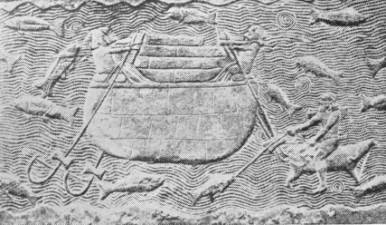

These four Assyrians seem to be rowing their boat in opposite
directions. At the right is a man fishing from a goat skin filled with air. The
fancy stream is the Tigris.
Two Assyrian generals, making camp for the night, talk things over
and perhaps exchange a toast. At the right a servant is making the bed for
them. Outside the tent the camels and goats are settling down for the night on
the desert.
Art and
architecture. In order to glorify themselves and enhance their prestige,
Assyrian rulers built imposing and luxurious palaces. Sargon's palace at
Khorsabad, built into the wall of the city, was on a high platform, and its
walls were thick and heavy, like a fortress. It contained not only the king's
living quarters, and the royal stables but also a temple and a ziggurat. The
arch, borrowed from Babylonia, became an impressive feature in Assyrian palace
gates.
To guard the
palace gateways, the Assyrians installed huge human-headed winged bulls carved
from imported stone. In these and other Assyrian motifs can be seen
combinations of beasts later used in European heraldry. These impressive
creatures were carved with five legs so that they would not seem to be lacking
a leg when seen from the front or the side. The Assyrians knew a great deal
about the anatomy 0£ men and animals. They exaggerated and stylized muscles,
suggesting strength and brutality. Beards and hair were also treated in
conventionalized fashion.
The inside brick
walls of the royal palaces were masked below with stone relief’s and painted
above in bright colors. Assyrian cruelty and ferocity are reflected in the
vigorous relief’s, especially in battle and hunting scenes. Although the men's
beards and hair and the lions' muscles, manes, and claws in the above relief
are all stylized, the figures are remarkably real, in contrast to the static
and monumental winged bull. The winged bulls functioned primarily as symbolic
architectural decoration, while the relief’s depicted action or told a story.

Lion
hunt from Assurbanipal’s Palace

Sargon
II Fortress Palace at Khorsaban (reconstruction)
Assurbanipal's
library. Assyrian kings were apparently interested in preserving the past.
The annals of the kings were kept with
unrivaled exactness. The emperor Assurbanipal collected .over 22,000 clay
tablets, comprising the first great library. At immense cost and effort the
knowledge of the Fertile Crescent was gathered for the royal bibliophile.
Sumerian hymns, temple rituals, myths of creation and the deluge, grammars, and
medical texts found their way to his library. On each tablet was the emperor's
mark of ownership, and just as a modern library stamps a warning on its books
against surreptitious removal, Assurbanipal had inscribed on his tablets:
"Whosoever shall carry off this tablet may Assur and Relit overthrow him
in wrath and anger, and destroy his home and posterity in the land”.
Decline of
Assyria. The Assyrian empire obtained its main resources from booty and
conquest. The failure of such a system was inevitable in the long run. About
the middle of the seventh century B.C. evidences of decline became apparent.
The sturdy Assyrian stock had been decimated by the long series of wars, the
task of ruling such a huge empire was proving too difficult for the ruling
class, and finally the cruelties of the Assyrians had made implacable foes
intent on their downfall. To the south,
Babylonia had come under the control of a new group of Semites, the Chaldeans,
who revolted against Assyrian rule. Wild tribes roamed north of the Fertile
Crescent, constantly threatening Assyrian frontiers. Also to the north and
northeast, the Indo-European Medes and Persians were on the march. By 616 B.C.
the Chaldeans had captured Babylonia, and in 612 these people, joining the
Medes, attacked Nineveh, the Assyrian capital, which was captured and totally
destroyed. Not one building was left standing. From one end of the Fertile
Crescent to the other there .was rejoicing over the extermination of Assyria.
In the words of the Hebrew Prophet Nahum, "All that look upon thee shall
flee from thee and say, 'Nineveh is laid waste.' "
With the
exception of their animal sculpture, their innovations in military science, and
their ability as imperial administrators, the Asyrians made few original
contributions to civilization. Their role was rather one of borrowing from the
cultures of other peoples, unifying the best elements into a new product, and
assisting in its dissemination over the Fertile Crescent.
New Babylonia: The Empire of the Chaldeans
The kingdom of the
Medes. The destruction of the Assyrian empire in 612 B.C. left four
powers to struggle over its legacy, the Medes and Persians, the Chaldeans,
Egypt, and Lydia. The Medes were an Indo-European people who by 1000 B.C. had
established themselves just east of Assyria. In the eighth century B.C. they
had managed to create a strong kingdom with Ecbatana as capital. Under King
Cyaxaras the Medes had extended their over lordship to the Persians, who lived
east of the Tigris. The Persians were of the same racial ancestry as the Medes
and for a time were content to be their vassals.

Winged
Bull from Sargon’s Palace
New Babylonia.
While the Median kingdom controlled the highland region, the Chaldeans, with
their capital at Babylon, were masters of the Fertile Crescent. Nebuchadnezzar,
becoming Chaldean king in 604 B.C., raised Babylonia to another epoch of
brilliance after over 1000 years of weakness following the reign of Hammurabi.
Nebuchadnezzar routed the Egyptians from Syria, thus terminating Egyptian
aspiration to re-create another empire. When the little Hebrew kingdom of Judah
rebelled against his rule, the Chaldean king destroyed Jerusalem (586 B.C.) and
carried several thousand Hebrew captives to Babylon.
Babylon was now
rebuilt and became one 0£ the greatest cities of its day. Herodotus, the Greek
historian, has left us a graphic description of its huge size and the
tremendous walls that were wide enough at the top to have rows of small houses
on each side with a space between them large enough for the passage of a
chariot. In the center of the city ran the famous Procession Street, which
passed through, Ishtar Gate. This great arch, still standing, is the best
example of Chaldean architecture. In the city there were also several imposing
temples, the grandest of which was dedicated to the Chaldean deity Marduk.
There was also the immense palace of Nebuchadnezzar. Inclosed by walls, the
palace towered terrace upon terrace, each resplendent with masses of fernery,
flowers, and trees. These roof gardens,
the famous Hanging Gardens, were so beautiful that they were selected by the
Greeks as one of the seven wonders of the ancient world.
Chaldean
astronomy. New Babylonia made few original contributions to civilization apart
from the field of science, but in astronomy her influence was profound. The
Babylonians were interested in the stars as a means of foretelling the future.
The observation of the stars with the view of showing their influence upon
human affairs is called astrology, a pseudo science which still persists today.
A reminder of its influence exists in our language idiom when we refer to our
"lucky star" or to an "ill-starred venture." The interest
of the Chaldeans in the heavens led to the identification of the twelve groups
of stars identified under the twelve signs of the zodiac. Five planets were
considered especially fateful in controlling the destinies of men. The names of
the five most important Chaldean gods were applied to the five fateful stars. Later
the Romans substituted the names of their gods. Thus the planet Marduk became
Jupiter, Nabu was changed to Mercury, Ishtar to Venus, and so on.
Even though
astronomy was primitive and illogical, it encouraged the systematic observation
of the heavens. Astrology had been practiced in Old Babylon, but Ghaldean
observations were much more accurate and complete. The prediction of eclipses
was common, and continuous observations of the heavens were made for over three
hundred years. One of the foremost Chaldean astronomers computed the length of
the year to within twenty-six minutes.

The Persian Empire
Persian
expansion. During the long reign of Nebuchadnezzar, some forty years,
Babylon flourished, but. at his death the power he had evolved rapidly crumbled.
In the latter years of his reign a new people, the Persians, began to assume
the offensive. They threw off the Median yoke and captured Ecbatana in 549 B.C.
The Medes apparently readily accepted their new ruler, the redoubtable Cyrus
the Great. Within twenty years the Persian leader had created a great empire.
His first opponent was wealthy King Croesus of Lydia, who met defeat in 546
B.C. At the same time Cyrus assumed control of the Greek Ionian cities and then
turned east, establishing his power as far as the frontier of India. Babylon
was next on his list, for in 539 B.C. without resistance the city capitulated
to the Persian host. Following the death of Cyrus, his son Cambyses conquered
Egypt. The next ruler, Darius, crossed the Hellespont and annexed Macedonia and
Thrace to his empire. It now appeared as if the promising Greek city-states
would also be crushed by the Persian steam roller. In 493 B.C. Darius began his
first campaigns against Greece. They precipitated a bitter struggle in which
the Greeks, fighting heroically, not only repelled the invasion but ultimately,
under Alexander the Great, carried the war into the enemy's territory and
crushed the great Persian army.
Persian
imperial administration. The governmental structure designed by the Persian
rulers to administer their extensive dominions was built upon the Assyrian
model but was far more efficient than its predecessor. The Persian imperial
system was first devised by Cyrus the Great and carried to completion by
Darius. The empire was divided into twenty-one provinces, or satrapies, each
under a provincial governor called a satrap. To check the satraps, a secretary
and a military official representing the king were also installed in every
province. Special inspectors, "the Eyes
and Ears of the King," were also sent to the satrapies to
report on the administrative methods of the satraps. A great empire must
possess good communications. Realizing that need, the Persians built great
imperial post roads, which in the thoroughness of their construction rivaled
the later Roman roads. The main highways connected the four capitals, Susa,
Ecbatana, Babylon and Persepolis, which had been established in various parts
of the empire. Along the Royal Road between Sardis and Susa there was a post
station every fourteen miles, where fresh horses could be obtained by the
king's messengers. By means of this first "pony express," royal
messengers could cover a distance of 1500 miles in a little more than seven
days, while ordinary travelers took three months.
Persian rulers
demonstrated a high sense of responsibility toward all their subjects, alien or
Persian. In fact, the Persian empire was the first attempt at governing many
different racial groups on the principle of equal rights and responsibilities
for all peoples. In their treatment of subject peoples there was a humaneness
and spirit of consideration which had been absent in the Assyrian empire. The
Persians respected the gods of all conquered people. The king made the
prosperity of every part of the empire his concern, in order that all provinces
would be enabled to provide the tribute levied against them. The tax burden,
however, was not excessive. The introduction of a uniform system of coinage
also did much to weld the empire together. .

These old men are subjects from Syria on the .other side of the
Fertile Crescent, bringing gifts to the emperor at Persepolis - gold vessels,
bracelets, horses, even a chariot. This relief decorated a wall of Xerxes'
palace at Perspolis.
Zoroastrianism.
The religion of the Persians was founded by a prophet named Zoroaster (called
Zarathustra by the ancient Greeks). The date of his birth is a matter of
dispute. Tradition places it about 1000
B.C., but the most recent scholarship puts his birth at 660 B.C. Zoroaster
taught that there was a Continuous struggle in the world between two great
cosmic forces. Mazda, or Ahura Mazda, symbolized righteousness; Ahriman was the
summation of everything evil. The sayings and legends concerning Zoroaster were
collected early in the Christian era and made into a sacred book called the
Zend-Avesta. In it the principle of good is referred to as "Ahura Mazda,
the creator, radiant, glorious, greatest and best, most beautiful, most firm,
wisest, most perfect, the most bounteous spirit." The Avesta contained
significant ideas on how the world would come to an end. The last days were
conceived as involving a mighty battle between Mazda and Ahriman in which the
forces of good should prevail. Then would come a last judgment involving a heaven
for some and a hell for others. The word paradise is Persian in its origin.
The wise
toleration of the Persian rulers was perhaps a result of their religion. In
describing some of his victories, Darius, on the famous Behistun monument,
declares: "On this account Ahura Mazda brought me help. ..because I was
not wicked, nor was I a liar, nor was I a tyrant, neither I nor any of my line.
I have ruled according to righteousness."
The followers of
Zoroaster are sometimes called fire worshipers, because they regard fire as a
symbol of the deity of light and purity.
Their religion still persists among a group of about 100,000 people
called Parsees, who live in and around the city of Bombay in India.

The
ruined palace of Xerxes at Persepolis, showing columns and typical palace
platform.
Art. The
art of the Persians is not very original. They borrowed from their predecessors
in the Fertile Crescent, especially the Assyrians. Their most important work
was in palace architecture. The royal residences at Persepolis are the best
remaining evidence of Persian building. Here a high terrace, or platform, was
constructed, reached by a grand stairway, the face of which was covered with
beautiful relief sculptures. The practice of raising the palace on a platform
originated as a protection 'against disease from the swamps. Other features were brilliantly colored
enameled bricks, entrances flanked by huge human headed bulls, and numerous
columns to support the roof. The columns were topped by large heads of bulls,
used for capitals as the Egyptians had used lotus motifs. Upon the terrace
stood a number of palaces and halls used for audience chambers. The walls of
the buildings were covered with brilliant enameled tiles. The arch was not
copied from Babylonia; doors were capped with horizontal blocks of stone in the
Egyptian fashion.
Summary
The evolution of
human affairs in the Ancient Near East from primitive culture to civilization
has now been recounted. The principal areas concerned were Egypt at the western
terminus of the Fertile Crescent, Syria-Palestine, forming the western band of
the Crescent, and Assyria and Babylonia, constituting the eastern bow.
Civilization rose about the same time in the western and eastern ends of the
Fertile Crescent, that is, in Egypt and in the plain of Shinar, later to be
called Babylonia. Both those civilizations were river-made, one by the Nile,
the other by the Tigris and Euphrates rivers. Natural barriers forming a
defense for Egypt explain the almost uninterrupted continuity of its
civilization. Along the Fertile Crescent, however, there were constant fighting
and movements of people, owing to the absence of any such barriers. The history
of that region, then, is a rather complex account of the rise and fall of
numerous nations.
The story of Old
Babylonia is primarily concerned with the significant achievements of the
Sumerians and the later adoption of their civilization by Semitic invaders. The
most important of the Semitic states was Babylon, created by the great Semitic
leader Hammurabi. Following an era of brilliant civilization in Old Babylonia,
attention was focused on Syria-Palestine. There the duel between Egypt and the
Hittite empire, which weakened both contestants, gave small nations, Phoenicia,
the Arameans, and the Hebrews, a chance to enjoy a brief period of
independence. Political diversity was ended by the rise of the Assyrian empire,
which had a span of about three hundred years (900-600 B.C.). The fall of
Assyria left four peoples to contest for the crumbs of empire: the Egyptians,
the Lydians, the Medes and Persians, and the Chaldeans. At the outset New
Babylonia, or Chaldea, under the great Nebuchadnezzar was the center of a
brilliant and powerful civilization, but the expansion of Persia quickly
terminated its' independence. Persia became the greatest empire the world had
yet seen; it even endeavored to extend its power over ancient Greece.
If the
Paleolithic and Neolithic periods represent the first great chapter of progress
in human history, the .accomplishments in the Ancient Near East represent a
second. There metals were first used on an extensive scale and the wheeled
vehicle, the plow, and irrigation introduced. Seagoing ships were built first
by the Egyptians. the use of coinage was spread by the Lydians. and busil;1ess
contractual instruments were developed by the Babylonians. In engineering, the
Egyptians demonstrated remarkable skill in transporting tremendously heavy
blocks of stone over long distances and then elevating them to great heights.
During this early period in the history of man. warfare was put on a firm basis
by the Sumerians and then developed to a high degree of efficiency by the
Assyrians. Great political states were created in which there were remarkable
centralization al;1d coordination in administration. Writing was evolved as
early as 4000 B.C. later the Phoenicians made a notable contribution in
devising an alphabet. In architecture the Egyptians evolved many of the basic
features which were later developed to perfection by the Greeks. Sculpture was
used with regard to its architectural setting, and Egyptian mural painters were
highly skilled.
In the Tigris and
Euphrates valley the outstanding artistic contributions were in palace building
and sculpture. In the building of palaces some of the Mesopotamian , peoples
used the arch and narrow vault successfully though not extensively. The
Assyrian use of the arch may have influenced the Romans, and certainly some of
their decorative animal motifs influenced later heraldry. In sculpture there
were some beautiful wall decorations, especially in the Assyrian period. The
greatest gift in literature was the Hebrew Bible, but mention should also be
made of the Mesopotamian epics of the flood and creation and the Persian holy
Zend-Avesta. Finally in religion, the Ancient Near East contributed some
notable religious concepts.
Such is the role
of the Ancient Near East in world history. But after several thousand years of
advance, progress seemed to level off and almost entirely cease. One great bar
to progress was that in all the countries of the N ear East there was no
thought of political liberty or the right of the individual to have a part in
the affairs of government. Coupled with the despotism of kings was the tyranny
of priests. The old gods had to be obeyed, old customs and mores implicitly
accepted. There was little opportunity for speculation, and society tended to
become more and more static.