HH-01-EarlyCivilzations4000-500BC
Early
Civilizations of the Near East 4000BC to 500 BC
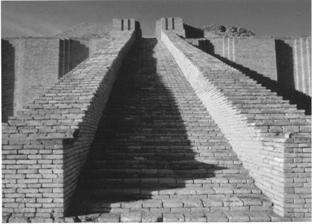
stepped ziggurat of Ur to honor Nanna the god of the moon
The Birthplace of Civilization
Early civilizations
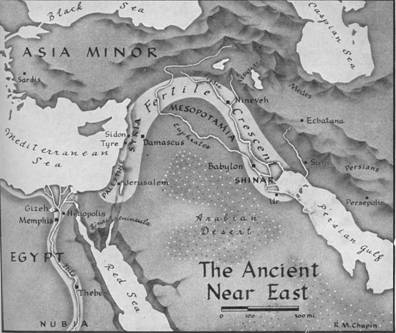
emerged in the Tigris-Euphrates valley of Mesopotamia (modern Iraq) and the
Nile valley of Egypt between 4000 and 3000 BC in river valleys. They also emerged in the Indus valley of
western India, China and Central America.
The rivers of Egypt and Mesopotamia overflowed their banks each year
leaving a deposit of rich soil and provided water enabling people to produce
sizable harvests. Both river valleys were quite narrow, and were surrounded by
huge expanses of desert.
By 3200 BC some
form of government had developed in both river valleys. The emergence of small
city‑states was one of the first examples of urban life in the Near East,
although settled communities had existed as early as 6000 BC in places like
Jerico.
Institutions as
schools and law codes also developed. The invention of writing, the development
of physics, astronomy, and mathematics, plus the art of smelting, were
additional factors in the emergence of civilized society.
Generally speaking,
Egypt was less susceptible to the invasions of the semicivilized groups that
repeatedly entered the Tigris‑Euphrates valley. Distance, rather than
formidable natural frontiers, seems to have been the chief factor. For this reason Egypt developed in relative
isolation until the Hyksos invasion.
The Civilization of Mesopotamia
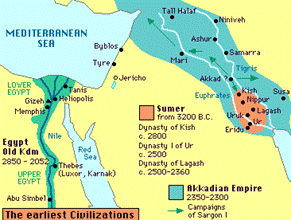
The Sumerians By 4000 BC the
Sumerians had settled in the Tigris‑Euphrates valley, their place of
origin unknown. By 3000 B.C. many
important city‑states appeared in Sumer. Among them were Ur, Eridu,
Lagash, and Nippur. These cities were fiercely jealous of their independence,
and one city seldom predominated for very long. Each city-state was administered by an official called a patesi.
He represented the highest political, religious, and military authority. A
patesi who was able to conquer a large number of city‑states was
dignified with the title of lugal, or king.
The First Dynasty of Ur (c. 2500‑2300 BC) produced a line that
dominated most of Sumer and part of Akkad for two centuries. Around 2275 BC Lugal Zaggisi of Uruk made
himself master of Mesopotamia. Soon
thereafter Sargon I of Agade overthrew Lugal Zaggisi and inaugurated a period
of Semitic hegemony.
The Akkadians Akkadian power was
centered about the city of Babylon.
Akkadian armies controlled the entire Tigris‑Euphrates valley as
far north as the Taurus Mountains. Some authorities even believe that Sargon I
subjugated Syria. Sargon I, the
"king of battle," divided his empire into districts ruled by the
"sons of the palace." Revolts were common, nevertheless, and these so
weakened the Akkadians that they were overwhelmed by the Guti around 2150
BC. During their brief period of
dominance, the Akkadians dropped their nomadic ways and adopted much of
Sumerian culture. Akkadian cultural
acquisitions included cuneiform writing, the Sumerian system of weights and
measures, and the Sumerian calendar.
The Akkadians surpassed their Sumerian teachers in the art of seal
cutting and stone sculpture.
The Guti This uncivilized
people swept into Mesopotamia around 2150 BC from their home in the Zagros
Mountains of Persia. They routed the weak Akkadian successors of Naram‑Sin. These Semitic conquerors had several capable
leaders during their short period of dominance (c. 2150‑2070 BC). Among
the better kings were Irridu‑Pizir, Lasirab, and Tirigan.
Sumerian
revival Around
2070 BC the Guti were driven out by Utu Khegal of Erech. The Sumerians were
able to reestablish their authority under the Third Dynasty of Ur. Commerce thrived, and cultural achievement
reached its zenith. Dungi, the
"King of the Four Quarters," was the most important monarch of this
dynasty. He is known for his excellent law code. Dynastic conflicts were responsible for the sharp decline of
Sumerian power after 2000 BC. Both the
Elamites and Amorites (Babylonians) poured into Mesopotamia to fill the power
vacuum left after the decline of the Third Dynasty of Ur.’
The Amorites
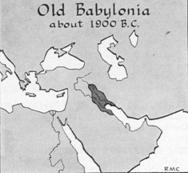
(Babylonians) This
Semitic people moved into Mesopotamia from Syria around 2000 BC. Only the Elamites offered resistance, since
the hostile Sumerian dynasties of Isin and Larsa were engaged in petty
quarrels. The Amorites fended off the
Elamite challenge and ruled Mesopotamia until the Kassite incursion around 1670
BC. The greatest Amorite ruler was
Hammurabi (1728‑1686 BC). He
created a permanent administration for his domains, set up law courts, a system
of taxation, and rules for military service.
His numerous letters mark him as a model administrator. Hammurabi's Code of Laws was the greatest
legacy he left. Its 282 paragraphs were based on Sumerian and Semitic
precedents. It dealt with property rights, personal injuries, family affairs,
and a host of other matters.
Mesopotamian
culture
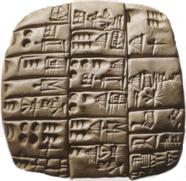
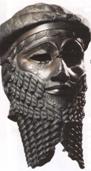

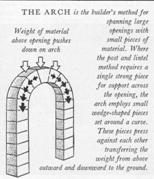
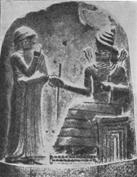
Cueiform Tablet Sargon Sumerian woman appeal to heaven Arch Hammurabi
The Sumerians must
be given credit for the basic cultural contributions. Prior to 3000 B.C. the Sumerians had developed a wedge‑shaped
writing called cuneiform. The signs
were pressed into small clay tablets with a reed and then dried in the sun or
baked. Other Near Eastern peoples adapted the Sumerian signs. The Sumerians used a sexagesimal system of
counting. Ten was the basic number, sixty the next, and then six hundred. A lunar year of 12 months was devised. It
contained 354 days. The Sumerians
developed a system of weights and measures. It was based on the mina which weighed a we more than a
pound. Civil law was first compiled by
the Sumerians, and provided a basis for the subsequent Hammurabi Code. The lex talionis principle of proportionate
retaliation was a feature of Sumerian law.
The Sumerians left an extensive literature in the form of epics, hymns,
and proverbs. Many were copied by the later Babylonians. The Gilgamesh Epic, a tale reminiscent of
Noah, is one of the great Sumerian literary contributions. The Babylonian Creation Epic is somewhat
similar to the Hebrew account found in Genesis. The Sumerians and their successors were polytheistic, their
faith offered no hope of resurrection.
The Sumerians did not mummify the dead or build elaborate tombs for
them. Sumerian deities had all of the
strengths and weaknesses of mortals.
The Sumerian religion did not demand definitive standards of morality
from its adherents.

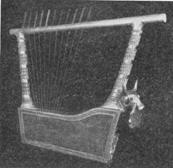
A signature seal and its impression, showing a Sumerian ruler in
audience with his local god. Sumerian
harp with gold bulls head
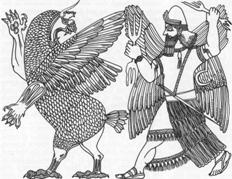
Marduk replaced
Tammuz as the leader of the gods during the Amorite (Babylonian) period. The vault, arch, and dome were all
inventions of the Sumerians. Their best
known structure was the ziggurat, a
pyramidal tower with a shrine at the top.
In the absence of stone, sun‑dried brick was used. Sculpture and metal work were two additional
areas in which Sumerian artisans excelled.
Egyptian
Civilization
The land of Egypt
was concentrated along a 550‑mile stretch of the Nile valley. The average
width of the cultivable land was but 12 miles. In all, Egypt had only 13,000
square miles of good soil to support a population of 7 million. On both sides of the Nile valley was desert.
This made for a compact society in the river valley. Egyptian civilization emerged into the light of history during
the fourth millennium BC. Its 3000‑year history during the ancient period
was divided into thirty dynasties by the historian Manetho (c. 280 BC).
The Predynastic
Period (4000‑3200 BC) During these eight centuries the Egyptians
developed a system of writing, an irrigation network, a calendar, and a system
of government. Egypt was divided into nomes or provinces. Each was governed by
a nomarch who collected taxes,
rendered justice, and commanded the local militia. The various nomarchs quarrelled among themselves like so many
feudal princes.
The Protodynastic
Period (3200‑2750
BC) Around 3100 BC the legendary Menes
supposedly united Upper and Lower Egypt.
Some internal conflict continued until the founding of the Third Dynasty
by Khasekemui in 2980 BC.
The Old Kingdom.
(2750‑2270 BC)
Dynasties III‑VI ruled Egypt from the city of Memphis. This was the era of pyramid building. These structures reached the peak of
magnificence during the Fourth Dynasty, particularly the Great Pyramid of
Cheops at Gizeh. The first pyramid was
probably built during the reign of Zoser by his adviser Imhotep. During this period the Pharaohs had almost
absolute authority. Egypt reached its
greatest size during the reign of Pepi II, but the weak rulers of the Sixth
Dynasty lost control after his death.
Ra, the sun deity, headed the Egyptian pantheon. The First Intermediate Period (2270‑2160
BC): this was a feudal age. The nobility was able to assert itself during the
chaotic century that ensued. Dynasties VII‑X ruled as the cities of
Memphis, Heracleopolis, and Thebes fought for the leadership of the Nile
valley.

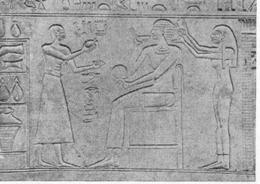
Duck hunting for this Egyptian is a matter of decoying the ducks
from his papyrus boat and hitting them with his boomerang
An
Egyptian princess is having her hair set in tight curls, holds a mirror,
beverage in the other, servant fixes her another .
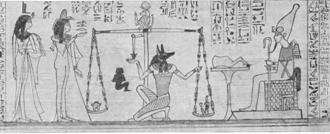
Osiris sits in judgment as his dog-headed creature weighs the
heart of a: princess against a feather. Isis stands behind the princess.
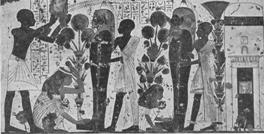
Theban
wall painting of ceremonial farewell to
the dead, on tomb of two Egyptian sculptors.
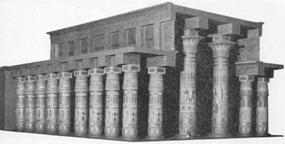
The Hypostyle Hall of the Temple of Karnak, showing Clerestrory
Windows (reconstruction)
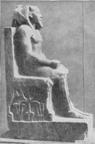
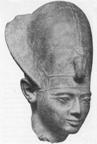
Portrait of Pharaoh Ramses II Stone block statue of the Pharaoh Khafre
Egyptian
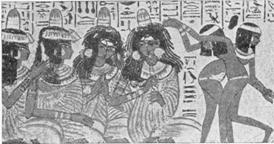
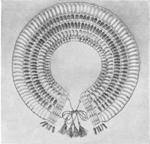
Dancing Girls (wall painting) An Egyptian collar of beads
Middle Kingdom
(2160‑1788 BC)
Order was restored when the Eleventh Dynasty of Thebes was able to win
control of Egypt. The patron deity of
Thebes, Amun, became identified with Ra as head of the Egyptian pantheon. The Middle Kingdom reached its apex under
Dynasty XII, particularly Pharaohs like Senwosret II and III. This was the classical period of Egyptian
literary achievement. Painting and sculpture flourished. Trade with Syria and Punt was extensive. In
addition, irrigation was pushed and a dam built in the Fayuni area to store
water in the event that the Nile was low.
Second Intermediate
Period (1788‑1680
BC) This was another feudal period
during which chaotic conditions existed.
The weak Thirteenth and Fourteenth Dynasties were the nominal rulers.
The Hyksos Era
(1680‑1580 BC)
The Hyksos were probably Syrian and Palestinian Semites driven south
into Egypt by Indo‑European peoples from north of the Black and Caspian
Seas. They were called "shepherd
kings" or "rulers of foreign lands." Their invasion ended 2000 years of Egyptian isolation. After this
attack, Egypt played an important role in Near Eastern affairs. Avaris, in Lower Egypt, became the Hyksos
capital. Upper Egypt sent tribute to the Hyksos, but that area remained
unoccupied. The Hyksos readily adopted
Egyptian culture and the old state administration. The horse and chariot were brought to Egypt by the Hyksos. The Hyksos were expelled by Ahmose I of
Thebes, founder of Dynasty XVII.
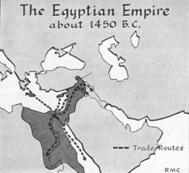
The New Empire‑(1580‑1090
BC) Ahmose I pursued the Hyksos into
Asia and laid the foundation for the Egyptian expansion that followed. Under Thutmose 1 (1525‑1508 BC)
Palestine and Syria were temporarily overrun.
The great Thutmose 111 (1501‑1447 BC) crushed the Kadesh
Confederacy and made Egyptian authority paramount in Syria and Palestine. Egypt reached the pinnacle of her power
during the "golden age" of Amenhotep III (1411‑1375 BC). During the reign of Amenhotep IV (Ikhnaton)
decline became evident. The Pharaoh did
nothing to meet the new Hittite challenge.
Amenhotep IV created an internal rift by experimenting with the
monotheistic Aton faith. Ramses 11
(1292‑1225 BC) managed to hold his decaying state together despite the
ambush at Kadesh by the Hittites (1288 BC)
The New Empire came to an end in 1090 BC when the priest Hrihor founded
Dynasty XXI,
The Period of
Decline (1090‑525
BC) This was an era of weak kings and
powerful priests. Libyan and Ethiopian
invaders often ruled the land. A short
Assyrian occupation occurred in the seventh century BC. Saite Revival (663‑525 BC) Began under Psamtik I who expelled the
Assyrians. The culture of the period
was a slavish imitation of past accomplishments. Cambyses and his Persian
armies conquered Egypt in 525 BC.
Egyptian
cultural and economic accomplishments
As early as 4241 BC
the Egyptians may have worked out a calendar.
The people of the Nile valley developed several systems of writing prior
to the advent of the Fourth Dynasty.
These included hieroglyphics, a
sacred form of writing that included 600 signs. The use of the Rosetta Stone
plus other materials enabled Champollion to decipher this language. A cursive script called hieratic was developed at a later time. It was used for public and
commercial affairs. The commoners of
Egypt came to use a still more abbreviated script called demotic Egyptian literature reached a zenith during
the Middle Kingdom with such works as The
Shipwrecked Sailor and The Tale of
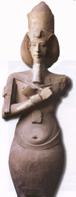
the Eloquent Peasant. Sculpture
became conventionalized by the Middle Kingdom. Statues had to have arms at the
sides and the left foot thrust forward.
The Medical Papyri indicate
that the Egyptians were making some progress in the art of healing. These New
Empire records contain many worthless remedies, but they were the first documents
in which medical data was assembled.
Significant advances were also made in geometry, astronomy, and
chemistry.
Old Kingdom
religious beliefs centered about the immortality of the Pharaoh. This solar
faith did not grant a life in the next world to the masses. During the Middle
Kingdom the people were able to reach this exalted state because of the god
Osiris. Ra and Osiris vied for
supremacy. The Egyptian religion
placed no emphasis on an ethical life.
Prayers and magical formulae from the Book of the Dead were sold by
priests. These could appease Osiris, and help insure immortality.
Egypt developed an
extensive trade with Syria, Crete, and Punt during the Middle Kingdom. Wheat, gold wares, and linen were exported.
Ivory, cedar wood, tapestries, and ebony were imported. Copper mining, tanning, stone quarrying, and
bronze making were important local industries.
Agriculture was the basic occupation of most Egyptians.
The
Empire of the Hittites
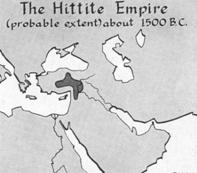
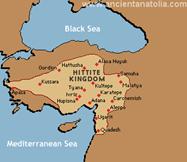
The Hittites
emanated from central and southeastern Asia Minor, present‑day
Turkey. Agriculture and shepherding
were their main occupations. They were the first to smelt iron in
quantity. The chief deity of the
Hittites was Teshub, but the sun goddess Arinna also had a place of
prominence. The Hittite king derived
his authority from a council of nobles called the pankus. By 1500 BC. the
Hittites had developed a legal code noted for its humane features. The Hittites spoke an Indo‑European
language. It was deciphered by the Czech scholar Hrozny. After 1900 BC the Hittites began to press
south into Syria from their citadel at Hattusas. Under Mursilis 1 (1620‑1590
BC) the loose confederation of city‑states was changed into a powerful
empire. Egyptian power in Syria was challenged by the Hittites until the
Mitanni brought about a temporary eclipse of their power (1500‑1375
BC). Shubbiluliuma (1375‑1335
BC) again brought a revived Hittite empire into conflict with Egypt. The continual invasions of the Sea Peoples
resulted in the destruction of the Hittite realm around 1190 BC.
Other Near Eastern States (2000‑1200 BC)
The Elamites This people was
subject to Sumerian and Akkadian rule during most of the third millennium
BC. For a brief period around 2000 BC
the Elamites pressed into Mesopotamia from the cast, but were later beaten by
Hammurabi and the Amorites. Most of our
evidence for the study of Elamite history has come from the capital city of
Shusan (Susa
The Kassites This Indo‑European
group moved into the Tigris‑Euphrates valley from the Iranian highlands
to the east around 1677 BC. The Kassite
attack was led by Gandash. Amorite resistance was quickly overcome. It is believed that the Kassites brought the
horse to Mesopotamia. The Kassites
waged a war against the Hittites under Agum II. By 1169 BC Assyrian, Median,
Babylonian, and Elamite pressure put an end to the Kassite kingdom.
The Hurrians This Armenoid
people probably came ‑from the Lake Van region of present day Turkey.
Around 1800 B.C. they migrated southward and overran parts of Syria and
Palestine. They probably brought the
horse‑drawn chariot into western Asia.
Their language may be related to that of the Elamites. The chief deities of the Hurrians were
Teshub, the storm god, and Hepa, the sun goddess. It is likely that the Hurrians were absorbed by other peoples of
Syria and Palestine.
The Mitanni The Mitanni
occupied an area that included much of northern Syria and Mesopotamia (1500
BC). Under Sauslishattar, the Mitanni
held off the Egyptian forces of Thutmose III and kept the Assyrians in
subjugation. By 1300 BC the rising
state of Assyria crushed the Mitanni. Soon thereafter the kingdom disappeared.
The
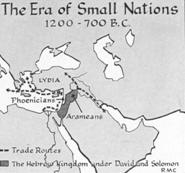
Era of Small States (1200‑800 BC)
With the decline of
Egyptian and Hittite power after 1200 BC, the Near East entered an era notable
for the absence of great powers.
Hittite
Lydian Phrygian
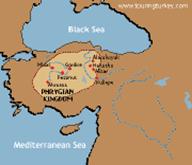
The Phrygians It is believed that
the Phrygians came to Asia Minor from eastern Greece around 1200 BC. They
settled in central Anatolia (Turkey) west of the Halys River. Phrygian power was great from 900 to about
547 BC, although it waned perceptibly after their defeat by the Lydians in 610
BC. Because of their location and Greek
background, the Phrygians were able to transmit many Asiatic ideas and
practices to the peoples of the Mediterranean.
Cybele, the Great Mother, was the chief deity of the Phrygians. She
headed the Phrygian fertility cult that was known for its wild ceremonies and
dances.
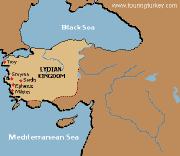
The Ludians This people
occupied western Asia Minor, holding the territory between Phrygia to the east
and the Ionian coastal towns to the west.
Lydia was an important power from the eighth to the sixth century BC. Gyges founded the famous Mernmadae Dynasty
in 670 BC, but the Persians under Cyrus overran Lydia in 547 BC by seizing King
Croesus in the capital city of, Sardis.
The Lydians were excellent craftsmen and merchants. They are credited
with the invention of metal coins. The
Lydians made contributions in music and dancing. They also excelled in weaving
and purple dyeing.
The Arameans This Semitic people
came out of the Syrian desert in the fourteenth century BC. The Hittites and Assyrians prevented them
from entering the Tigris valley a century later. An Aramean kingdom was organized around Damascus in the tenth
century BC. Other Arameans drifted into Mesopotamia in considerable
numbers. The Arameans were noted for
their ability in international trade. Their language was
used everywhere in the Near East.
The
Phoenicians This
nation of sea‑traders lived in the
excellent coastal ports along what is now the shore of Lebanon. The main Phoenician cities were Acre, Tyre,
Sidon, and Byblos. After the decline of
Minoan and Mycenaean seapower in the twelfth century BC, the Phoenicians
succeeded in dominating the commercial life of the Mediterranean. Phoenician colonies were established in
Carthage, Cyprus, and southern Spain.
The greatest Phoenician contribution to civilization was their
alphabet. It had 22 consonants and no vowels, and may
have been based on Egyptian signs. It has become the basis for most ancient and
modern I alphabets. For the better part
of the period 1500‑1300 BC Phoenicia was dominated by Egypt. From 1000‑774
BC the city of Tyre took the lead, but this was followed by a century and a
half of Assyrian domination.
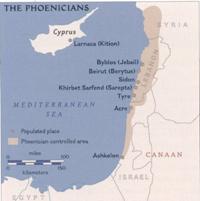
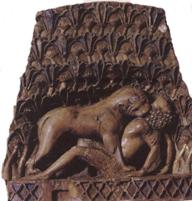
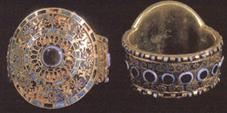
Phoenician coast
Phoenician carved ivory Early metal artistry

The Hebrews This
Semitic people migrated from Egypt to Palestine around 1200 BC. As told in
Exodus, the Hebrew entrance into Palestine involved the subjugation of the
Canaanites. Moses led the Hebrews to Palestine and must be given credit for
welding them together as a nation.
Period of the
judges (c. 1200‑1030 BC) This was
the era from the Exodus to the reign of Saul.
The twelve Hebrew tribes formed a loose confederation. In times of war
certain leaders such as Samson, Gideon, or Samuel took charge. Collectively, they
are known as judges. The judges
acquired a temporary judicial and military authority. The rise of Saul as king of the Hebrews ended this era.
Under Saul (1030‑1005
BC) and David (1005‑965 BC) the Philistines, Edomites, and Moabites were
brought under control. A sense of
national consciousness developed. The
Hebrew kingdom reached its greatest size under David.
Under Solomon (965‑925
BC) the Hebrews made alliances with Egypt and Tyre. A great building program was inaugurated at Jerusalem. Heavy taxation
and forced labor made the regime unpopular.
After Solomon's death the Hebrew kingdom split into a southern state of
Judah and a northern state of Israel.
The kingdom of
Israel continued to exist for two centuries until the Assyrians under Sargon II
crushed it in 722 BC.
Judah managed to
maintain its independence until 586 B.C. when the Chaldeans under
Nebuchadnezzar seized Jerusalem. Many
Hebrews were taken to Mesopotamia in the so‑called Babylonian Captivity
(586‑538 BC). The Persian ruler
Cyrus permitted the Hebrews to return to Palestine in 538 BC. The Hebrews remained under Achaemenid rule
until Alexander the Great conquered the area in 332 BC.

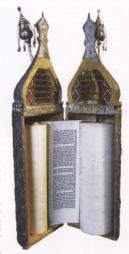
Kingdom of Israel
Hebrew
religion It
was here that the Hebrews made their greatest contribution. The Hebrew faith emphasized the belief in
one supreme deity, monotheism. Yahweh
was the one god of the Hebrews. The
Hebrew religion demanded an adherence to ethical standards. Such prophets as
Amos and Ezra often called the leaders and populace to task for lax moral
behavior. The Torah or Pentateuch (Five
Books of Moses) contained the teachings of God as revealed through the prophets
or discovered by the sages. Ezra must
be given credit for giving the Torah its position of importance. Its 613
commandments provided the Hebrews with a rigid code of personal and ritualistic
behavior. It is believed that much of the Torah may date from the Hebrew trek
through Sinai. The Hebrew faith had a
great influence on several religions that emerged at a later time.
Christianity, for example, borrowed much of its theology as well as the Ten
Commandments.
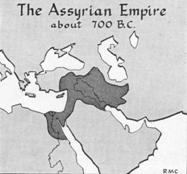
Assyrian Dominance in the Near East
The Assyrians lived
in the northeast corner of the Fertil Crescent. Their key Centers were Assur, Arbela and Nineveh. Prior to 1300 BC the Assyrians were
dominated by the Sumerians, Akkadians, Elamites, and Amorites. Assyna expansion
began with the reign of Adadnirari (1310-1280 BC). Hittite, Egyptian, and Kassite
decline were important factors in the rise of Assyria. After two centuries of temporary decline
(1100‑885 BC) the Assyrians began a period of revival by reorganizing
their army and government. Two hundred years of expansion followed with the
zenith of power being reached under Sargron II (722‑705 BC). After the death of Assurbanipal in 626 BC
decline came quickly. The Babylonians and Medes razed Nineveh in 612 BC, and Assyrian military power
was permanently destroyed.
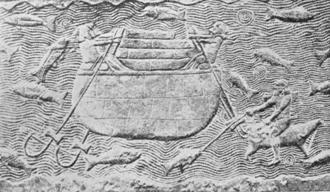
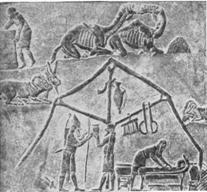
Assyrians
Scenes
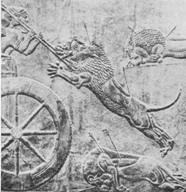
Lion
hunt from Assurbanipal’s Palace
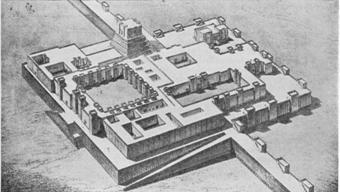
argon II Fortress Palace at Khorsaban (reconstruction)
Assyrian
civilization The
Assyrian army was the key institution. Its Prussian like efficiency made it the
terror of the Near East. The army committed fearful atrocities during its
conquests. Most Assyrians were engaged
in agriculture. Many peasants were serfs.
Commerce and industry were ignored by the dominant nobility. The chief deity of the Assyrians was Assur,
a god that fought beside their soldiers in battle. The Assyrians had no belief
in a hereafter. Although the Assyrians
did not generally excel in the arts, they did some fine work in stone sculpture
and palace building. Assurbanipal also compiled a library of 22,000 cuneiform
tablets at Nineveh.
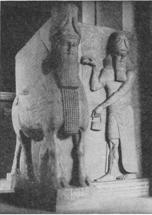
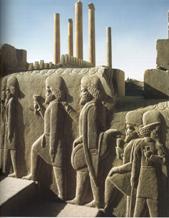
Winged
Bull from Sargon’s Palace
The Rise of Chaldea
The
Chaldeans were a Semitic people who settled in southern Mesopotamia. They
organized the Neo‑Babylonian Empire under Nabopolassar (625‑605
BC). In alliance with the Medes, the Chaldeans crushed the Assyrians and razed
Nineveh in 612 BC. Under
Nebuchadnezzar (605‑562 BC) the Chaldeans reached their pinnacle. Mesopotamia, Syria, and Palestine were
subjugated. The famous Hanging Gardens
and Ishtar Gate adorned the city of Babylon. After Nebuchadnezzar's death decline
was rapid. The Persians under Cyrus seized Babylon in 539 BC.
Chaldean
civilization The
Chaldeans identified their deities with the planets. Marduk, for example, was
linked to Jupiter. Deities could no
longer be influenced by man. The gods
were all‑powerful, but their intentions were unknown. Since the desires of the deities could not
be learned, the Chaldeans fatalistically submitted themselves to the will of
the gods. Like their Sumerian
predecessors, the Chaldeans had no interest in the hereafter. The Chaldeans prayed for material betterment
on earth. They were not particularly interested in ethical values.
Chaldean
science The
Chaldeans could boast of many important achievements, particularly in
astronomy. Chaldean astronomers worked out a 7‑day week and a 24‑hour
day. The study of astronomy was
motivated by the Chaldean desire to better understand the wishes of the
gods. The Chaldeans showed no
particular originality in literature or the other arts.

Imperial
Persia and Her Civilization
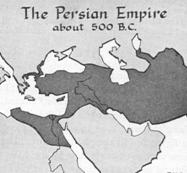
The Persians were
an Aryan people who came to Iran from the east around 650 BC. For a considerable period the Persians were
subjected to Mede overlordship, but the successful revolt of Cyrus around 550
BC ended that state of affairs. Cyrus
founded the Achaemenid Dynasty (559‑331 BC) which lasted until its
destruction by Alexander the Great. By
539 BC Cyrus had conquered Chaldea, Lydia, Syria, and Palestine. His successor,
Cambyses (529‑522 BC), added Egypt to the Persian domains.
Under Darius (521‑485
BC) the empire was reorganized on a more efficient basis. The empire was divided into administrative
districts called satrapies. A satrap, or governor, ruled ear district. The satrap was kept under close observation
by nth officials of the king. This procedure was effective on] during the reign
of a strong ruler like Darius. Darius' plans to crush Greece were made known
toward the end of his reign. He was angered by the aid the Geeks gave to the
cities of Ionia. His first attempt
failed in 492 B.C. because a storm destroyed the expedition. Darius made a second try in 490 BC, but the
Athenians defeated his forces at Marathon.
Xerxes (485‑465
BC) continued the campaign against Hellas.
Persia suffered a crushing naval defeat at Salamis in 480 BC. Her land forces
were beaten decisively at Plataea in 479 BC.
The Greek war dragged on for three additional decades until it was
officially ended by the Peace of Cimon in 449 BC. After Xerxes, Persian power and prestige sank to a new low. Intrigue and internal strife (Satrap's War)
were responsible. Persia became a ripe
target for the ambitious Alexander the Great.
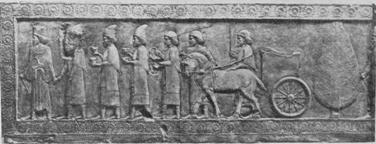
These old men are subjects from Syria on the .other side of the
Fertile Crescent, bringing gifts to the emperor at Persepolis - gold vessels,
bracelets, horses, even a chariot. This relief decorated a wall of Xerxes'
palace at Perspolis.
Persian
civilization
The Zoroastrian
religion The
Persians permitted the worship of deities other than the Zoroastrian. Zoroastrian dualism made Ahura‑Mazda
the personification of good, while Ahriman represented all that was evil. These two deities were engaged in a battle
for supremacy, but Ahura‑Mazda would win in the end. The Zoroastrian faith predicted the coming
of a judgment day. The Zoroastrian
faithful believed that a messiah, Saoshyant, would come prior to the end of
this world. Zoroastrianism demanded an
ethical and temperate life. It was a revealed faith whose secrets were received
by Zoroaster from Ahura‑Mazda. Many tenets and ideas were recorded in the
sacred Avesta.
The Persian Empire
was divided into 20 satrapies for administrative purposes. Excellent roads serviced this vast empire.
Particularly important was the royal road between Susa and Sardis. Because of the excellent network of roads, a
fine postal system existed. Most
Persians were peasants. They were ruled by a powerful nobility. Important cities were few in number. Susa
was the capital, but Persepolis, Pasargadae, and Ecbatana were also
important. Palace building was one of
the few architectural achievements of the Persians. The arch was not used. The Persians did little original work in
art. They borrowed heavily from the Babylonians, Hittites, and Egyptians.
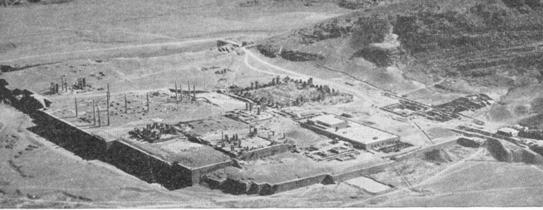
The
ruined palace of Xerxes at Persepolis, showing columns and typical palace
platform.