H-Evolution-004Prokaryotes
Prokaryotes
The history of prokaryotic life is a
success story spanning billions of years (Figure 15.8). Prokaryotes lived and
evolved all alone on Earth for 2 billion years. They have continued to adapt
and flourish on an evolving Earth and in turn have helped to change Earth.

They're
Everywhere!
Today, prokaryotes are found wherever
there is life, and they outnumber all eukaryotes combined. More prokaryotes
inhabit a handful of fertile soil or the mouth or skin of a human than the
total number of people who have ever lived. Prokaryotes also thrive in habitats
too cold, too hot, too salty, too acidic, or too alkaline for any eukaryote. In
1999, biologists even discovered prokaryotes growing on the walls of a gold
mine 2 miles below Earth's surface.


Figure
15.8a Figure 15.8b Figure
14.27
Figure 15.8 Over 3 billion years of prokaryotes. (a) This
microscopic fossil is a filamentous species consisting of a chain of prokaryotic
cells. It is one of a diversity of prokaryotes found in western Australian
rocks that are about 3.5 billion years old. (b) The orange rods are individual
modern bacteria, each about 5 mm long,
on the head of a pin. Most prokaryotic cells have diameters in the range of
1-10 mm, much smaller than most
eukaryotic cells (typically 10-100 mm). This
micrograph will help you understand why a pin prick can cause infection. And it
will help you remember to flame the tip of a needle before using it to remover
a splinter. The heat kills the bacteria.
Though individual prokaryotes are
relatively small organisms, they are , giants in their collective impact on
Earth and its life. We hear most about a few species that cause serious
illness. During the fourteenth century, Black Death-bubonic plague, a bacterial
disease-spread across Europe, killing an estimated 25% of the human population.
Tuberculosis; cholera, many sexually transmissible diseases, and certain types
of food poisoning are some other human diseases caused by bacteria.
However, prokaryoric life is no rogue’s
gallery. Far more common than harmful bacteria are those that are benign or
beneficial. Bacteria in our intestines provide us with important vitamins, and
others living in our mouth prevent harmful fungi from growing there.
Prokaryotes also recycle carbon and other vital chemical elements back and
forth between organic matter and the soil and atmosphere. For example, there
are prokaryotes that decompose dead organisms. Found in soil and at the bottom
of lakes, rivers, and oceans, these decomposers return chemical elements to the
environment in the form of inorganic compounds that can be used by plants,
which in turn feed animals. If prokaryotic decomposers were to disappear, the
chemical cycles that sustain life would come to a halt. All forms of eukaryotic
life would also be doomed. In contrast, prokaryotic life would undoubtedly
persist in the absence of eukaryotes, as it once did for 2 billion years.
The
Two Main Branches of Prokaryotic Evolution: Bacteria and Archaea
Prokaryotes have a cellular organization
fundamentally different from that of eukaryotes. Whereas eukaryotic cells have
a membrane-enclosed nucleus and numerous other membrane-enclosed organelles,
prokaryotic cells lack these structural features. The traditional five-kingdom
classification scheme emphasizes this fundamental difference in cellular
organization. Prokaryotes make up the kingdom Monera, separate from the four
eukaryotic kingdoms (Protista, Plantae, Fungi, and Animalia). In the past two
decades, however, researchers have learned that a single prokaryotic kingdom
may not fit evolutionary history. By comparing genomes of diverse prokaryotes,
biologists have identified two major branches of prokaryotic evolution: the
bacteria and the archaea. Though they have prokaryotic cell organization in
common, bacteria and cuchaea differ in many structural, biochemical, and
physiological characteristics. And there is also evidence that archaea are more
closely related to eukaryotes than they are to bacteria. It was these
discoveries that prompted the three-domain classification- domains Bacteria,
Archaea, and Eukarya - which you can review in Figure 14.27b. The majority of
prokaryotes are bacteria, but the archaea are worth studying for their
evolutionary and ecological significance.
The term archaea ("ancient")
refers to the antiquity of the group's origin from the earliest cells. Even
today, most species of archaea inhabit extreme environments, such as hot
springs and salt ponds. Few other modem organisms (if any) can survive in these
environments, which may resemble habitats on the early Earth.
Biologists refer to some archaea as
"extremophiles:' meaning "lovers of the extreme:' There are extreme
halophiles ("salt lovers"), archaea that thrive in such environments
as Utah's Great Salt Lake and seawater-evaporating ponds used to produce salt
(Figure 15.9) .There are also extreme thermophiles ("heat lovers")
that live in very hot water; some even populate the deep-ocean vents that gush
superheated water hotter than 100°C, the boiling point of water at sea level.
And then there are the methanogens, archathat live in anaerobic environments
and give off methane as a waste product. They are abundant in the anaerobic mud
at the bottom of lakes and swamps. You may have seen methane, also called marsh
gas, bubbling up from a swamp. Great numbers of methanogens also inhabit the
digestive tracts of animals. In humans, intestinal gas is largely the result of
their metabolism. More importantly, methanogens aid digestion in cattle, deer,
and other animals that depend heavily on cellulose for their nutrition.
Normally, bloating does not occur because these animals regularly belch out
large volumes of gas produced by the methanogens and other microorganisms that
enable them to utilize cellulose. And that may be more than you wanted to know
about these gas-producing microbes.
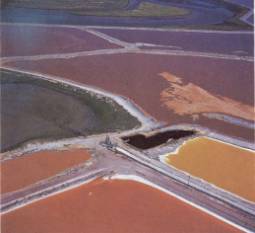

Figure 15.9 Figure 4.5 Prokaryote
Figure 15.9 Extreme halophiles (“salt-loving” archaea). These are
seawater-evaporating ponds at the edge San Francisco Bay. The colors of the
ponds result from dense growth of the prokaryotes that thrive when the salinity
of the water reaches 15-20% (before evaporation, seawater has a salt
concentration of about 3%). The ponds are used for commercial salt production;
the halophilic archaea are harmless.


Figure
15.10 Figure
15.11
Figure 15.11 Some examples of bacterial diversity (a) This prokaryotic organism, called an
actinomycete, is a mass of branching chains of rod-shaped cells. These bacteria
are very common in soil, where they break down organic substances. The
filaments enable the organism to bridge dry gaps between soil particles. Most species
secrete antibiotics, which inhibit the growth of competing bacteria.
Pharmaceutical companies use various species of actinomycetes to produce
antibiotic drugs, including streptomycin. (b) This filamentous prokaryote
belongs to a photosynthetic group called the cyanobacteria. Many species are
truly multicellular in having a division of labor among specialized cells. The
box on this micrograph highlights a cell that converts atmospheric nitrogen to
ammonia, which can then be incorporated into amino acids and other organic
compounds. (c) There are actually some prokaryotic cells that are gigantic,
even by eukaryoti standards. The bright ball in this photo is a marine
bacterium discovered in 1997 (the two smaller spheres above it are dead cells)
This prokaryotic cell is over half a millimeter in
diameter, about the size of a fruit fly's head.
The
Structure, Function, and Reproduction of Prokaryotes
You can use Figure 4.5 to review the
general structure of prokaryotic cells. Note again the absence of a true
nucleus and the other membrane-enclosed organelles characteristic of the much
more complex eukaryotic cells. Another feature to note in prokaryotes is that
nearly all species have cell walls exterior to their plasma membranes. These
walls are chemically different from the cellulose walls of plant cells. Some
antibiotics, including the penicillins, kill certain bacteria by incapacitating
an enzyme the microbes use to make their walls. Determining cell shape by
microscopic examination is an important step in identifying prokaryotes (Figure
15.10). Spherical species are called cocci (singular, coccus), from the Greek
word for "berries." Cocci that occur in clusters are called
staphylococci ("cluster of grapes"), or staph for short (as in
"staph infections"). Other cocci occur in chains; they are called I
streptococci ("twisted grapes"). The bacterium that causes strep
throat in humans is a streptococcus. Rod-shaped prokaryotes are called bacilli
(singular, bacillus). A third group of prokaryotes are curved or spiral-shaped.
The largest spiral-shaped prokaryotes are called spirochetes. The bacterium
that causes syphilis, for example, is a spirochete. The culprit that causes
Lyme disease is also a spirochete. Most prokaryotes are unicellular and very
small, but there are exceptions to both of these generalizations. Some species
tend to aggregate transiently into groups of two or more cells, such as the
streptococci already mentioned. Others form true colonies, which are permanent
aggregates of identical cells (Figure 15.11a). And some species even exhibit a
simple multi cellular organization, with a division of labor between
specialized types of cells (Figure 15.11 b ). Among unicellular species, there
are some giants that actually dwarf most eukaryotic cells (Figure 15.11 c).


Figure
15.12 Figure
15.13
Figure 15.12 Prokaryotic flagella. These locomotor appendages are
entirely different in structure and mechanics from the eukaryotic flagella
discussed in Chapter 4. At the base of the prokaryotic version is a motor and
set of rings embedded in the plasma membrane and cell wall. This machinery
actually spins like a wheel, rotating the filament of the flagellum.
Figure 15.13 An anthrax endospore. This prokaryote is Bacillus
anthracis, the notorious bacterium that produces the deadly disease called
anthrax in cattle, sheep, and humans. There are actually two cells here, one
inside the other. The outer cell produced the specialized inner cell, called an
endospore. The endospore has a thick, protective coat. Its cytoplasm is
dehydrated, and the cell does not metabolize. Under harsh conditions, the outer
cell may disintegrate, but the endospore survives all sorts of trauma,
including lack of water and nutrients, extreme heat or cold, and most poisons.
When the environment becomes more hospitable, the endospore absorbs water and
resumes growth. In late 2001, one or more bioterrorists disseminated anthrax
spores through the U.S. postal system.
About half of all prokaryotic species are
motile. Many of those travelers have one or more flagella that propel the cells
away from unfavorable places or toward more favorable places, such as
nutrient-rich locales (Figure 15.12).
Although few bacteria can thrive in the
extreme environments favored by many archaea, some bacteria can survive
extended periods of very harsh conditions by forming specialized
"resting" cells, or endospores (Figure 15.13) .Some endospores can
remain dormant for centuries. Not even boiling water kills most of these
resistant cells. To sterilize
laboratory equipment, microbiologists use an appliance called an autoclave, a
pressure cooker that kills endospores by heating to a temperature of 121°C
(250°F) with high-pressure steam. The food-canning industry uses similar
methods to kill endospores of dangerous soil bacteria such as Clostridium
botulinum, which produces a toxin that causes the potentially fatal disease
botulism.
Most prokaryotes can reproduce at a
phenomenal rate if conditions are favorable. The cells copy their DNA almost
continuously and divide again and again by the process called binary fission.
To understand how this makes explosive population growth possible, flash back
to that childhood numbers game: "Would you rather have a million dollars or
start out with just a penny and have it doubled every day for a month?" If
you opt for the penny, you feel like a loser at midmonth, when you have only a
few hundred dollars. But by the end of the month, you've bagged about 10
million bucks. This is the exponential growth that repeated doublings make
possible. Now apply that concept to bacterial reproduction, except double the
number every 20 minutes. That's the rate at which some bacteria can divide if
there is plenty of food and space. In just 24 hours, a single tiny cell could
give rise to a bacterial colony equivalent in mass to about 15,000 humans!
Fortunately, few bacterial populations can sustain exponential growth for long.
Environments are usually limiting in resources such as food and space. The
bacteria also produce metabolic waste products that may eventually pollute the
colony's environment. Still, you can understand why certain bacteria can make
you sick so soon after just a few cells infect you - or why food can spoil so
rapidly. Refrigeration retards food spoilage not because the cold kills the
bacteria on food but because most microorganisms reproduce only very slowly at
such low temperatures.
The
Nutritional Diversity of Prokaryotes
Prokaryotic evolution "invented"
every type of nutrition we observe through out life, plus some nutritional
modes unique to prokaryotes. Nutrition refers here to how an organism obtains
two resources for synthesizing organic compounds: energy and a source of
carbon. Species that use light energy are termed phototrophs. Chemotrophs
obtain their energy from chemicals taken from the environment. If an organism
needs only the inorganic compound carbon dioxide (CO2) as a carbon
source, it is called an autotroph. Heterotrophs require at least one organic
nutrient - the sugar glucose, for instance - as a source of carbon for making
other organic compounds. We can combine
the phototroph-versus-cheniotroph (energy source) and
autotroph-versus-heterotroph (carbon source) criteria to group organisms
according to four major modes of nutrition:
1.
Photoautotrophs are photosynthetic organisms that harness light
energy to drive the synthesis of organic compounds from CO2. Among
the diverse groups of photosynthetic prokaryotes are the cyanobacteria, such as
the species in Figure 15.11 b. All photosynthetic eukaryotes-plants and
algae-also fit into this nutritional. category.
2.
Chemoautotrophs need only CO2 as a carbon
source. However, instead of using light for energy, these prokaryotes extract
energy from certain inorganic substances, such as hydrogen sulfide (H2S)
or ammonia (NH3). This mode of nutrition is unique to certain
prokaryotes. For example, prokaryotic species living around the hot-water vents
deep in the seas are the main food producers in those bizarre ecosystems.
3. Photoheterotrophs can
use light to generate ATP but must obtain their carbon in organic form. This
mode of nutrition is restricted to certain prokaryotes.
4.
Chemoheterotrophs must consume organic molecules for both energy and
carbon. This nutritional mode is found widely among prokaryotes, certain
protists, and even some plants. And all fungi and animals are
chemoheterotrophs.
Table
15.1 reviews the four major modes of nutrition.
|
Table 15.1 |
Nutritional Classification of Organisms |
|
|
Nutritional Type |
Energy Source |
Carbon Source |
|
Photoautotroph (photosynthesizer) |
Sunlight |
CO2 |
|
Chemoautotroph |
Inorganic chemicals, |
CO2 |
|
Photoheterotroph |
Sunlight |
Organic compounds |
|
Chemoheterotroph |
Organic compounds |
Organic compounds |
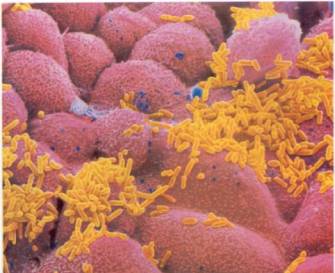
Figure 15.14 Really bad bacteria. The yellow rods are Haemophilus
influenzae bacteria on skin cells lining the interior of a human nose. These
pathogens are transmitted through the air. H. influenzae, not to be confused
with influenza (flu) viruses, causes pneumonia and other lung infections that
kill about 4 million people worldwide per year. Most victims are children in
developing countries, where malnutrition lowers resistance to all pathogens.
The
Ecological Impact of Prokaryotes
Organisms as pervasive, abundant, and
diverse as prokaryotes are guaranteed to have tremendous impact on Earth and
all its inhabitants. Here we survey just a few examples of prokaryotic clout.
Bacteria That Cause
Disease We are constantly exposed to bacteria, some of which are
potentially harmful (Figure 15.14). Bacteria and other microorganisms that
cause disease are called pathogens. Most of us are healthy most of the time
only because our body defenses check the growth of pathogens. Occasionally, the
balance shifts in favor of a pathogen, and we become ill. Even some of the
bacteria that are normal residents of the human body can make us sick when our
defenses have been weakened by poor nutrition or by a viral infection.
Most
pathogenic bacteria cause disease by producing poisons. There are two classes
of these poisons: exotoxins and endotoxins. Exotoxins are poisonous proteins
secreted by bacterial cells. A single gram of the exotoxin that causes botulism
could kill a million people. Another exotoxin producer is Staphylococcus aureus
(abbreviated S. aureus). It is a common, usually harmless resident of our skin
surface. However, if S. aureus enters the body through a cut or other wound or
is swallowed in contaminated food, it can cause serious diseases. One type of
S. aureus produces exotoxins that cause layers of skin to slough off; another
can cause vomiting and severe diarrhea; yet another can produce the potentially
deadly toxic shock syndrome. In contrast to exotoxins, endotoxins are not cell
secretions but are chemical components of the cell walls of certain bacteria.
All endotoxins induce the same general symptoms: fever, aches, and sometimes a
dangerous drop in blood pressure (shock). The severity of symptoms varies with
the host's condition and with the bacterium. Different species of Salmonella,
for example, produce endotoxins that cause food poisoning and typhoid fever.
During
the last 100 years, following the nineteenth-century discovery that
"germs" cause disease, the incidence of bacterial infections has
declined, particularly in developed nations. Sanitation is generally the most
effective way to prevent bacterial disease. The installation of water treatment
and sewage systems continues to be a public health priority through-out the
world. Antibiotics have been discovered that can cure most bacterial diseases.
However, resistance to widely used antibiotics has evolved in many of these
pathogens.
In addition to sanitation and antibiotics,
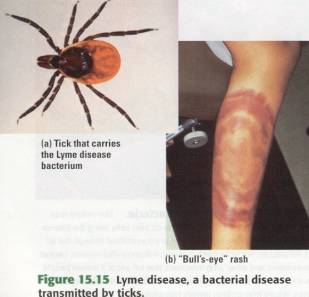
a third defense against bacterial disease is education. A case in point is Lyme
disease, currently the most widespread pest-carried disease in the United
States. The disease is caused by a spirochete bacterium carried by ticks that
live on deer and field mice (Figure 15.15) .Lyme disease usually starts as a
red rash shaped like a bull's-eye around a tick bite. Antibiotics can cure the
disease if administered within about a month after exposure. If untreated, Lyme
disease can cause debilitating arthritis, heart disease, and nervous disorders.
A vaccine is now available, but it does not give full protection. The best defense
is public education about avoiding tick bites and the importance of seeking
treatment if a rash develops. When walking through brush, using insect
repellent and wearing light-colored clothing can reduce contact with ticks.
Pathogenic bacteria are in the minority
among prokaryotes. Far more common are species that are essential to our
well-being, either directly or indirectly. Let's turn our attention now to the
vital role that prokaryotes play in sustaining the biosphere.
Prokaryotes and
Chemical Recycling Not too long ago, in geologic terms, the atoms of the organic molecules in
your body were parts of the in-organic compounds of soil, air, and water, as
they will be again. Life depends on the recycling of chemical elements between
the biological and physical components of ecosystems. Prokaryotes play
essential roles in these chemical cycles. For example, cyanobacteria not only
restore oxygen to the atmosphere; some of them also convert nitrogen gas (N2)
in the atmosphere to nitrogen compounds that plants can absorb from soil and
water (see Figure 15.11 b ). Other prokaryotes, including bacteria living
within the roots of bean plants and other legumes, also contribute large
amounts of nitrogen compounds to soil. In fact, all the nitrogen that plants use
to make proteins and nucleic acids comes from prokaryotic metabolism in the
soil, In turn, animals get their nitrogen compounds from plants.
Another vital function of prokaryotes is
the breakdown of organic waste and dead organisms. Prokaryotes decompose
organic matter and, in the process, return elements to the environment in
inorganic forms that can be used by other organisms. If it were not for such
decomposers, carbon, nitrogen, and other elements essential to life would
become locked in the organic molecules of corpses and waste products.
Prokaryotes and
Bioremediation Humans have put the metabolically divers
prokaryotes to work in cleaning up the environment. The use of organisms to
remove pollutants from water, air, and soil is called bioremediation. The most
familiar example of bioremediation is the use of prokaryotic decomposers to
treat our sewage. Raw sewage is first passed through a series of screens and
shredders, and solid matter is allowed to settle out from the liquid waste.
This solid matter, called sludge, is then gradually added to a culture of
anaerobic prokaryotes, including both bacteria and archaea. The microbes decompose the organic matter in
the sludge, converting it to material that can be used as landfill or
fertilizer after chemical sterilization. Liquid wastes are treated separately
from the sludge Figure 15.16).
We are just beginning to explore the great
potential that prokaryotes offer for bioremediation. Certain bacteria that
occur naturally on ocean beaches can decompose petroleum and are useful in
cleaning up oil spills (Figure 15.17). Genetically engineered bacteria may be
able to degrade oil more rapidly than the naturally occurring oil-eaters.
Bacteria may also help us clean up old mining sites. The water that drains from mines is highly acidic and is also
laced with poisons-often compounds of arsenic, copper, zinc, and the heavy
metals lead, mercury, and cadmium. Contamination of our soils and groundwater
by these toxic substances poses a widespread threat, and cleaning up the mess
is extremely expensive. Although there are no simple solutions to the problem,
prokaryotes may be able to help. Bacteria called Thiobacillus thrive in the
acidic waters that drain from mines. Some mining companies use these microbes
to extract copper and other valuable metals from low-grade ores. While
obtaining energy by oxidizing sulfur or sulfur- containing compounds, the
bacteria also accumulate metals from the mine waters. Unfortunately, their use
in cleaning up mine wastes is limited be- cause their metabolism also adds
sulfuric acid to the water. If this problem is solved, perhaps through genetic
engineering, Thiobacillus and other prokaryotes may help us overcome some
environmental dilemmas that seem intractable today. One current research focus
is a bacterium that tolerates radiation doses thousands of times stronger than
those that would kill people. This species may help clean up toxic dump sites
that include radioactive wastes.
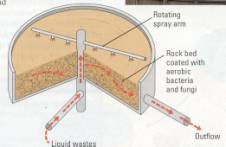
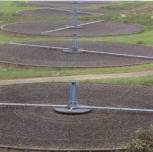
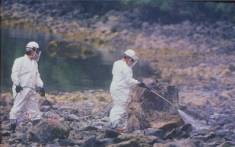
Figure 15.16 Figure 15.17
Figure 15.16 Putting prokaryotes to work in sewage treatment
facilities. This is a trickling filter system, one type of mechanism for
treating liquid wastes after sludge is removed. The long horizontal pipes
rotate slowly, spraying liquid wastes through the air onto a thick bed of
rocks. Bacteria and fungi growing on the rocks remove much of the organic
material dissolved in the waste. Outflow from the rock bed is sterilized and then
released, usually into a river or ocean.
Figure 15.17 Treatment of an oil spill in Alaska. The workers are spraying fertilizers onto an
oil-soaked beach. The fertilizers stimulate growth of naturally occurring
bacteria that initiate the breakdown of the oil. This technique is the fastest
and least expensive way yet devised to clean up spills on beaches. Of course,
it would be much better to keep oil off the beaches in the first place!
It is the nutritional diversity of
prokaryotes that makes such benefits as chemical recycling and bioremediation
possible. 'The various modes of nutrition and metabolic pathways we find
throughout life are all variations on themes that prokaryotes
"invented" during their long reign as Earth's exclusive inhabitants.
Prokaryotes are at the foundation of life in both the ecological sense and the
evolutionary sense. The subsequent breakthroughs in evolution were mostly
structural, including the origin of the eukaryotic cell and the diversification
of the organisms we call protists.