H-Evolution-001
Earth
History and Macroevolution
The history of biological diversity,
macroevolution, is closely tied to the history of Earth.
Knowledge
of what happened long ago comes from Fossil Records
Geologic
Time and the Fossil Record
The fossil record is an archive of
macroevolution. Figure 14.18 surveys the diverse ways that organisms can
fossilize. Sedimentary rocks are the richest sources of fossils and provide a
record of life on Earth in their layers or strata.. The trapping of dead
organisms in sediments freezes fossils in time. Thus, the fossils in each
stratum of sedimentary rock are a local sample of the organisms that existed at
the time the sediment was deposited. Because younger sediments are superimposed
on older o the layers of sediment tell the relative ages of fossils.


Figure 14.18 A gallery of fossils. (a)
Sedimentary rocks are the richest hunting grounds for paleontologists,
scientists who study the fossil record. This research is excavating a
fossilized dinosaur skeleton from sandstone in Dinosaur National Monument,
located in Utah and Colorado. (b) The hard parts of organisms are the most
common fossils. This is a skull of Homo erectu5, an ancestor of humans that
lived about 1.5 million years ago. (c) Fossils may become even harder if
minerals replace their organic matter. These petrified (stone) trees in the
Petrified Forest National Park in Arizona are about 190 million years old. (d)
Some sedimentary fossils, such as this 40-million-year-old leaf, retain organic
material, including DNA, which scientists can analyze. (e) Buried organisms
that decay may leave molds that are filled by minerals dissolved in water. The
casts that form when the minerals harden are replicas of the organisms, as in
the case of these casts of shelled marine animals called ammonites. (f) Trace
fossils are footprints, burrows, and other remnants of an ancient organism's
behavior. A dinosaur left these footprints in a creek bed in what is now
Oklahoma. (9) This 30-million-year-old scorpion is embedded in amber (hardened
resin from a tree). (h) These tusks belong to a whole 23,000-year-old mammoth,
which scientists discovered in Siberian ice in 1999.
Figure 14.20 The history of continental drift. Pangaea
formed about 250 million years ago. About 180 million years ago, Pangaea began
to split into northern (Laurasia) and southern (Gondwana) landmasses, which
later separated into the modern continents. India collided with Eurasia just 10
million years ago, forming the Himalayas, the tallest and youngest of Earth's
mountain ranges. The continents continue to drift, though not at a rate that’s
likely to cause any motion sickness for their passengers.
By studying many
different sites, geologists have established a geologic time scale, reflecting
a consistent sequence of geologic periods (Table 14.1) These periods are
grouped into four eras: the Precambrian, Paleozoic, Mesozoic, and Cenozoic
eras. Each era represents a distinct age in the history of Earth and its life.
The boundaries are marked in the fossil record by explosive diversification of
many new forms of life. Mass extinctions also mark many of the boundaries
between periods and between eras. For example, the beginning of the Cambrian
period is delineated by a great diversity of fossilized animals that are absent
in rocks of the late Precambrian. And most of the animals that lived during the
late Precambrian became extinct at the end of that era.

Fossils are reliable historical documents
only if we can determine their ages. The record of the rocks chronicles the
relative ages of fossils. It tells us the order in which groups of species
evolved. However, the series of sedimentary rocks does not tell the absolute
ages of the embedded fossils. The difference is analogous to peeling the layers
of wallpaper from the walls of a very old house that has been inhabited by many
owners. You could determine the sequence in which the wallpapers had been
applied, but not the year that each layer was added. Paleontologists use a
variety of methods to determine the ages of fossils in years. The most common
method is radiometric dating. which is based on the decay of radioactive
isotopes (Figure 14.19). The dates you see on the geologic time scale in Table
14.1 were established by the radiometric dating of rocks and the fossils they
contain.
Continental
Drift and Macroevolution
The continents
are not locked in place. They drift about Earth's surface like passengers on
great plates of crust floating on the hot, underlying mantle. Unless two
landmasses are embedded in the same plate, their positions relative to each
other change. For example, North America and Europe are presently drifting
apart at a rate of about 2 cm per year. Many important geologic processes,
including mountain building, volcanic activity, and earthquakes, occur at plate
boundaries. California's infamous San Andreas Fault is at the border where two
plates slide past each other.
Plate movements
rearrange geography constantly, but two chapters in the continuing saga of
continental drift had an especially strong influence on life. About 250 million
years ago, near the end of the Paleozoic era, plate movements brought all the
landmasses together into a supercontinent that has been named Pangaea
("all land") (Figure 14.20). Imagine some of the possible effects on
life. Species that had been evolving in isolation came together and competed.
When the landmasses coalesced, the total amount of shoreline was reduced. There
is also evidence that the ocean basins increased in depth, which lowered sea
level and drained the shallow coastal seas. Then, as now, most marine species
inhabited shallow waters, and the formation of Pangaea destroyed a considerable
amount of that habitat. It was probably a long, traumatic period for
terrestrial life as well. The continental interior, which has a drier and more
erratic climate than coastal regions, increased in area substantially when the
land came together. Changing ocean currents also would have affected land life
as well as sea life. The formation of Pangaea had a tremendous environmental
impact that reshaped biological diversity by causing extinctions and providing
new opportunities for the survivors, which diversified through branching
evolution.
The second
dramatic chapter in the history of continental drift was written about 180
million years ago, during the Mesozoic era. Pangaea began to break up, causing
geographic isolation of colossal proportions. As the continents drifted apart,
each became a separate evolutionary arena, and the organisms of the different biogeographic
realms diverged.
The pattern of
continental separations is the solution to many biogeographic puzzles. For
example, paleontologists have discovered matching fossils of Mesozoic reptiles
in Ghana (West Africa) and Brazil. These two parts of the world, now separated
by 3,000 km of ocean, were contiguous during the early Mesozoic era.
Continental drift also explains much about the current distribution of
organisms, such as why the Australian fauna and flora contrast so sharply with
that of the rest of the world.
Mass
Extinctions and Explosive Diversifications of Life
The evolutionary
road from ancient to modern life has not been smooth. The fossil record reveals an episodic history, with long,
relatively stable periods punctuated by briefer intervals when the turnover in
species composition was much more extensive. These biological makeovers include
mass extinctions as well as explosive diversifications of certain forms of
life. As discussed at the start of the
chapter, the world lost an enormous number of species-more than half of its
marine animals and many groups of terrestrial plants and animals, including
dinosaurs-at the end of the Cretaceous period, about 65 million years ago.
Major
Episodes in the History of Life
Life began when
the Earth was young. The planet was born about 4.5 billion years ago, and it’s
crust began to solidify about 4.0 billion years ago. A few hundred million years later, by 3.5 billion years ago,
Earth was already inhabited by a diversity of organisms. Those earliest organisms were all
prokaryotes, their cells lacking true nuclei.
Within the next billion years, two distinct groups of prokaryotes –
bacteria and archaea – diverged.
An oxygen revolution began about 2.5
billion years ago (Figure 15.2). Photosynthetic prokaryotes that split water
molecules released oxygen gas, changing Earth's atmosphere profoundly. The
corrosive O2 doomed many prokaryotic groups. Among the survivors, a diversity
of metabolic modes evolved, including cellular respiration, which uses O2 to extract
energy from food. All of this metabolic evolution occurred during the almost 2
billion years that prokaryotes had Earth to themselves.
The oldest eukaryotic fossils are about
1.7 billion years old. Eukaryotic cells contain nuclei and many other organelles
that are absent in prokaryotic cells. The eukaryotic cell evolved from a
prokaryotic community, a host cell containing even smaller prokaryotes. The
mitochondria of our cells and those of every other eukaryote are descendants of
those smaller prokaryotes. And so are the chloroplasts of plants and algae.
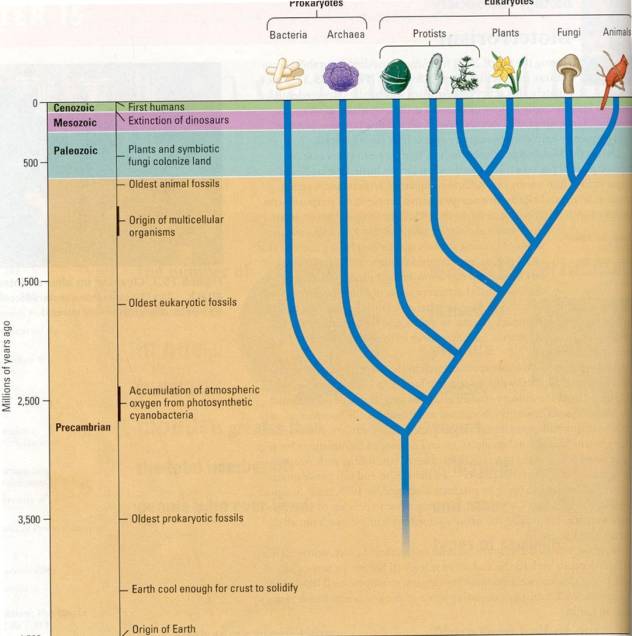
Figure
15.2 Some major episodes in the history
of life
The origin of
more complex cells launched an explosive diversification of eukaryotic forms.
They were the protists. Represented today by a great diversity of organisms,
protists are mosdy microscopic and unicellular. The organisms we call
protozoans are protists. So are a great variety of single-celled algae,
including diatoms.
The next great
evolutionary "experiment" was multicellularity. The first
multicellular eukaryotes evolved, perhaps a billion years ago, as colonies of
single-celled ancestors. Their modern descendants include multicellular
protists, such as seaweeds. Other evolutionary branches stemming from the
ancient protists gave rise to animals, fungi, and plants.
The greatest
diversification of animals was the so-called Cambrian explosion. The Cambrian
was the first period of the Paleozoic era, which began about 570 million years
ago. The earliest animals lived in late Precambrian seas, but they diversified
extensively over a span of just 10 million years during the early Cambrian. In
fact, all the major body plans (phyla) of animals had evolved by the end of
that evolutionary eruption.
For over 85% of
biological history-life's first 3 billion years-life was mostly confined to
aquatic habitats. The colonization of land was a major milestone in the history
of life. Plants, in the company of fungi, led the way about 475 million years
ago. Even today, the roots of most plants are associated with fungi that aid in
the absorption of water and minerals from soil. Plants transformed the
landscape, creating new opportunities for all life-forms, especially
herbivorous (plant-eating) animals and their predators.
The evolutionary
venture onto land included vertebrate animals in the form of the first
amphibians. These prototypes of today's frogs and salamanders descended from
air-breathing fish with fleshy fins that could support the animal's weight on
land. Reptiles evolved from amphibians, and birds and mammals evolved from
reptiles. Among the mammals are the primates, the animal group that includes
humans and their closest relatives, apes and monkeys. But trace our genealogy
back far enough, and we count certain protists, and before them certain
prokaryotes, as our ancestors. To understand life on Earth, we must go back to
the origin and diversification of microbes.