FP-1942-1944AC.DOC
Aircraft & Engine Development
For the first time in the history of warfare four engine bombers were able to fly global distances to combat areas. They made it possible to move combat forces long distances, over waters under enemy control. Only B-17s, B-24s, PBY’s and submarines could take personnel from and to the Philippines before and just after surrender. By the end of 1942 Gen Kenney demonstrated to Gen MacArthur that combat troops could be moved rapidly using these bombers. The Japanese did not have an equivalent.
Prior to Dec 7 1941 most aircraft production had been in support of orders placed by foreign nations -- this abruptly changed. 1942 saw a huge increase in production capacity. Technology was changing rapidly but only prewar designs were available for production. New designs were initiated and rushed to production as fast as possible. Old facilities continued to produce upgraded models and new facilities were built for the newly designed aircraft. New engines, superchargers, gun turrets and radar were in high demand. Experience gained on building the exhaust turbines for P-38’s and B-17’s paid off when applied to the P-47 & B-29.
Engines & Superchargers
Engines and Superchargers became essential ingredients for winning the war. Sec of State Dean Rusk, who had served in India, described how the Burma Road, built at much cost was not used -- the new C-54 airplane with more powerful engines (R2600) could carry more faster at less cost than convoys of truck. Tremendous improvements were made in a few years.
|
|
|


The 9 cyl R1820 (not shown) was used on B10, B17, B18 & C47.
The 9 cyl R1830 (above) was used on the LB30, B24, C47, P43, F2F, F4F
The 12cyl V1710 (above) was used on P38, P39, P40 & early P51
These were the work horse engines at the start of the large by 1935 standards small by 1942 standards. The Allison V1710 was a beautiful to look at as compared to the Rolls Royce V1650 with it’s wartime rough exterior. The US never funded a gear driven supercharger for the Allison, as it was used in association with turbo exhaust superchargers on the P-38.


Left: P-38 V1710 Engine and Turbo-Supercharger
Installation was awkward.
Mid & Right: Two bank 18 cyl R2800 with gear driven supercharger, F4U installation shown
The R2800 was used on: C46, B-26, F4U, P-47, A26 and P61.
|
North
American B-25 (2) R2250 eng. |
Martin B-26 (2) R2800 eng. |
Douglas A-26 (2) R-2800 eng. |
|
Northrop P-61 (2) R2800 eng. |
Republic P-47 R2800+TSC |
_______ F4U R2800+SC |


The B-25 was used for Doolittle’s raid from the carrier Lexington against Japan in mid 1942. It was later perfected to strafe and bomb surface ships by using multiple forward firing 50 caliber machine guns. They got down to where they couldn’t miss.
The B-26 was called “widow maker” until 13 feet wing span was added. It was fast, carried more bombs than a B-17, and loved by those who flew them in combat.
The A-26 developed in 1942 was re-designated the B-26 for the Korean war
The P-61 Black Widow, used in Europe, was a radar equipped night fighter using remotely controlled gun turrets. Gun turrets proven on the P-61 were used on the B-29.
The F4U Corsair, with it’s gear driven supercharger was very successful, at first limited to land operations in support of Marines, it was soon adapted to carrier use. The F4U & F6F played a critical roll in the Marianas Turkey Shoot where Japanese naval forces were decimated making it possible to capture Saipan, Tinian and Guam for pending B-29 operations.
P-47s with their R2800 engine and turbo-supercharger behind the pilot they had the power to carry heavy loads and compete with the best enemy fighters. They were used extensively to destroy enemy sources of supply behind the front lines. They cut bridges and roads in Northern Italy cutting supplies, causing well entrenched German forces to withdraw. They were equipped with water injection to permit “war emergency power” burst for short periods of time. Extra fuel cools the cylinder by evaporation in the cylinder. Too much fuel ruins the fuel air mixture ration, reducing power. Keeping the fuel air ration optimum and evaporating water in the cylinder head permitted bursts of extended power.

The P-51 constituted a real breakthrough. Lee Atwood, chief engineer of North American Aviation was asked to build P-40s for Britain. Studying British research papers he found the British had come up with a way to salvage energy from the cooling system. Atwood convinced the British to make use of their research by applying it to upgrading the P-51. The concept required a change to the Rolls Royce engine with it's engine driven supercharger. In a following article, Atwood's tells how this came to be. Inlet air to the Allison V1710 comes in at the top, and for the Rolls Royce V1650 it comes up from the bottom. Shifting the cooling radiators under the cockpit eliminated the “P-40 Tigers Jaw" frontal air drag. But this is only part of it. The P-51 was designed to converts energy from the coolant to thrust. After the war the German designer Meshershersmit told a North American engineer they probably ran more wind tunnel tests than North American, trying to figure out how the P-51 gained speed and range. Few who serviced or flew the P-51 knew what was happening under the cockpit.
Of the energy in a gallon of gasoline
1/3 is used to turn the crank shaft,
1/3 is lost out the exhaust, and
1/3 must be removed by the cooling system.
The extra P-51 thrust came from recovering energy from the 1/3 taken out with the cooling system -- the principle of a rocket engine was applied -- expand a hot gas through a "nozzle" and gain thrust.
The British paid the bill to start the P-51, and the French to start the P-40, when US taxpayers would not. It was fitting that P-51’s in England would eventually use the same engine as Spitfires.
The US did not fund adding a gear driven supercharger to the Allison engine. It was more practical to have US Packard motor company build the existing Rolls Royce. In some ways the Allison was a better engine. For example Allison used steel inserts in the aluminum heads for valve cover hold down screws – these were never a problem. The Rolls Royce used a fine and coarse threaded stud with fine threads for the nut & coarse threads into the aluminum block. Threads in the aluminum block would often give out making it necessary to replace the engine head. Packard did much to improve the way the Rolls was built and insisted that their engines be called Packard Rolls Royce’s.

B-29 Engine, Supercharger & Air Cooling System
B-29
requirements demanded a huge advance beyond anything before. The power plant
installation was one of many difficult challenges. The B-29, with 4 new R3350
cubic inch 2200 hp engines was given top priority, but would not see combat
until 1944.
Flex exhaust stacks, allowed engine to vibrate relative to the air frame, and ported exhaust gas into a forward and aft collector rings. The collector rings feed hot gas to turbines in left and right superchargers. These exhaust driven turbines spin air compressors which feed air through a cooler. Compressed air becomes hot and must be cooled to pack more through the carburetor on the top back side of the engine. The upper right view shows how the engine nacelle comes down over the forward collector ring leaving an annulus inlet passage for cylinder head cooling air.

Boeing would build 3970 B-29s for use in the Pacific against Japan
R3350 cylinders are designed and arranged in the same way as the time honored method used for the R1820 & R1830; ie, inlet and exhaust to the cylinders are symmetrical. Artistically they look great, however the Inlet Valve is cooled by incoming air and the exhaust valve is super heated. The problem was compounded by two large distributors and a large propeller control mechanism on top of the engine housing in front of the cylinders.

The above figure shows how cylinders are symmetrical, with intake and exhaust having the same cooling fin areas. It also shows the distributor and prop governor obstructions in front on top. Prior to the B-29 this layout had been no problem. There was plenty of cooling air relative to heat generated. However on the B-29 an exhaust collector ring must pass in front of the distributor and be housed by the engine nacelle to reduce drag. The # one cylinder, top front, provided the only temperature reading, flight crews made sure it did not get too hot – however it was not the hottest. The prop caused cooling air to swirl counter clockwise, cooling the #1 cylinder but disrupting cooling air flow to the cylinders in upper left quadrant as seen from in front – upper right from in back.
B-29 engines would be plagued with the problem of exhaust valves burning off – when the cause could have been determined and fixed -- it was blamed on hot Kansas summers.
19th BG B-29 engines on Guam lasted an average of 98 hours per 314 Wing data covering Feb to June 1945 –though the engines were rated for 450 hours. Subsequent photos will show failures and tell of a simple fix to cool valves with engine oil, had the cause of failures been known in time. This fundamental problem was never fixed on B-29 engines during WWII. Based on failure reports Wright Field thought the entire engine was running too hot causing redesign to use fuel injection. A few of these arrived on Okinawa based B-29s.
Design of the B-29
Extracted from "Eddie Allen and the B-29" by R. Robbins, Test Pilot on #1 XB-29


The Twentieth Air Force and the B-29s it used to bomb Japan shortened the war by months, perhaps years, and saved, it has been reliably estimated, a million or more U.S. casualties by ending the war before a planned invasion of the heavily defended Japanese homeland was undertaken an invasion that was scheduled to begin November 1, 1945, less than three months after Japan capitulated. That invasion would undoubtedly have taken place had the B-29 program been delayed or had it and the bombing of Japan not been pushed as fast as humanly possible in spite of the cost in lives and the very difficult odds, choices and problems that were encountered.
Throughout the chronicle that follows, I believe that you will be struck by the number of close calls that the B-29 program itself had events that could have very easily terminated or mortally compromised the program or the capabilities of the B-29 airplane had it not been for the outstanding courage, foresight and abilities of a relatively few key people-both military and civilian. Two of the very tough choices they made were to put the B-29 into production even before the engineering was completed and to commit them to combat before developmental testing could get them more fully debugged.
This story is about the early development of the XB-29 and particularly about a very important man to that early development the famous experimental test pilot and Boeing Director of Flight and Research, Edmund T. Allen, who lost his life trying to make the B-29 combat ready as quickly as possible. Without Eddie Allen the B-29 program might never have succeeded. B-29 (42-24519), THE EDDIE ALLEN, flown by the 40th Bomb Group was named posthumously in honor of Eddie.
The unsurpassed experience and ability that Eddie Allen applied make the B-29 into the awesome giant that it became can best be appreciated by a look at Eddie's aeronautical experience.
Before we entered World War I, Eddie Allen worked for three years, after his father died, to help support his family. He then finished one year at the University of Illinois. In 1917 we entered World War I when he was 21. Eddie enlisted in the Army, learned to fly, became a flight instructor and taught advanced aerobatics. He was sent to the British flight test center in England to learn British aircraft flight testing techniques. Before the armistice in November 1918 he returned to the Army's flight test center at McCook Field to apply his flight experience and overseas observations. After the armistice he became the first test pilot for the National Advisory Committee for Aeronautics -- forerunner of today's NASA. In 1919 he returned to the University of Illinois for a year, studied aeronautical engineering for two years at M.I.T. and topped that off by entering glider competitions in England and France in a glider he built while at M.I.T. From 1923 to 1925 he did free lance test piloting and became a civilian test pilot at McCook Field. From July 1925 to mid 1927 Eddie flew rebuilt WWI DeHavilands as an air mail pilot for the Post Office Department over the treacherous Rocky Mountains routes between Cheyenne and Salt Lake City-sometimes under extremely adverse conditions. Starting on September 1, 1927 when the Post Office Department got out of the flying business, Eddie joined Boeing Air Transport flying Boeing 40-As an air mail pilot on their new Chicago -- San Francisco run. Over the next five years Eddie began to do more and more test flying particularly for Boeing Airplane Co., an affiliate of Boeing Air Transport which later became United Air Lines. By 1932 Eddie Allen was a recognized, established, highly respected, independent test pilot and consulting aeronautical engineer. In the years that followed his accomplishments became legendary from landing a Northrop Beta with jammed aileron controls out of a barrel roll to developing the first ever effective cruise control techniques based on some 200 hours of flight testing on the DC-2 to being a widely published author mostly on test flying but a few just plain good flying stories but all with a serious message. He worked for most if not all of the major aircraft manufacturers at one time or another and for Eastern Airlines and Pan American Airways.
For at least some insurance companies, Eddie Allen's blessing on a new aircraft was a prerequisite to them insuring it. If Eddie was to make the first flight and do the initial testing on a new design, the insurance premiums would be substantially lower and the manufacturer could have great confidence that his creation would come back in one piece. Over the years Eddie made initial flights on over thirty different new models of aircraft. These included the Boeing Model 83 in 1928, the forerunner of the famous F4Bs and P-12s; the Douglas DC-2 in 1934; the Sikorsky S43 in 1936; the Boeing XB-15 in 1937; the Boeing B-17B, C, D, E and F in 1939 to 1942; the Boeing XPBB-l and XB-29 in 1942; and the Lockheed Model 049 Constellation on January 9, 1943, just 39 days before his death in the Number 2 XB-29 crash. That Eddie Allen should be taken by the Air Corps from his vital job at Boeing to make the first flight on the Lockheed Constellation is a further testimonial to the high esteem with which he was regarded.
Between December 31, 1938 and January 20, 1939 Eddie Allen, still as a free lance test pilot, test flew the new Boeing 307 thirty three passenger Stratoliner. Two months later on March 18,1939 on its 19th test flight the 307 crashed killing all on board. Boeing chief test pilot, Julius Barr was in the pilot's seat an engineer for a prospective airline customer was in the copilot's seat. That engineer had been pressing Boeing hard to find out what would happen if the airplane were stalled with the No. 1 and No. 2 engines throttled and the No. 3 and No. 4 engines at take off power. Boeing refused to demonstrate such a dangerous, unrealistic condition but did agree to approach the condition cautiously. One can only speculate as to just what went on in the cockpit and what really caused the stall, spin, partial recovery, airplane breakup and crash that occurred. Eddie returned to Seattle to testify at the April 3, 1939 CAA Air Safety Board hearing on the crash. He was there as an expert witness, a highly respected test pilot and the man who had made the first 15 of the 19 test flights prior to the accident.
While in Seattle for the CAA hearings, Eddie had a conversation with Bob Minshall, Boeing Vice President and General Manager. Eddie told Minshall that calling in a test pilot to fly a new design after the airplane was built was no longer a proper approach. Eddie felt that the real need in the aviation community was for exhaustive aeronautical research both on the ground in laboratories and wind tunnels and in flight with sophisticated instrumentation and equipment and specialized flight crews. Ground and flight research needed to be carefully coordinated to complement each other. The results should be combined with the expertise of the specialized flight crews and engineering test pilots and be applied during the design of any new airplane. Eddie felt that Boeing was in a unique position to do it. Boeing had the big airplanes needed to carry all the instrumentation, equipment and specialized crews. It had the need-its real future was in big airplanes where it already had an enviable background. Minshall liked the concept and so did Claire Egtvedt, Boeing President. The grim reality of the recent Stratoliner accident added emphasis to Eddie's ideas. On April 26, 1939 Edmund T. Allen became Boeing's first and only Director of Aerodynamics and Flight Research a position which he held for almost four crucial years. It was a fortunate, far reaching event for Boeing and our country. The timing was fortuitous. His beneficial impact on the B-17, B-29 and even today's jet fleets would ultimately touch the lives of literally millions of people most of whom never knew his name or realized his contributions. This is no exaggeration when one considers the huge B-17 fleets that bombed Germany and the massive B-29 raids on Japan and the lives that were saved and otherwise touched by their parts in bringing WWII to an earlier end. Modern worldwide aerodynamic and flight research which is such a vital part of today's multifaceted aerospace industries, including modern commercial jet transports, have their roots in and evolve from the ideas that Eddie Allen brought to Boeing in April 1939 and implemented shortly thereafter.
In April 1939 Boeing was many things. It was already a superb designer of the big airplanes Eddie had referred to such as the B-15 and B-17 bombers, the 314 Pan Am Clippers and the 307 Stratoliner. It had only a so-so production reputation, particularly with the Army whose B-17Bs were behind schedule. The 314 deliveries were well underway and the second 307 was nearing flight test stage. Boeing was losing money, was in deep financial trouble and was struggling to survive. It was a company with people who were courageous, full of vision, imagination, integrity, determination and a dedication to design airplanes that were superior and right. Boeing designs were innovative but at the same time, conservative. Boeing would not pursue a poor or even a mediocre design even though it might appear to be the politically desirable course.
In late 1938 Boeing had started thinking about a superbomber an airplane for which, at that time, there was no established military requirement and no money also, an airplane which no one knew how to build. The Army's Oliver Echols and Bob Olds talked about an airplane with a 5,000 mile range capable of hitting an enemy aircraft carrier when it was still at least two days offshore. The B-17 could strike a comer that was only one day out -- too close for comfort. The key to a successful superbomber would be to get the drag way down. Many preliminary design studies were run on numerous configurations including such ideas as new flat liquid cooled engines buried in the wing. Some were tempting but none would really make a good airplane -- so the studies were continued in an attempt to find an idea that would give the needed breakthrough.
Eddie Allen's reputation now combined with Boeing's commitment to a serious, full time scientific aerodynamic and flight research program was a strong attraction for some of the best brains in the country. Noticeable among them was George Schairer who wanted to work for Eddie at Boeing. Schairer was M.I.T. educated, had been an aerodynamicist at Consolidated and would leave his mark on Boeing airplanes for decades to come. His first job for Eddie was to put a new Stratoliner model Eddie had built into the wind tunnel to try to find a way of improving the 307 so that even if it were very badly mistreated a repeat of the 18 March accident could be avoided. A famous Boeing trademark, the dorsal fin, was George's answer. It went on all Stratoliners and B-17s after the B-17D. It greatly reduced the possibility of stalling the vertical tail even under very extreme yaw conditions and made the B-17 a much safer and more stable bombing platform. The somewhat shortened dorsal fin used on the B-29 provided similar benefits for the flight crews of the Twentieth Air Force.
Eddie now had George Schairer apply his talents to the struggling superbomber drag problem to which a satisfactory answer had still not been found in the many configurations that had been considered. It was Schairer who proposed, promoted and developed the solution. It lay in abandoning the up to then conventional approach in favor of concentrating first on developing a wing with the lowest possible drag. (Drag is the resistance, the friction, load decellerating the plane, a constant load for the engines.) Schairer's view was that the wing is typically the big drag item on an airplane and therefore provides the greatest potential for drag reduction The result was, for its time, a thin, very high aspect ratio (long and narrow) wing with a very high wing loading (small wing for the weight it carried). The airfoil section was also very critical. George was familiar with the, at the time, controversial Davis wing which was planned for the B-24. When efforts to obtain permission to use the Davis patents dragged on, Boeing decided to develop its own wing, which George Schairer did. The Boeing "117" wing was the result. Very large high lift wing flaps also developed by Schairer were added to permit takeoffs and landings in reasonable distances with the smallest possible wing. The fuselage, nacelles (nacelles are the aerodynamic housing about the engines) fairings (fairings are the aerodynamic transitions from a wing to fuselage, a nacelle to wing, etc), equipment, etc. were now designed so that they added a minimum of drag.
By August 1939 there finally was a superbomber configuration that Boeing could be proud to propose to the Air Corps. It was called the Model 341. It would later grow into the Model 345 and eventually become the B-29. The wind tunnel work, the research and development done by Eddie Allen, George Shairer and their people had finally paid off. Later as the detail design progressed, Eddie and George applied the same painstaking "try, try, try again" philosophy and effort to developing the flight control system and other details that needed attention.
The B-29 was the first (and only) airplane that Eddie Allen could participate in and watch evolve from concept through initial flight testing and into large scale planned production which was designed under the philosophy and in the environment that Eddie first proposed to Bob Minshall that April 1939 day in Minshall's Seattle office. Admittedly the B-29s had their problems, however, it is noteworthy that the aerodynamics of the thousands of B-29s that were built remained essentially unchanged from those of the first XB-29 on its initial flight. The B-29 crews of the Twentieth Air Force who managed to control and get their sometimes badly damaged B-29s from over Japan to safe landings owe their successes to a substantial degree to the work, philosophies and contributions of Eddie Allen. Needless to say there were many other people, civilian and military, who also played vital roles in the B-29 program. Space here does not allow for the adequate recognition they deserve.
The model 341 superbomber configuration breakthrough came just in time. The Army began showing real interest in the fall of 1939 as a result of the shock of Hitler's 1 September invasion of Poland and the coincidentally simultaneous completion of a special Air Board study of hemisphere defense that emphasized the need for a flexible, long range bomber fleet.
Support for a superbomber spread rapidly. On 5 February 1940 Boeing was one of several aircraft manufacturers to receive from the Army an invitation to bid on a high altitude, high speed bombardment airplane with a requirement for a 5,333 mile range with a 2,000 pound bomb load. A month later Boeing proposed the Model 341 with a gross weight of 85,000 pounds to meet the requirement. Four 2,000 horsepower Pratt and Whitney engines would be used. The wing loading would be a whopping 64 pounds per square foot double what had previously been considered acceptable by the experts. Eddie Allen had convinced the doubters that with a very big, properly designed wing flap they could get away with it. The fact that Eddie's aerodynamics group would have to develop the flap, that Eddie would fly the airplane and that he was confident of success won the day. In addition, extreme measures would be required to further reduce drag as much as possible. Among many other things flush rivets and butt joints would be required and that would add to the manufacturing problems. But confidence was high that the 341 would be a good airplane.
Several agonizing weeks passed with no word on the superbomber competition. Then the Air Corps announced that none of the proposals were acceptable. The requirements had changed as a result of lessons being learned in Europe. The superbomber must have more armament, powered gun turrets, armor plate, self sealing fuel tanks, higher cabin pressures, a 16,000 pound bomb load capability for shorter flight and no decrease in performance! A revised proposal was required in 30 days. Back to the drawing board!
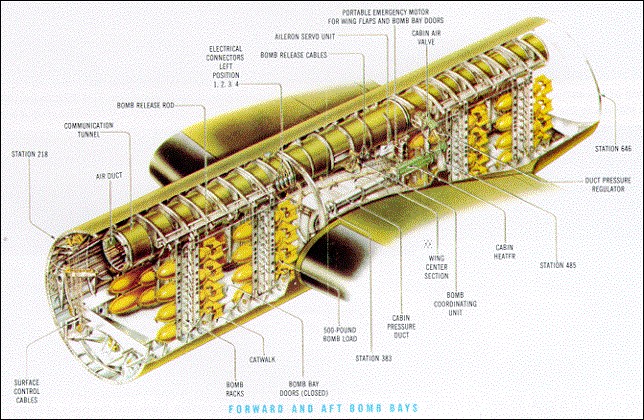
The Boeing Model 341 became the Model 345. The gross weight went from 85,000 pounds to 112,000 pounds (and later to a maximum overload design gross weight of 120,000 pounds). The wing span increased from 124 feet to 141 feet. More power was required and the new 2,200 horsepower Wright R-3350 engines would have to be used instead of the 2,000 horsepower Pratt and Whitney. The 2,200 horsepower Wright was an undeveloped engine and there were serious reservations about whether it would be a good engine. Boeing was very uncomfortable about the Model 345 -- about being pushed too far into unexplored areas. To make things even worse, there was now serious talk about ordering large production quantities before an experimental prototype could be built The risks were becoming very high. Boeing came very close to proposing a smaller airplane with which they would be more comfortable but which would not be what the Air Corps said was required. On the other hand, the war was spreading rapidly in Europe and threatened to spread much further. The expanded superbomber requirements of the Air Corps might very well prove necessary even though the technological risks were very high. After careful soul searching with the war in mind, Boeing uncharacteristically decided to submit the Model 345 configuration with a strong determination to do everything possible to make it successful. The Model 345 proposal was submitted on 11 May 1940. Within weeks the Air Corps told Boeing they were issuing a contract for engineering, wind tunnel models and a mock-up of the Model 345 which would be the B-29. Furthermore, production contracts for perhaps 200 B-29s would be let long before an experimental prototype could be flown. Clearly the Air Corps had joined Boeing in a desperate gamble on the success of the Model 345 design. After Paris fell on 14 June 1940 Congress was asked for money for 990 B-29s. The ante had just been raised! On 6 September 1940 a formal contract for two XB-29s was released. Engineering studies which had started with only a few people in late 1938 had now grown into a full scale production design effort which would require 1,433,026 engineering manhours before the first XB-29 would fly. Eddie Allen and George Shairer were kept busy with literally hundreds of wind tunnel and flight research investigations to everlastingly reduce drag and to feed the design project the necessary aerodynamic and flight test data to permit the design to move forward as rapidly as possible -- and to confirm design decisions and minimize the risks wherever possible. A PT-19 experimental wing flight test program and three specially configured B-17s conducted flight tests of many different configurations of developmental items for the B-29 such as propellers, cowling, turbo superchargers, empennage (empennage is the aft end of the fuselage, the body, it is the section which which holds the tail members such as horizontal stabilizer and vertical fin), rudder, elevators, ailerons and flaps. These tests helped to find the best configurations and to optimize such things as control forces and control balance and to reduce the technical risks.
Additional growth during the B-29 design phase increased the design maximum overload gross weight to 120,000 pounds and the corresponding wing loading to 69 pounds per square foot.
There were to be two more serious "wing loading crises" long before the XB-29 ever got off the ground. The first was when a new Air Corps "Plane X" with only a 53 pound per square foot wing loading was a "dog" to fly and in addition would not get above 28,000 feet. The Air Corps intently questioned Boeing about the wing loading on the B-29. The second and even more serious crisis was when a respected aircraft manufacturer's engineers reviewed Boeing data and told the Air Corps that Boeing was very wrong in its predicted B-29 performance. They said that the B-29 would be 40 miles per hour slower, would have a 5,000 foot lower ceiling and would have 1,000 miles less range than Boeing had predicted. In the face of such criticism, it took real courage and confidence on the part of Boeing and Air Corps principals involved not to increase the B-29 wing area to substantially reduce the wing loading from the planned 69 pounds per square foot -- a step which Boeing firmly maintained would be catastrophic to performance and, by then, to production schedules. Again it was Eddie Allen's and George Schairer's work that was being challenged and who needed to defend their positions if they really had confidence in their predictions. The price for being wrong either way would have been catastrophic to the B-29 successes of the Twentieth Air Force. They had the courage of their convictions and commanded sufficient respect to convince their inquisitioners that they were right and to continue the rapidly expanding B-29 program without change. Again a catastrophe was averted. It is interesting to note that in combat the B-29s were frequently successfully flown at 140,000 pounds gross weights unheard of wing loading of over 80 pounds per square foot!
While the many B-29 problems were being addressed, Eddie Allen had had another extremely important task to accomplish. That was to build the kind of a Flight Research operation that he had outlined to Bob Minshall in his office in early April 1939. At that time no one realized how crucial it would be to the all out war effort that was to come.
In the following three years Eddie built a sophisticated Boeing flight research capability that was second to none. His basic purpose was to safely, economically and quickly obtain and disseminate accurate, quantitative flight test data. This would help find, develop and prove the best possible configurations from perhaps hundreds of candidates. The data would be used to determine the safety of the article being tested, the degree to which it met its guarantees and requirements, its adequacy for the purpose intended, areas needing improvement, ways of improving the existing article or making the next design as good as possible and, finally, the best way of operating the equipment in service. To accomplish these goals he hired the best people he could get with as close to the qualifications he wanted and then trained and developed them into the skillfully expert team that was required to accomplish his vision. Most of the flight crew members and a high percent of the flight test department ground personnel were engineers. Each had weeks of formal, structured classroom training tailored to specific assignments. There was "hands on" training in the altitude chamber and in the appropriate airplanes and with test and safety equipment. There was periodic recurring training as necessary to maintain the highest possible skill level to minimize personnel risks and to obtain high quality data.
It should be noted here in passing that there were three completely separate flight test groups at Boeing with entirely different people reporting through different organizational lines. One was Production Flight Test which was responsible for flying every new production airplane to make sure there were no manufacturing or quality control problems and to make any necessary adjustments before turning the airplane over to the customer for acceptance. Another was the customer flight acceptance group. In the case of B-17s and B-29s they were Air Corps officers who flew and accepted the airplanes for the Army. The third was the Research Flight Test Department which was Eddie Allen's creation and is referred to throughout this paper. It conducted engineering, experimental and research flight testing. In the purest sense those were really three different kinds of flight testing that were all conducted in Eddie Allen's department. For the most part all three were done by the same people using the same methods although it was recognized that certain tests in any of the categories might potentially require specialized or exceptional skills and thus warrant selective picking of specific flight crew members. First flights on new models of airplanes fell in this category. Because of the similarities in methods and crews and the fact that some flights might involve engineering, experimental and research testing, the three terms are often used interchangeably with something less than precise regard for the differences.
Eddie Allen's Flight Research Department was under Al Reed, Chief of Flight Test and Chief Test Pilot. It was organized into functional groups such as: pilots and copilots; the other specialized flight crew members, for the most part flight test engineers; the instrumentation group who was responsible for obtaining or designing and making, calibrating, installing, servicing and maintaining the vast amounts of standard and specialized instrumentation and photographic equipment required to measure and record the many variables that needed to be measured; the analysis group who transcribed, corrected with calibration data, plotted or tabulated the corrected data, analyzed the results and prepared the final reports for distribution; the liaison group who worked with the mechanics and shops to make sure that the airplane configuration and instrumentation were in accordance with the requirements established by the Project Flight Test Engineer in charge of each test airplane; a flight equipment group to service, store and maintain items such as parachutes, oxygen masks, bailout and walk-around oxygen bottles, etc.; and an administrative support group.
Prior to each flight the airplane was prepared to conform with the very specific written test and configuration requirements. A very detailed, specific Plan of Test setting forth each test condition was prepared for each test flight, given to each of the some 10 flight crew members and then gone over in detail in the pre-flight conference so everyone knew exactly what to expect and what was expected of him in flight.
During normal flight the basic flight crew performed their duties in the conventional manner. During the flight test phases the Project Flight Test Engineer would be slightly aft of and between the pilot and copilot to provide the best possible communication and awareness between those three people and, in the case of the B-29, the flight engineer as well. A normal flight test crew on B-17s and B-29s consisted of about 10 people. The additional people manned the special instrumentation and equipment involved in the test. All had inter phone contact. A typical instrumentation load might include two photo recorders with 40 or so instruments and a camera in each; two or three manometer boards to record 40 or 50 pressures; one or two potentiometers to record 50 to 100 temperatures; a Brown recorder that could be selectively set for continuous recording of any one of many different potentially critical temperatures; and perhaps an oscillograph to record strain gage or vibration data on structural demonstration or flutter flight tests. Large bundles of wires or tubing connected each instrument with the appropriate transmitters on propellers, engines, nacelles, wings, control surfaces, etc. Manual and photographic recording of data was routine. Frequency of recording depended upon the requirements of the test condition that was set up. For instance, automatic recording once a second for perhaps three minutes during a stabilized performance condition was common and produced a lot of performance and cooling data to be analyzed. The Project Flight Test Engineer coordinated the activities of the entire crew, kept a master log of events and set the appropriate recording frequency of all cameras from his master control. At every recording station there was a coordination light and a coordination counter that clicked over once a second that provided precise coordination of all manual and photographic data from before takeoff to after landing. Typically one pilot would concentrate entirely on flying the airplane to precisely stabilize and maintain the planned flight condition. The other pilot would set up the engine power, set cowl or wing flap positions, maybe operate special equipment such as an engine water injection system and monitor everything going on inside and outside the airplane to be able to anticipate and react immediately to cope with any emergency. In the XB -29 the flight engineer helped with particularly the power plant related tasks.
Immediately after every flight there was a highly structured but pretty informal post-flight conference that was recorded verbatum in its entirety by a court type stenotypist. The conference was attended by the entire flight crew and any key ground personnel who had a direct interest in the flight. These could include: design project and staff engineers who had requested specific test conditions and who might have to design corrections or request additional tests based on problems encountered and the data obtained; technical and management representatives from outside suppliers whose components were being tested such as engines, propellers, carburetors, accessories, brakes, armament; flight test instrumentation engineers who wanted to know how their instrumentation worked and what they needed to do before the next flight; the data analysis supervisor whose people would have to take the vast amounts of manual and recorded data and sort out what should be processed; the shop foreman and quality control supervisor who wanted to know of any airplane problems and any special actions needed from them for the next flight; customer representatives, usually at least an Air Corps quality control supervisor and for particularly important flights perhaps high level company and customer management. A post-flight conference might have as few as a dozen or as many as forty or more people. It might last for only five minutes or as long as a couple of hours. The Project Flight Test Engineer or perhaps the Project Test Pilot was chairman. The short items were usually disposed of first so most of the people could leave and get back to their work. The test conditions that were run were each reviewed using the Plan of Test as the agenda. Any unusual events were noted. Any clarifying questions were asked and answered while circumstances were still clearly remembered. Plans for the next flight were tentatively made before the conference adjourned.
Before their day was over the steno typists (sometimes two alternated) would have transcribed their verbatim recording of the post-flight conference so that it could be distributed the next morning to all those with a need to know. The Project Flight Test Engineer would make every effort to complete and distribute his "Report of Test" also on the following day. It was a written summary of the test flight conditions run along with his log sheet The system was not allowed to get bogged down. Flight test data promptly got to those who needed it.
Eddie Allen said "Flight Testing Is A Sound Business" and wrote a paper proving it. It is also an expensive business usually involving heavily instrumented airplanes that would be hard, expensive, and time consuming to replace. Sometimes they are one of a kind. With the highly organized, structured approach that Eddie developed, risks, costs and time were minimized while results and accuracy were maximized.
Eddie's drive to make airplanes as safe as possible extended to the special needs of military aircraft. He and Boeing worked particularly hard to design and build combat damage tolerant aircraft. It allowed many B-17 and B-29 crews to get to safety in spite of extreme combat damage.
When Pearl Harbor hit on 7 December 1941, Eddie Allen had his organization set up as described. It was operating smoothly and he was in the process of expanding it. Including Eddie, there were only four pilots at that time doing engineering flight testing at Boeing. In early January 1942 I started working for Eddie along with six other new copilots and twice that many new flight engineers. We were moved quickly through school and the formal training program and acquired B-17 experience with the production acceptance crews. Most of our engineering flight test efforts in 1942 were spent trying to find out how to make the B-17 work at altitude and how to make crews safer and allow them to operate more efficiently while unpressurized at altitudes to add a little above 35,000 feet. Between April and the end of 1942 I flew a number of times with Eddie as his copilot on the B-17 and XPBB-l twin engine flying boat.
When I first met Eddie in January 1942 I was surprised. Although I had no preconceived ideas, I did not expect the world renown test pilot to be of so slight a build and so unassuming. He weighed about 145 pounds and was about 5'8" tall. In those first moments he fit better my image of a naturally friendly, soft spoken, mild mannered midwestern farmer. It was hard then to visualize him skillfully controlling the sometimes huge, sometimes balky airplanes he had tested.
As I got to know Eddie better over the subsequent 14 months, I came to have very great respect, admiration and affection for him. I have never heard anyone say an unkind word about Eddie Allen. On the contrary, there have been many very complimentary words used to describe Eddie. They include: calm, competent, skillful, precise, earnest, ingenious, courageous, intensely curious, dedicated, sincere, pleasant, congenial, gentlemanly, retiring, friendly, unassuming, generous and the list goes on and I'll bet there is at least one story or act of Eddie's to fit each word. No wonder his people were so dedicated to him. In spite of his great personal ability, he let me, his copilot, do most of the flying when I was with him. He was a kind but precise teacher. I learned a lot from him in flight and on the ground. He made me feel that he had great faith in me. I believe he was the same with most of us. It made one determined to do everything possible to justify that faith and confidence. Although he ran a tight ship with highly structured procedures, I don't ever remember feeling resentment or rebellion against the discipline perhaps because it seemed so right, so logical, so proper. He was a great team leader and a tremendous inspiration to us.
Eddie was a conservative test pilot -- not prone to take chances. He understood his limitations and those of the equipment he was testing. He did not like the then common Hollywood depiction of a test pilot as a brash, wild, flamboyant daredevil. He felt keenly responsible for protecting the huge investment that an experimental airplane and its crew represented. He said that he was afraid to take risks! He felt that fear is healthy, whereas panic is debilitating. He stayed cool under pressure.
This, then was the man and the organization he had built which was to begin flight testing of the first XB-29 in September 1942.
There had been many tough decisions made and significant risks taken in the short three years since the Model 341 concept had sparked real hope for a superbomber. It was only two very compressed years since the contract for two XB-29s had been signed. Now, after investing more than 1,400,000 engineering manhours in the XB-29, flight testing was about to begin:-- flight testing which would prove whether Eddie Allen and George Schairer had been right in their many decisions including defending a 69 pound per square foot wing loading;-- whether the Air Corps had been right in building two new plants, in starting B29 production by Boeing, Bell and Martin in four plants in Wichita, Renton, Marietta and Omaha, and in already ordering 764 B-29s before the first XB-29 ever flew;-- and whether the thousands of other decisions that had been made were right.
Everyone had been under tremendous pressures and time had not allowed as much pre-flight development testing as most would have liked. For instance, the engines which Eddie was about to fly with had been cleared for only 35 hours! The need for flight test answers was enormous.
The pressure was really on Eddie Allen and still he "kept his cool" in spite of it all. Eddie estimated that with an all out effort it should take 5 months and 200 flying hours to do a reasonable job of shaking down the XB-29, determining its capabilities and getting the minimum performance and operating data the Air Corps needed to start training and place the forthcoming production airplanes in service.
Taxi tests and a couple of very short hops were made by Eddie on the relatively short 5200 foot runway at Boeing Field in Seattle in the first part of September 1942. Although there were some system problems, Eddie felt that meaningful testing in flight could be conducted while solutions to the identified problems were being worked on.
On 21 September 1942 the first XB-29 flew for the first time, and Al Reed was Eddie's co-pilot. Eddie climbed to 6000 feet and checked lateral, directional and longitudinal stability and control. He checked controllability and general performance with #1 engine throttled. Power off stalls were checked. Control response, forces and effectiveness were noted. Everything that should be checked on a first flight was satisfactorily accomplished in the 1:15 flight. It was a pretty uneventful flight and first indications were certainly favorable. But Eddie and the others knew there was a great deal of work ahead.
There were to be very few additional uneventful flights. The troubles started adding up. By 28 December Eddie had been able to make only 23 flights in 27 hours of flying. There had been 16 engine changes, 22 carburetor changes and 19 exhaust system revisions in those 3 months. In addition there were propeller governing and feathering difficulties, runaway engines that over sped to 3600 RPM and a host of lesser problems. The longest flight was 2:19. The average flight was only 1:10 long. It was almost impossible to get much meaningful quantitative data when flights were that short-particularly when much of the time was spent fighting the problems and getting back to the field. One of the few bright spots was that the aerodynamics of the airplane seemed to be just what Eddie and George Schairer had worked so hard to achieve. Later testing would confirm that early assessment. Performance and handling qualities were excellent. No significant aerodynamic changes were ever made except for research work on the rudder which resulted in being able to simplify and improve the airplane by eliminating the rudder boost. Eddie and George were vindicated.
The flight on 28 December was intended to check the service ceiling and get performance data. #1 engine failed at 6800 feet and the flight was terminated after 26 minutes. Ground inspection of #2 engine showed metal chips in the sump -- it too was about to fail. That was the last time Eddie Allen or Al Reed would fly the #1 XB-29. Subsequent events kept the airplane grounded for more than seven months -- until August.
There is an interesting personal sidelight to that 28 December flight. Six days before on 22 December I flew with Eddie as his copilot on the 62,000 pound XPBB-l twin engine flying boat. It turned out to be the last time Eddie flew the XPBB-l and also the last time I ever flew with Eddie. The purpose of the flight was to complete a few tests prior to flying final demonstration for the Navy in a few days. Eddie let me fly the airplane including the required power off landing which called for cutting the ignition on both engines at 1000 feet. The high drag boat came down like a brick! It was the first time I had ever done that!! Eddie just sat there and watched. Fortunately it was a good landing in spite of the extremely steep glide path. I had no inkling that that would be my checkout flight (and I doubt that Eddie did) until the morning of 28 December when Eddie came to my desk and very casually asked me to fly final demonstration for the Navy that day on the XPBB-l because he and Al Reed needed to fly the XB-29. I managed, in my amazement, to stammer something like "I'd be glad to." The demonstration went well and I have always been extremely grateful to Eddie for giving me that opportunity and for placing that much trust and confidence in me. Incidentally, he let me have the fun of making the delivery flight to the Sand Point Naval Air Station two weeks later.
On 30 December the #2 XB-29 (AAF 41-003) was ready for its initial flight It too had engines that were cleared for only 35 hour in positions # 1, #3. and #4. It was to be a thorough functional check of the airplane and its extensive instrumentation. The weather was marginal. The functional check proceeded normally until #4 propeller would not feather and governing was erratic. Eddie elected to discontinue the flight and immediately headed back to Boeing Field at which time he was advised that the weather was deteriorating rapidly. About 6 minutes out, #4 engine caught on fire, the propeller over sped to 3500 RPM, the propeller would not feather and smoke, sparks, and flame were coming from the exhausts. Shutting off the fuel and use of the fire extinguishers were ineffective. The fire continued to get worse. About 2 minutes out the fire was burning fiercely in the accessory compartment. Flames were pouring from the nacelle access door and from the intercooler exit area. Heavy smoke and long fingers of flame were trailing off the wing. In the meantime heavy smoke was pouring from the bomb bay into the cabin making it increasingly difficult to see or breathe. Eddie landed downwind, choking, partially blinded, on the 5200 foot long 200 foot wide runway. The intense fire was put out by fire equipment on the ground. Eddie later received the Air Medal for his skill and bravery during that harrowing 32 minute flight. Ground inspection showed more trouble a fire had just started in #1 engine and #3 engine was close to failure too. Those three 35-hour engines each had less than 3 hours total ground and flight time. Because of engine shortages, 2 of the 3 engines had to be replaced with engines cannibalized from the #1 XB-29 which was laid up for some modifications. In addition the fire in #4 had been so severe that the #4 nacelle had to be replaced with the #4 nacelle also cannibalized from the #1 XB-29. At least the #2 XB-29 now had 4 so called "unlimited" engines.
Unfortunately, engine/nacelle fires similar to the #4 fire continued to occasionally haunt production B-29s and caused at least 19 serious B-29 accidents between February 1943 and September 1944. While Boeing and Wright tried hard to find and correct the cause or causes, there was a natural tendency for each to blame the other. It was 15 months before there was positive proof that the R-3350 was susceptible to induction system fires which could very rapidly get out of hand and become uncontrollable magnesium fires which then destroyed the evidence of the fire's origin. That proof came on 24 March 1944 when I had an induction system fire on #4 engine during a routine test flight on the #1 XB-29. I was fortunate enough to get the engine feathered and the fire out before it broke out of the blower section or the intake pipes and became an external fire. The partially burned magnesium impeller and interior of the blower case were irrefutable evidence. In the face of that evidence Wright developed the fuel injection system to eliminate the potential for induction system fires.
It was almost a month before the #2 XB-29 flew again on 23 January 1943. In the next three weeks emphasis was on engine, propeller, governing, and airplane performance testing. Catastrophic engine failures eased up but that was about all. During descent for landing on 2 February there was a strong odor of gasoline emanating from the bomb bay into the cabin. A thorough inspection uncovered nothing conclusive. On a flight on 17 February there was a bad fuel leak over the wing from #4 fuel filler cap. The leaking cap was fixed.
By 17 February 1943 the #2 XB-29 had made 8 flights totaling 7:27 hour an average of only 56 minutes per flight. In the 5 months since the first XB-29 flight on 21 December, there had been only 31 flights totaling 34:27 -- a long way from what Eddie had estimated in September would be done. And with an overall average flight time of only 1:07 the amount of meaningful test data was pretty sparse from that meager 34:27. As hard as everyone was working to solve the problems the answers were coming painfully slowly. As Eddie and his Project Flight Test Engineer left the airplane that afternoon and walked across the ramp to the post-flight conference, Eddie expressed to him the grave reservations he had about continuing flight testing unit at least the more serious of the XB-29 problems could be fixed. Unfortunately, the fastest, and maybe the only way to fix some of them was to try out the various fixes in flight the "try, try, try again" approach that had been so successfully used by Eddie and George Schairer over the years. But now Eddie faced a real dilemma. The B-29 was potentially a fine airplane. It was urgently needed in the Pacific. It was committed to production -- 1600 B-29s were now on order at 4 separate plants. Flight test was way behind its expected schedule and the data was badly needed to: -- prove the airplane; quickly find and correct the problems; minimize production disruptions; develop training and operating procedures and manuals. But it was currently a dangerous airplane. Major improvements were badly needed. Temporary grounding would be the normal, prudent thing to do. But they were not normal times. The sooner the B-29 could be used in combat, the sooner the war would end and the sooner the casualties and carnage would stop. Eddie concluded that he must continue flight testing as rapidly as possible. His entire crew had to also know the risk to a man they stayed with him.
The primary objectives of the 18 February 1943 flight were to measure climb and level flight performance and get engine cooling data with 4 and 2 engines operating. Maximum altitude would be limited to 25,000 feet because of the excessive trouble that had been encountered with low engine nose oil pressures above that altitude. The effectiveness of fixes for some of the past problems would also be evaluated. Takeoff would be at the normal design gross weight of 105,000 pounds with full fuel tanks -- 5,410 gallons of gasoline.
Eight minutes after the 12:09 PM takeoff to the south while climbing through 5000 feet with rated power, afire was reported in #1 engine. Mixture and fuel to #1 engine were cut off, propeller was feathered, cowl flaps were closed, a CO2 fire extinguisher bottle was discharged and a descent and return to Boeing Field was initiated. Since the fire appeared to have been put out and everything seemed under control, Eddie elected to make a normal landing pattern and land from the north on runway 13 (128 degrees magnetic) to the SSE into the 5 MPH wind rather than making a downwind landing on the 5200 foot runway with a heavy airplane. At 12:24 PM the radio operator routinely reported altitude at 1500 feet at a point 4 miles NE of the field. They were on the downwind leg, headed NNW and starting a left turn onto base leg. No one suspected the drastic change that would take place in the next 2 minutes. At 12:25 they had just completed turning onto base leg, had just crossed the heavily populated west shore of Lake Washington about 5 miles NNE of the field, were at about 1200 feet altitude and were heading SW approaching the commercial and industrial south side of downtown Seattle. At that point ground witnesses heard an explosion that sounded like a loud backfire and a piece of metal fell from the airplane. About that time the radio operator, who could see into the forward bomb bay and the wing center section front spar, was overheard by the Boeing tower on an open microphone circuit to say: "Allen, better get this thing down in a hurry. The wing spar is burning badly." He told Boeing Radio on a different frequency: "Have fire equipment ready -- am coming in with a wing on fire. "About a mile down the flight path from the explosion, burned parts of a deicer valve, hose clamps, and instrumentation tubing were later found. They had come from an area normally inside the wing leading edge, ahead of the front spar, and just outboard of #2 nacelle near the #2 fuel tank filler neck which was rubber like the self sealing fuel cell. The airplane now turned south on an oblique final approach in a desperate effort to reach Boeing Field just 4 miles away. Eddie was about 250 feet high and ground witnesses later reported that part of the wing leading edge between #1 and #2 engines was missing. In the next mile the flight engineer's data sheet was found and three of the forward compartment crew members left the airplane too low for their parachutes to open. At 12:26 PM, only 3 miles from Boeing Field, the #2 XB-29 crashed into the Frye Meat Packing Plant killing pilots Eddie Allen, Bob Dansfield and the other 6 crew members still on board. The crash and resulting major fire killed an additional 20 people on the ground and destroyed much of the airplane and the plant. There was clear evidence that fire and dense smoke had gone through the bomb bay and into the cockpit in the last moments before impact. Burns on the bodies and clothing of the 3 crew members who bailed out just before impact were a part of that evidence. Eddie Allen and his crew died serving their country the best way they knew how. In 1 minute the fire had gone from undetectable to catastrophic.
At 12:26 P.M. on that 18th day of February 1943, the saga of Eddie Allen ended. However, not so his legacy which has continued to this day to benefit his fellow men for whom he always showed such great respect.
The scientific flight testing methods which Eddie Allen developed continued to serve his country well throughout the war. And they have continued to this day to evolve and improve and keep pace with technology and to serve man -- just as Eddie Allen would have wanted.
The flight test team that Eddie had assembled and trained was decimated, devastated, and demoralized. Some of its members would probably never completely get over his loss but they did put the pieces back together and continued to "fight the battles" and get the answers as Eddie would expect them to.
EDITORS' NOTE: On 23 April 1946, three years after Eddie Allen's death in the 18 February 1943 crash of the #2 XB-29, he was posthumously awarded the Air Medal-of Honor rarely bestowed upon a civilian by direction of the President of the United States.
The medal was presented to Florence Allen Howard, Eddie's widow, by Major General Benjamin T. Chidlaw, Deputy Commander for Engineering for the Air Material Command at Wright Field, during ceremonies at the Boeing Plant ##2. At Mrs. Howard's request, General Chidlaw pinned the medal on Turney Allen, the six-year old daughter of the late pilot.
The Citation reads:
"To Mr. Edmund T. Allen, Civilian Test Pilot, for meritorious achievement in aerial flight on 30 December 1942. On this occasion while piloting an Army Air Force XB-29 type aircraft under extremely unfavorable flying conditions, an uncontrollable fire developed in the number four engine. In spite of the fact that he would have been justified in abandoning the airplane under such conditions, Mr. Allen elected to remain at the controls and attempt to safely land it. As a result of his skill and daring invaluable test data and a prototype airplane were saved, the loss of which would have immeasurably retarded the entire B-29 Program at a crucial time in its development."
It is signed by President Harry S. Truman.
In his presentation remarks, General Chidlaw said:
"In the course of a great war such as we have only recently concluded, there are a great many unsung heroes -- men who labor and work in relative obscurity while others garner the laurels of combat accomplishments. Of course, the men who flew the planes in combat and met the enemy on his own ground deserve the plaudits which have been accorded them. But in the air war there were other men without whose work and without whose sacrifice it would not have been possible to get into combat the planes that finally won the war. Especially this was true in the case of the aircraft test pilot the men who took the planes in their experimental stages, tested their potentialities, ironed out their defects and brought in the reports that made it possible to fashion these airplanes into formidable weapons of war. Theirs was the contribution of a scientific objectivity combined with the daring and fearlessness of the pioneer, and the contribution was a magnificent one. They have earned the admiration and the respect of the men who flew the planes that grew out of their efforts and accomplishments and, as a matter of fact, they were really a part of the great Air Force team that bombed the enemy to defeat. "Eddie Allen was outstanding among these men."
Origin and Evolution of the
Mustang by J Leland Atwood
Atwood was chief engineer when the P-51 was designed and was Chairman when the company became Rockwell International. This article explains why the P-51 was the only fighter that could accompany B-29s from Iwo Jima to Japan. I obtained this article from E Buxton chief engineer at Autonetics. DL

The Supermarine Spitfire and it's stable mate, the Hawker Hurricane, are probably the most appreciated defensive weapons in the history of civilization for a very good reason. These airplanes -- with their elegant Rolls-Royce engines -- enabled the determined RAF to stand off certain defeat and occupation. The legendary Reginal Mitchell, leader of the Supermarine design team, worked to the end of his life perfecting the Spitfire, and Sidney Camm of Hawker brought in the Hurricane, largely with private financial backing of T.O.M. Sopwith, himself a World War I airplane designer. These events were surely high on the list of the accomplishments in England's "Finest Hour" and no later achievements in this category can be classified as in the same degree of effectiveness or timeliness. The Spitfire, in particular, with somewhat more performance, is especially memorable and symbolic.
But the RAF (the "Few") made its Thermopylae stand in 1940, and the war lasted for nearly five more long and bitter years. The United States was able to mobilize its capabilities, including massive air power and some very good airplanes in great numbers. I participated as an aeronautical engineer and manager and would like to describe the origin and some aspects of the P-51 "Mustang" fighter as one of those airplanes. I do not intend to elaborate on its capabilities as a first line warplane with the speed and range to carry air combat successfully to the heart of Germany -- which is a well known matter of record -- but rather on some interesting sequences leading to its origination and some technical aspects of its design which hopefully, I can describe in reasonable language without integral signs or complex equations -- although I can not eliminate mathematics entirely and still explain the design rationale.
To begin with, the Mustang had a large British component. In 1940, it was underwritten by England with their very scarce U.S. dollars (12 million of them), utilized Farnborough research in design, and in its final and best configuration it used the incomparable Rolls V-1650 "Merlin" engine. It was, of course, taken over by the U.S. Army Air Corps, which eventually purchased and financed its large wartime production and supervised its specifications and utilization.
Briefly the British and French both began to buy airplanes and engines in the U.S. in 1938, and shortly orders were being issued for this equipment, including engines from Pratt and Whitney, Allison, and Wright Aeronautical, planes from Lockheed, Douglas, North American, Curtiss (including P-40 fighters), and others. The British shortly established a Purchasing Commission, first under Mr. Arthur Purvis, who was replaced in 1939 by Sir Henry Self. Offices were taken at 15 Broad Street, New York, and staff was assigned.
North American Aviation (now Rockwell International) operated in Inglewood, California, adjacent to Mines Field, which is now Los Angeles International Airport (LAX), and or British orders were for advanced trainer planes, a version of the Air Corps AT-6, which the British named the "Harvard." These, for the times, were relatively large orders -- eventually involving several hundred planes -- and were naturally very important for North American, leading to greatly increased employment and additional buildings.
As we went into 1939, concerns about the possibility of war increased and our military received larger appropriations and began to place orders. In mid 1939, North American received a large order for our B-25 medium bomber and expansion continued at a rapid rate. This was true of the rest of the industry also, and capacity was getting to be the problem.
North American Aviation, though a derivative of some antecedent organizations, was a relatively young company. Through earlier investments and involvement, the General Motors Corporation owned about 30% of the stock and effectively controlled the company. Ernest R Breech, a General Motors vice president, was designated chairman -- although he never served in an operating capacity. In 1934, he recruited James Howard ("Dutch") Kindelberger, a vice president of Douglas, as president and chief officer. I worked for Douglas at that time under Dutch as a mathematical analyst and component designer, and he recruited me to come with him as chief engineer at North American. Dutch was just 39 year old and most of the rest of us were some 10 years younger.
We were quite successful with the advanced trainer line, including the Harvard, and had built a couple of medium bomber and attack plane prototypes, which didn't really get anywhere until the B-25 order. So in 1939, we were booked up and expanding, and a transition in the organization was shaping up. Dutch had a lot of balls in the air with contracts, building plans, machinery orders, financial requirement, personnel expansion, government interfaces, etc and after trying and failing a couple of times to get a competent deputy , he began to move me into that position. In my place, Raymond Rice became chief engineer and I ended up with the title of first vice president. This transition was somewhat gradual, but by the latter part of 1939, it was rather complete -- although I kept in very close touch with the engineering work.
At about this time, we first heard about the possibility of taking an order for supplementary production of the Curtiss P-40 fighter planes. Of course, fighters were and obvious requirement and in 1939 the P-40 was considered a good contemporary plane in this country, but it had some drawbacks. The Allison V-1710 engine had only a single-stage supercharger, and its critical altitude for maximum speed was only about 12,000 feet. While not in the high altitude interceptor class, it could be used for low altitude combat and ground attack missions. To me however, the radiator and cooling system seemed to be most inefficient and poorly located -- with the glycol and oil radiators under the rear of the engine and partially cowled. Also Dutch felt we were heavily loaded as far as tooling and production were concerned and we would have a hard time coping with Curtiss drawings, manufacturing standards and tooling, at least for some time.
As chief engineer, I had regularly reviewed the NACA (Nation Advisory Committee for Aeronautics, later NASA) reports on aerodynamics and related subjects, and in 1939, one came to my attention that was a review of some British experimental radiator work at Farnborough, a research establishment in England. An investigator named Meredith had experimented with energy recovery from airplane radiators. This, of course, was not anything new conceptually, since energy recovery in steam and heat engines was common, as in triple expansion cylinder engines and in turbine applications, but these all started at relatively high temperatures. In reciprocating internal combustion engine, the "coolant-out" temperature cannot be allowed to exceed something like 250 deg Fahrenheit, which is at about the temperature of the end of a heat recovery cycle in a steam engine. However, Meredith experimented with fully ducted radiators and showed that substantial recovery was possible.
Aircraft radiators had been generally treated like those in automobiles, using the speed of the airplane to force air through the radiators (ram air) and dissipating the heated air at random. The ram air pressure is proportional to the square of the speed(V2), but only directly proportional (1 to 1) for changes in density of the air with altitude. This is expressed as Pressure = 1/2 rV2 where r is air mass density [Bernoulli's classic equation for uncompressed flow], Mass of an object, or a quantity of air, is intrinsic and does not change with gravity, but on earth its measure is in pounds or kilograms. So we divided weight by the acceleration of gravity (32.2 fps/s) to obtain mass which will be the same on the moon or in space as it is on earth. Using the weight of the air and the earth's gravity constant, r at sea level is 0.00237 mass units per cubic foot in English measure, and 0.001606 at 25,000 feet.
Now airplane cooling has to be effective for various speeds and power settings, so the conventional radiator had to be able to cool and engine at full power in a climb at perhaps half its speed at full-power in level flight. So an airplane climbing at full power at 150 mph would require about four times the radiator exposure area as the same plane at full power in level flight at twice the speed, 300 mph. This fixed radiator exposure, of course, led to an unnecessarily high drag at high speed and absorbed a great deal of the engine's power. It also had to cool on the ground -- but only at idle or taxi speed power output.
Radiators constructed of tubing and metal fins considerably restrict airflow and so Meredith's experimented with ducting it out to the airstream. By making the outlet variable, he could restrict the air passing through the radiator to just that amount needed for cooling. Pressure ahead of the radiator, P1, is determined by the speed and air density (altitude) and is approximately 1/2 rV2. By closing the outlet partially, the pressure behind the radiator, P2, is maintained to the level that permits just enough air to pass thorough for cooling purposes. It is also apparent that the intake opening can be much smaller than the radiator size and that the drag is much less.
In passing through the radiator, the air is heated and expands in volume. A 200 deg Fahrenheit temperature rise expands the air some 40%, so it can be seen that the discharged air -- although having the same mass as the incoming air -- has a larger volume and for a given pressure requires a larger discharge opening providing some forward thrust. This trust is roughly the pressure behind the radiator, P2, times the area of the discharge opening . This, incidentally, is the principle of the ramjet engine with, of course, much higher temperatures.
With this insight from the Meredith report, I began to gradually think about some way it might be applied to the P-40. However, with a little more consideration I began to believe that in spited of the extra plumbing and probable weight increase, the radiator should be in the fuselage with only the duct openings exposed. The P-40 had the cooling system forward under the rear of the engine, and to balance the plane properly for stability, the pilot was rather far back -- somewhat compromising his view and limiting fuselage space.
The idea of a re-design, or even a new design, looked attractive, but the thought of such a possibility seemed somewhat fanciful since I had never seen any government buy a production plane without a set of requirements in detail, some kind of competition and/or flight test approval and a formal appropriation of money.
In my position as vice president, I had responsibility for contract administration, among other things, and so had occasion to go to 15 Broad Street rather frequently to negotiate contracts, prices, spare parts, equipment, and support services. In January 1940, I told Dutch that I would like to try to get some kind of a fighter authorization and that I hoped my ideas on reduced cooling drag might be a vehicle. He was generally supportive, but skeptical, as I was myself. My best hope was perhaps a contract to modify a single P-40 or possibly to build an experimental airplane.
The British Purchasing Commission, in addition to Sir Henry, had as principal personnel Air Commodore Baker, Colonel William Cave, and J.C.B. (Tommy) Thomas. Thomas was a senior technical man, and I used some occasions to talk to him about the cooling drag subject, making the point that my confidence in the possibilities of a major improvement was based on the Farnborough papers as well as the natural technical logic of the application.
I made a point of visiting Tommy and also Bill Cave when I could, both on direct business and from Dayton and Washington, which I visited frequently. Coast-to-coast was just a long overnight trip then in DC-3's and I could cover quite a bit of ground. I could see that my suggestion had been taken seriously after two or three visits, and I believe Thomas established some communication with Farnborough on the subject. I used only some free hand sketches, but Tommy was very astute and technically qualified. The questions about implementation got more concrete, but no company engineering work was started -- it seemed a long shot. I had discussed my concept with Ed Schmued, preliminary design supervisor, who, though not technically educated, had a real talent for shapes and arrangements and mechanical components, but the first work authorization, denominated NA-73, was not until April 1940.
Finally, early in that month, I was invited into Sir Henry's office and was advised approximately as follows: that they had decided to accept our proposal; that I should prepare a letter contract for his signature; that it should provide for the purchase of 320 aircraft of our design; that it provide a schedule and a not-to-exceed price per airplane; that the British supplies equipment, including engine, would be specified; and finally, that a definitive contract would be negotiated on the basis of this letter contract. Furthermore, he told me that since we had never produced a fighter airplane, he considered is desirable that we have some P-40 data as a helpful guide. He specified the P-40 wind tunnel report and the flight test report. He suggested that I attempt to obtain these data. I told him I would immediately try to do so and took the night train to Buffalo, home of the Curtiss plant. Parenthetically, this was on April 10, 1940, the day Hitler seized Denmark and the Norwegian ports. I remember on that day Colonel Bill Cave told me that this was just one of a number of obvious moves.
In Buffalo, Burdette Wright, general manager of Curtiss Airplane Company, was reasonable enough, considering the competitive aspects. Colonel Ben Kelsey of the Air Corps is reported to have said that the Air Corps encouraged him to sell me the data. This I didn't know, but it could have been the case. Later, Dutch Kindleberger quipped that we didn't even open the package, although I am sure that some of our technical staff did examine the reports. I gave Burdy a marker for $56,000 for the copies, went back to New York, and as soon as I could, presented the letter contract. After staff review, Sir Henry signed it, and I went to the LaGuardia Airport. Work Order NA-73 was issued shortly after.
Dutch Kindleberger put a lot of effort and talent into increasing the efficiency of airplane production. Even at high wartime rates of production parts were made in batches, and it was most unusual to have a machine tool dedicated to making one part, or even to one operation. Many tools, especially for sheet metal parts, were "soft" tooling, using masonite, plywood, or low temperature casting materials rather that tool steel, and were much cheaper -- if not as durable. However they were adequate for the purpose, were made very much more quickly, and were adaptable to the inevitable changes that came along. Dutch made many contributions to the cutting forming, and stretch-forming techniques, but his greatest improvement came from a rationalization of assembly and installation processes.
It was common practice to finish the structural elements, wing, fuselage, etc, and then begin installation of equipment -- electrical, hydraulic, armament, instruments and other items -- in the nearly completed structure. In large airplanes, with plenty of access room, this worked reasonably well with few bottlenecks, but in the smaller planes, such as fighters and trainers, the final assembly stage was crowded, hectic and in efficient. Starting with the T-6 series, Dutch required the fuselage and wing structures remain open in sort of half-shell condition until all wiring, tubing, and permanent equipment installations were made and that they be inspected and tested before joining into complete structures. This naturally required that the engineering design provide for this construction process -- so it became part of house practice in all models.
During the war, the War Production Board kept production statistics and the principal comparative parameter was labor hours per pound of airframe (airplanes less engines and equipments). North American's record was consistently about 20% below industry average. Noting this Jake Swirbul, production chief for Grumman, came out to Inglewood during the war and spent a couple of days looking at the process. On departing he visited Dutch and made approximately this remark: "Dutch, I don't believe you have better people or machinery or buildings or production control than we do, but how in hell do you get your engineers to design a plane so that the workers can get to the work?" The final 5,000 P-51 airplanes were built for 4/10ths of an hour per pound and sold for $17,000 each, less government furnished equipment: engine, armament, etc.
In 1940, the science of aerodynamics was largely empirical and much depended on actual tests. Even today, this is true to some extent as far as some fine points are concerned, and wind tunnels are still used. The Mustang first flew in October 1940, with an Allison engine, and soon some problems with the radiator ducting arose. The upper edge of the intake duct had been made flush with the bottom surface of the wing, and we soon found that the air flowing along the surface in front of the duct became a turbulent irregular pattern as it entered the duct and caused an audible rumble and vibration which was unacceptable. Also, it was thought that the opening should be larger for cooling on the ground at low speed, so a fold-down front panel was provided to admit more air for ground operation. This leaked pressurized air and caused considerable drag.
Both these problems required that some re-design and refinement be made. Some very capable aerodynamics people worked very diligently on the problems, using round-the-clock wind tunnel duct models and flight test measurements to arrive at the optimum configuration of a fixed intake with rounded lip edges. Also the intake was moved down some two or three inches to provide a gutter or scupper for the thin layer of turbulent air to bypass the intake. This has been common practice for such ducts ever since.
The Mustangs went to England and began to participate in reconnaissance and low-level rhubarb sorties over enemy territory, although they were not considered for high-altitude combat because of the single stage supercharging. However, the RAF began to note that the Mustangs were faster than the Spitfires at the same altitude, and interest was increased. The Rolls Royce factory actually installed a two-stage Merlin in a Mustang on an experimental basis, first flown in October, 1942. Also, the Army Air Corps had put the Mustang into production as an attack plane, the A-36, which saw service in North Africa, Sicily, and Italy.
The crucial part of the air war was clearly shaping up as an air superiority battle over Germany and occupied Europe, and our bomber losses were becoming insupportable. Unescorted daylight formations were badly cut up and it was becoming clear that formation flying with machine gun turret protection might be losing rather than gaining in this contest., as the Luftwaffe had in 1940 over England.
At about this point, I became aware that Rolls-Royce Merlin production had been established in the United States. Packard Motor Car Company was selected and it's chief engineer was none other than Colonel Jesse Vincent who had designed the Liberty engine of World War I fame. Colonel John Sessums called me from the Pentagon one day in late May, 1942. His message was terse and electrifying: We are sending you a pair of Series 61 Rolls V-1650 engines and we want you to install them in a couple of P-51's. North American engineers worked at top speed to make the structural, aerodynamic, and cooling adaptations -- and in November one was in the air. Excitement was high when the speed results came in -- over 440 mph, or Mach 0.65, at about 25,000 feet. A considerable portion of the potential of the Meredith Effect was being realized as advertised in April 1940.
Soon American made Merlins were flowing, and the P-51's so equipped were deployed on airfield in England in 1943. Although their range was more than that of the Spitfire, it was still inadequate for effective bomber protection to most of the key targets, and the need for "longer legs" was acute. Responding in a way that left flight test stability engineers aghast, Raymond Rice and his team designed and 85-gallon puncture-sealing fuel tank to fit behind the pilot's seat and in front of the ducted radiator. This tank, weighing some 600 pounds when full of fuel, moved the center of gravity of the plane backward several inches and made it longitudinally unstable, meaning that it would not fly hands off, and went into a sharp dive or climb, it would either pitch up or dive out of control if not corrected continuously by the pilot. It was manageable at least, until some of the fuel was used up.
Colonel Mark Bradley was strongly sponsoring this change, and in his assessment for General Arnold and General Spaatz, he took a fully loaded P-51 with wing-drop tanks and 85 gallon fuselage tank and flew a trial mission equal to London-to-Berlin round trip, engaging in a 20-minute full-power simulated combat at maximum distance out and returned. He dropped the wing tanks first, then used the fuselage fuel and finally the internal wing tank supply. The high command accepted this test and the tanks started to go to England.
Lieutenant Colonel Thomas Hitchcock was air attaché in London and was pushing hard for the long-range P-51. He was over 45, a member of a prominent New York family, an athlete, pilot, and reserve officer. He eagerly took a long-range P-51 for a test flight, and in pulling out of a high speed dive the plane failed and he was killed. I was not there of course, and do not know exactly what happened, but it would not be surprising that the stick force reversed and it came back in his lap, over stressing the airplane at high speed. If he had kept under some three times the indicated stalling speed, the wing loads would have been within a 9G limit and well within the wings strength capability. However, that was not his way -- he apparently wanted to do what the combat pilots would have to do. However, with some practice, the Air Corps pilots successfully flew and fought these long-range planes. The appearance of the little friends was a welcome sight for the battered bomber crews.
One of the most important activities in the production of the P-51's was a major coordinated effort to make changes and improvement on a continuous basis -- both on the production line and in the field -- with kits of parts and technical orders to operating units. We fielded a large group of qualified technicians who assisted the engineering and maintenance officers and reported back on problems, deficiencies, and recommendations. Also Colonel Ben Kelsey was very effective in implementing improvements. He would visit combat wings, sometimes flying combat missions, and monitoring problems. He would then make a circuit of Dayton, Inglewood and Washington -- both recommending and authorizing changes and improvements.
This kind of activity was not well understood by some higher-ups, and I had an interesting experience. The chief of the Aircraft Production Board at one point was Charles E. Wilson ("Electric Charlie"), who had been chief officer of the General Electric Company. Mr. Wilson was making the rounds of industrial companies, generally stressing the importance of war production and looking for ways to improve it. After touring the Inglewood plant, he gave a bit of a speech to a group in a conference room, consisting of some 50 or 60 of our leading engineers and production supervisors. He as talking production, production to the limit, and when he finally paused, I spoke up and said something like this: "Mr. Wilson, if we just produce all we can we are not doing our best for the war effort." He seemed surprised and almost affronted and asked what I could possibly mean. I tried to explain that we had a large backlog of changes that would improve the safety and effectiveness of the planes and that we must take some time to fit them in. He didn't say much more, but that evening, he spoke in downtown Los Angeles to a civic industrial group, and I had the satisfaction of hearing him say that in all the need for production, we must do all we can to make improvements in efficiency and serviceability as we go along.
One might ask where is the Meredith Effect today? It is alive and well and was applied on radial engines in the form of cowl flaps, but in modern jets, there is little requirement for direct cooling of fluids or air in the 200 deg Fahrenheit temperature range. Jet engine bleed air is hot and high pressure, so for cooling purposes, some heat is extracted by ducted heat exchangers in the Meredith manner, and the high pressure air is then rapidly expanded. The snow flakes sometimes seen in the jet passenger cabin ventilators are a result of expansion cooling, the reverse of compression heating.
To summarize, the Mustang cooling system provided just enough, but no excess of cooling air. Ideally, the back pressure P2 should be minimum, close to zero, in a low-speed, high-power climb and maximum at high speed and in long-range cruise, resulting in the lowest net drag where it is most needed.
An objective assessment of the Mustang is probably unavailable or inconclusive. During the war, the Collier Trophy Committee, certainly no military authority, passed over the Mustang repeatedly. The Congress, no center of airplane technology, in postwar assessment, declared the plane to be the most "aerodynamically perfect" plane of the war. Perhaps we should simply say that it was just one facet of the effort of million of people doing their best for the war effort with varying degrees of capability and effectiveness. After all, the front line personnel deserved the honor in war.
In recent years, there has been much introspection and analysis of the U.S. manufacturing establishment, and much has been written about product quality, employee participation, more choice for customers, quick change of models, rapid correction of deficiencies, flexibility in tooling and methods, and cost in general. I have seen many notable and almost heroic efforts in engineering and production and great efforts at product improvement. In the Apollo lunar program, I have seen responsible people work to an almost unbelievable degree to make some very difficult goals. However, while war production was a massive struggle against shortages of every description, I doubt that I shall ever see again such a degree of product improvement, employee participation, relative product value, economic production and generally superior results as I experienced in Dutch Kindelbergers airplane production complex during the period of 1939-1945.


left: P-51 cooling air flow showing Inlet and P2
Outlet
right: P-51 cooling air inlet duct.
B-29 System Design Concept